Servings 4
- Amount Per Serving
- % Daily Value *
- Total Fat 38g59%
- Saturated Fat 19g95%
- Sodium 1050mg44%
- Total Carbohydrate 65g22%
- Dietary Fiber 2g8%
- Sugars 3g
- Protein 27g54%
* Percent Daily Values are based on a 2,000 calorie diet. Your daily value may be higher or lower depending on your calorie needs.
Note
How to substitute tastasal
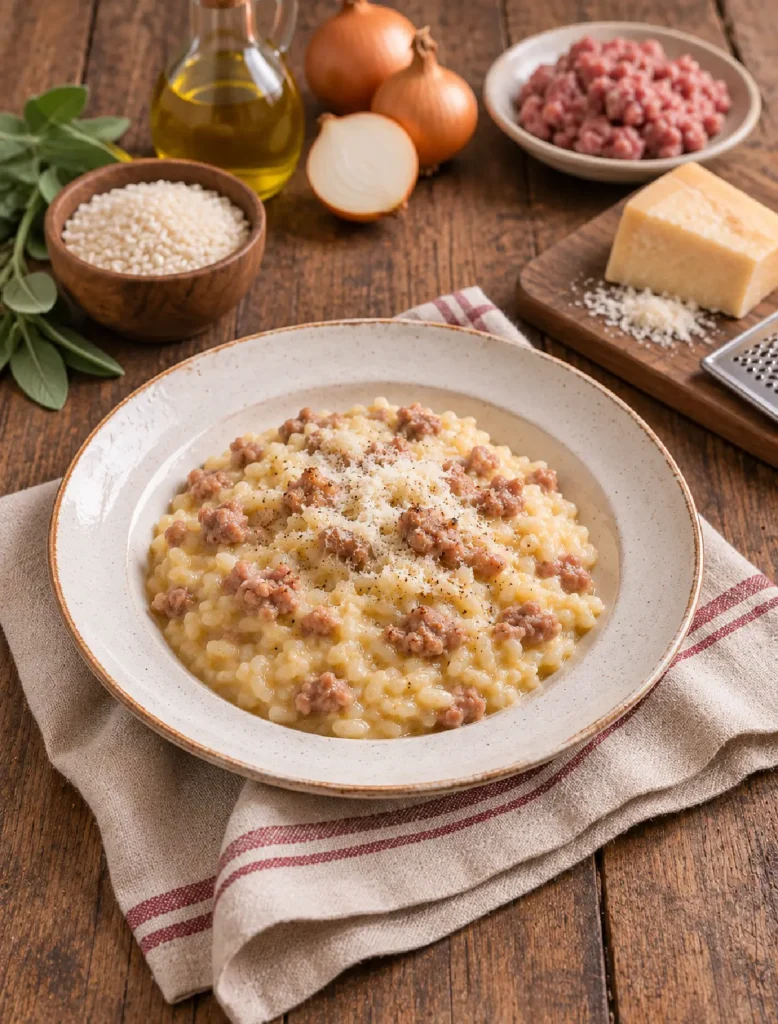
If tastasal is unavailable, use the same quantity of fresh pork sausage meat. Remove the casing, if present, and break the meat into small pieces before cooking. Choose a mildly seasoned sausage, preferably containing only salt and pepper. Avoid smoked, spicy or fennel-flavoured sausages, as these would noticeably change the flavour of the risotto. Alternatively, use ground pork (US) or minced pork (UK), seasoned with salt and black pepper.
Choosing the rice
Vialone Nano Veronese PGI rice is the variety traditionally associated with this part of Veneto. If you cannot find it, Arborio rice is a suitable alternative. Follow the cooking time indicated on the package. When using Arborio, you may need to add the tastasal a few minutes later.
Adjusting the stock
The amount of stock needed depends on the rice variety, the saucepan and the heat. Keep some stock hot and add it as necessary to prevent the risotto from becoming too dry. You may not need the full quantity.
Check the seasoning
Tastasal is already seasoned and can be quite salty. If your stock also contains salt, taste the risotto before adding more.
Storage
Risotto al tastasal is best eaten immediately. If you have leftovers, cool them quickly and refrigerate in a sealed container, preferably eating them within 24 hours. Reheat thoroughly only once, until piping hot throughout. Do not leave cooked rice at room temperature for extended periods.
Keywords:
risotto al tastasal, Veronese risotto, pork sausage risotto, Italian sausage risotto, Vialone Nano rice, traditional Italian risotto, Veneto cuisine
"El mas-cio l'è la musina de na fameia", goes an old Venetian saying recorded by Dino Coltro. The pig was the family's savings bank, a supply of meat and fat that had to last for much of the year. Slaughtering traditionally took place during the colder months and required several pairs of hands. Some prepared the equipment, others worked on the meat, while someone else took care of the seasoning. It was not a job that could be finished in just a few hours.
One of the most delicate moments came when the mixtures intended for cured meats had to be salted. Coltro described how the oldest woman in the family was often responsible for deciding how much salt, pepper, garlic and spices to use. Seasoning was not just a matter of taste: the right amount of salt was also essential for preserving the meat. Each household had its own habits, passed down through practice rather than written recipes. On these occasions, risotto was also a way of feeding the people who had helped with the work.
Rice had been cultivated in the countryside south of Verona long before Vialone Nano arrived. The earliest documented rice fields date back to the sixteenth century, when families from Lombardy brought their agricultural knowledge to the area. Water from natural springs irrigated the fields and powered the pile, traditional rice mills where large wooden pestles removed the outer husks from the grains. Rice was also transported from here to Venice, particularly to the Rialto market.
Vialone Nano appeared much later. First cultivated in 1937, the variety reached the Verona area in 1945. In 1996, Riso Nano Vialone Veronese received Protected Geographical Indication (PGI) status, becoming the first European rice to obtain this recognition.
Risotto al tastasal was already familiar in Isola della Scala when the first Rice Festival was organised in 1967. For the occasion, chef Pietro Secchiati developed a different preparation using small pieces of pork and veal. This became risotto all'isolana, which received its own official recipe specification, approved by the local council in 1985. Risotto al tastasal, on the other hand, has no single formally registered recipe. Recipes from local butchers and Veronese families still differ in their seasonings, proportions and even the point at which the pork is added to the rice.