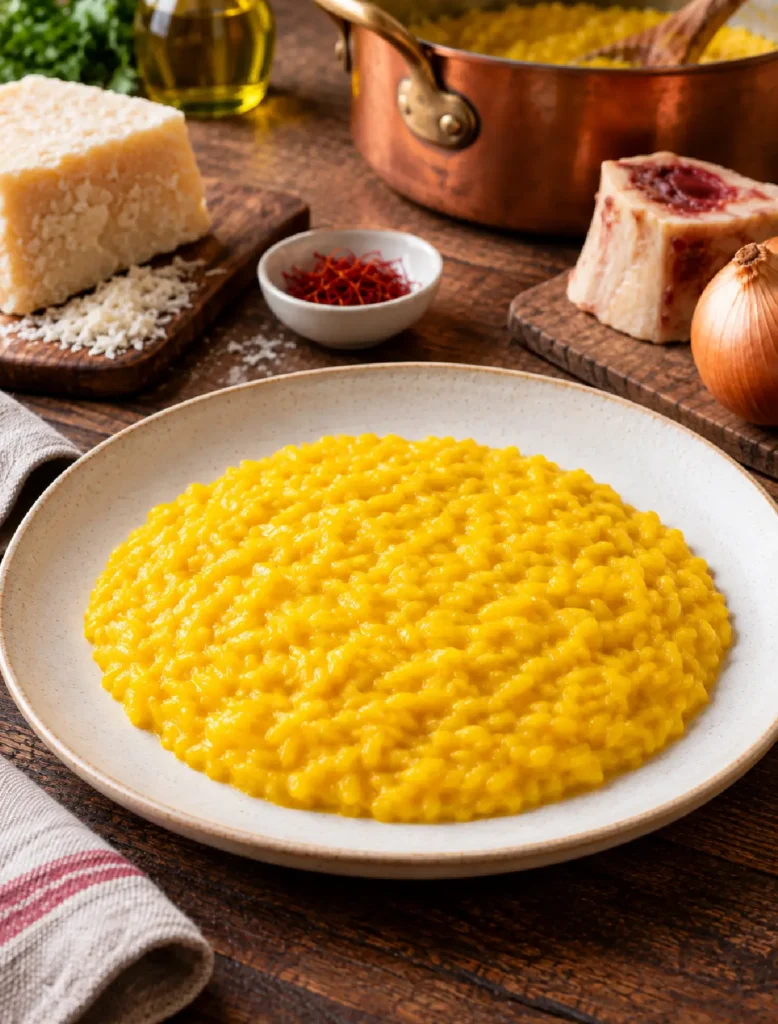
Cook the risotto with the broth 🥄
Add a ladleful of hot broth and continue cooking over medium heat, adding more a little at a time as it is absorbed. Stir regularly and keep the rice slightly wet throughout the cooking process, without flooding it with broth or allowing the bottom of the pan to dry out completely.
Taste before adding any more salt, as the broth may already provide enough seasoning.
6 Add the saffron 🌼
When the rice is about two-thirds of the way through cooking, add the broth with the saffron threads prepared earlier and stir well.
If you are using saffron powder, dissolve it in a little hot broth and add it towards the end of cooking.
Continue adding hot broth a little at a time until the rice is al dente. Before removing it from the heat, leave the risotto slightly looser than you want it on the plate, as it will continue to absorb liquid while you finish it.
7 Finish the risotto all'onda 🧈
Remove the saucepan from the heat and add the remaining 25 g of chilled butter and the 60 g of grated hard Italian cheese. Stir vigorously until the risotto is creamy and glossy, with the individual grains of rice still clearly defined.
If it becomes too thick, add a little hot broth and stir again. When you move the saucepan, the risotto should form the characteristic all'onda, or wave-like movement, and spread gently across the plate without becoming runny. Serve immediately.
Servings 4
- Amount Per Serving
- % Daily Value *
- Total Fat 26g40%
- Saturated Fat 13g65%
- Sodium 450mg19%
- Total Carbohydrate 64g22%
- Dietary Fiber 1g4%
- Sugars 1g
- Protein 15g30%
* Percent Daily Values are based on a 2,000 calorie diet. Your daily value may be higher or lower depending on your calorie needs.
Note
The amount of broth you actually need can vary depending on the rice, the width of the saucepan and the intensity of the heat. Make plenty and keep it hot throughout cooking; you do not need to use all of it.
If you do not have beef roasting fat, replace it with another 25 g of marrow, bringing the total amount of marrow to 50 g. This is the simplest alternative when making the risotto at home.
You can prepare the risotto with either saffron threads or saffron powder. The threads need time to release their colour and aroma into the broth, while saffron powder can simply be dissolved in a little hot broth and added towards the end of cooking.
Keep 25 g of butter in the refrigerator until you are ready to finish the risotto. If the rice becomes too thick after adding the butter and cheese, a little hot broth will bring it back to the proper all'onda consistency.
Keywords:
risotto alla Milanese, Milanese risotto, saffron risotto, risotto with beef marrow, yellow risotto, Milanese recipe, Milanese cuisine, De.Co. risotto
The Duomo legend and two centuries of silence
In 1574, while work was under way on the stained-glass windows of Milan Cathedral, saffron was not used only in the kitchen. Glassmakers used it to obtain certain shades of yellow, and this is where the most famous story about the origins of Milanese risotto begins.
According to the story, an assistant to the master glassmaker Valerio di Fiandra, nicknamed Saffron because of his habit of using the spice in his colours, decided to add it to the rice prepared for a wedding banquet. The rice turned yellow and, the story goes, proved popular enough to find its way into the cooking of the city.
The problem comes with what happens next: for more than two centuries, we have no recipe that allows us to follow that story all the way to the dish we know today. We have to wait until 1809 to find Riso giallo in padella — “yellow rice in a pan” — in Cuoco Moderno, made with butter, onion, marrow, cervellata, broth and saffron. At that point, the ingredients begin to look familiar.
There was cervellata too
If we opened a Milanese cookbook from the nineteenth century, we would find something in the risotto that we would not put in the saucepan today: cervellata, a sausage associated with Milanese cooking at the time.
Antonio Odescalchi uses it in his 1826 Il cuoco senza pretese, in a recipe called “Risotto da par vostro”. Onion, butter, marrow and fat go into the pan first, followed by the rice and then the broth. The saffron has to wait: Odescalchi adds it when the rice is already about two-thirds of the way through cooking. For anyone wanting to go further, there are even mushrooms or truffles.
In 1829, Giovanni Felice Luraschi's Nuovo cuoco milanese economico finally gives us a much more familiar name: “Risotto alla milanese giallo”. Once again we find beef fat and marrow, saffron, grated cheese and, still, cervellata.
Eventually, cervellata disappeared from the saucepan. The marrow did not.