You can recognize Risotto alla Milanese immediately by its saffron colour, but there is much more to it than the yellow. Beef marrow matters here: it goes into the base with the onion and butter, giving the rice a depth of flavour that an ordinary saffron risotto simply does not have.
We prepare it following Milan’s official De.Co. recipe. That means no white wine. We start with the marrow, cook the rice gradually with beef broth and add the saffron later, once the risotto is already well under way.
At the end, the consistency matters more than anything else. We do not want a stiff risotto: it should move all’onda, remain creamy and spread slightly across the plate while the individual grains of rice are still clearly defined. This is where the final addition of butter and cheese makes the difference.
In Milan, it is difficult to separate it from Ossobuco alla Milanese. We can serve the two together, one of the city’s classic combinations, or bring the risotto to the table on its own as a first course.
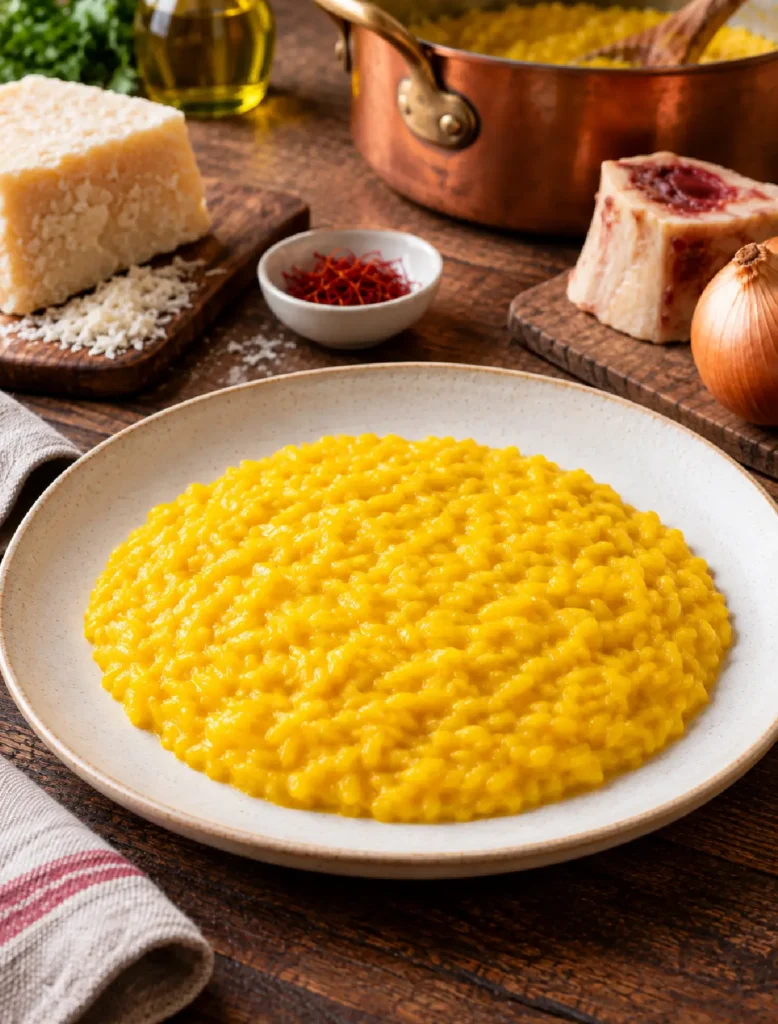
Risotto alla Milanese: Traditional Saffron Risotto with Beef Marrow
Description
Risotto alla Milanese following Milan's De.Co. recipe, made with saffron, beef marrow and homemade beef broth, then finished with cold butter and grated cheese for its characteristic all'onda consistency.
Ingredients
For the beef broth
For the risotto
Instructions
How to Make Risotto alla Milanese
-
Make the beef broth 🍲
Trim the carrot, celery and onion and cut them into large pieces, then place them in a large pot with the bone-in beef. Pour in 2 l of cold water and slowly bring to the boil.
As impurities begin to collect on the surface, skim them off. Lower the heat and leave the broth to simmer gently for about 2 hours.
Strain the broth, season lightly with salt and keep it hot throughout the preparation of the risotto.
-
Prepare the saffron 🌼
If you are using saffron threads, pour a ladleful of hot broth into a small bowl and allow it to cool slightly. Gently crush the saffron threads, add them to the broth and leave them to infuse while you start the risotto.
If you are using saffron powder, set it aside. We will dissolve it in a little hot broth shortly before adding it to the rice.
-
Soften the onion with the marrow 🧅
Finely chop the 45 g of onion. Put 25 g of butter, the 25 g of marrow and 25 g of beef roasting fat into a wide saucepan. If you are not using the roasting fat, add the additional 25 g of marrow instead.
Allow the fats to melt gently, then add the onion and cook it over low heat until soft and translucent without allowing it to brown.
-
Add the rice 🍚
Add the 320 g of Carnaroli rice directly to the saucepan. Stir to coat it evenly in the fat and let it cook briefly until the grains have absorbed the flavours and look glossy.
-
Cook the risotto with the broth 🥄
Add a ladleful of hot broth and continue cooking over medium heat, adding more a little at a time as it is absorbed. Stir regularly and keep the rice slightly wet throughout the cooking process, without flooding it with broth or allowing the bottom of the pan to dry out completely.
Taste before adding any more salt, as the broth may already provide enough seasoning.
-
Add the saffron 🌼
When the rice is about two-thirds of the way through cooking, add the broth with the saffron threads prepared earlier and stir well.
If you are using saffron powder, dissolve it in a little hot broth and add it towards the end of cooking.
Continue adding hot broth a little at a time until the rice is al dente. Before removing it from the heat, leave the risotto slightly looser than you want it on the plate, as it will continue to absorb liquid while you finish it.
-
Finish the risotto all'onda 🧈
Remove the saucepan from the heat and add the remaining 25 g of chilled butter and the 60 g of grated hard Italian cheese. Stir vigorously until the risotto is creamy and glossy, with the individual grains of rice still clearly defined.
If it becomes too thick, add a little hot broth and stir again. When you move the saucepan, the risotto should form the characteristic all'onda, or wave-like movement, and spread gently across the plate without becoming runny. Serve immediately.
Nutrition Facts
Servings 4
- Amount Per Serving
- Calories 550kcal
- % Daily Value *
- Total Fat 26g40%
- Saturated Fat 13g65%
- Sodium 450mg19%
- Total Carbohydrate 64g22%
- Dietary Fiber 1g4%
- Sugars 1g
- Protein 15g30%
* Percent Daily Values are based on a 2,000 calorie diet. Your daily value may be higher or lower depending on your calorie needs.
Note
The amount of broth you actually need can vary depending on the rice, the width of the saucepan and the intensity of the heat. Make plenty and keep it hot throughout cooking; you do not need to use all of it.
If you do not have beef roasting fat, replace it with another 25 g of marrow, bringing the total amount of marrow to 50 g. This is the simplest alternative when making the risotto at home.
You can prepare the risotto with either saffron threads or saffron powder. The threads need time to release their colour and aroma into the broth, while saffron powder can simply be dissolved in a little hot broth and added towards the end of cooking.
Keep 25 g of butter in the refrigerator until you are ready to finish the risotto. If the rice becomes too thick after adding the butter and cheese, a little hot broth will bring it back to the proper all'onda consistency.