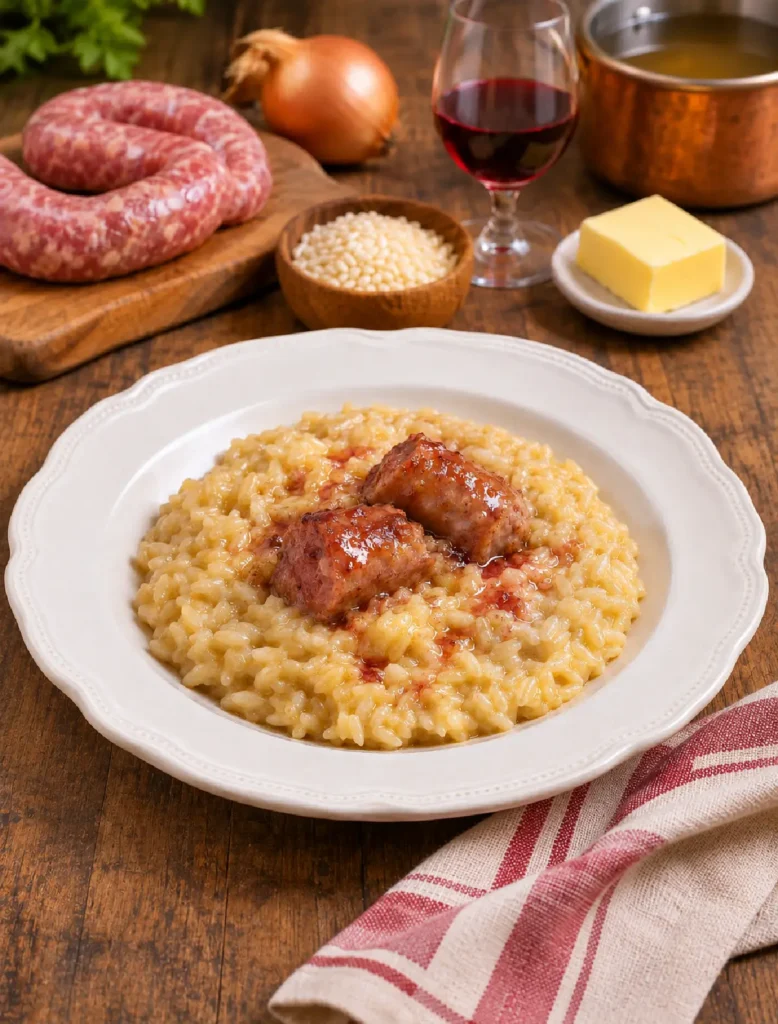
Cook the sausage in red wine 🍷
While the risotto is cooking, drain the sausage, remove any kitchen twine and cut it into large pieces, allowing one or two pieces per serving.
Transfer the pieces to a pan, add the red wine and cook over medium heat for about 5 minutes, turning them occasionally.
Before turning off the heat, make sure the meat is fully cooked. If using a kitchen thermometer, the internal temperature should reach at least 71°C (160°F).
If necessary, continue cooking for a few more minutes, adding a little hot water if the cooking juices reduce too much.
Turn off the heat, cover the pan with a lid and let the sausage rest for 10 minutes, retaining all the cooking juices.
6 Finish the risotto 🥄
When the rice is al dente, taste and adjust the salt, taking into account the saltiness of both the stock and the sausage.
Turn off the heat and gently stir the risotto. If necessary, add a little hot stock to achieve a soft, creamy and flowing consistency, known in Italian as all'onda.
7 Plate and serve 🍽️
Divide the risotto among the plates and use the back of a spoon to create a small hollow in the centre of each serving.
Place one or two pieces of sausage in the hollow. Spoon the red wine cooking juices remaining in the pan over the sausage, allowing them to flow slightly onto the surrounding rice.
Serve immediately while hot.
Servings 4
- Amount Per Serving
- % Daily Value *
- Total Fat 29g45%
- Saturated Fat 13g65%
- Sodium 1050mg44%
- Total Carbohydrate 62g21%
- Dietary Fiber 1.2g5%
- Sugars 1.8g
- Protein 18g36%
* Percent Daily Values are based on a 2,000 calorie diet. Your daily value may be higher or lower depending on your calorie needs.
Note
Storage
Risotto alla Monzese is best enjoyed freshly prepared, while the rice still retains its creamy consistency. If there are leftovers, cool them quickly, preferably within one hour, and refrigerate them in an airtight container for no more than 24 hours.
If possible, store the sausage separately with its cooking juices. When reheating the risotto, add a little hot stock to restore its soft consistency and heat it thoroughly. Avoid reheating it more than once.
Freezing cooked risotto is not recommended, as it may affect its texture.
How to substitute Luganega di Monza
Luganega di Monza has a distinctive flavour thanks to the grated cheese, meat stock and Marsala wine in its filling.
If it is unavailable, we can use another variety of fresh pork luganega or a mild fresh pork sausage, preferably without fennel, chilli or strongly flavoured seasonings.
Outside Italy, look for mild Italian-style fresh pork sausage, avoiding smoked, cured or precooked varieties. The result will still be different from the dish prepared with authentic Monza sausage.
Which rice to use
Carnaroli rice is particularly well suited to this recipe because it retains its texture during cooking while releasing the starch needed to create a creamy risotto.
Arborio or Vialone Nano rice can also be used, adjusting the cooking time and amount of stock according to the variety.
Which red wine to choose
Choose a dry red wine, preferably young, with a balanced flavour and moderate tannins. Barbera or a dry Bonarda from the Oltrepò Pavese area are two suitable options.
Avoid allowing the liquid to evaporate completely while cooking the sausage, as the red wine cooking juices are used to finish the risotto just before serving.
The saffron variation
Another version of sausage risotto made with saffron is popular in Brianza and is particularly associated with the Giubiana festival.
The version presented here keeps the rice plain and cooks the sausage separately in red wine, following the preparation described in Viaggio tra i sapori della Lombardia, published by ERSAF, Lombardy's regional agency for agriculture and forestry services.
Keywords:
Italian sausage risotto, Risotto alla Monzese, Luganega di Monza, sausage risotto recipe, risotto without saffron, red wine sausage, Brianza cuisine, traditional Lombard recipes
Although luganega is closely associated with Monza, its name takes us much further south, to ancient Lucania. As early as the first century BC, the Roman scholar Marcus Terentius Varro traced the Latin term lucanica to the Lucanian people, from whom Roman soldiers are believed to have learned how to prepare this sausage. Over the centuries, the name evolved into different forms that can still be recognised in the culinary traditions of northern Italy.
In Monza, however, local folklore attributes its invention to Queen Theodelinda. According to legend, the Lombard queen gave the recipe to the city's inhabitants to brighten their festive occasions. No historical documents confirm the story, but the reputation of Monza's luganega dates back at least to the sixteenth century, when the writer Ortensio Lando recommended it to travellers in his writings about Italy.
In 1839, Francesco Cherubini recorded the expression Corda di Monscia, meaning 'Monza rope', in his Milanese-Italian dictionary. Luganega had even left its mark on the local dialect: a cured meat seller was known as a luganeghée, small fresh sausages as luganeghitt, and cotechino as luganeghin de codega.
We do not know exactly when the custom of serving luganega with risotto began. One written account of the recipe appears in Vecchia Brianza in cucina, a book published in 1968 by Ottorina Perna Bozzi, who collected and preserved many of Brianza's traditional home-cooked recipes.
Sausage risotto also plays a central role in one of Brianza's most distinctive folk celebrations, the Giubiana festival. According to legend, a witch with extraordinarily long legs dressed in red stockings moved through the trees of the forest in search of children. To rid the village of her, a mother set a trap by preparing a large pot of sausage risotto. The witch became so absorbed in eating that she failed to notice the approaching dawn and was caught by the rays of the rising sun.
Even today, on the last Thursday of January, bonfires are lit in many towns across Brianza, where an effigy representing the Giubiana is burned. Around the fire, people continue the tradition of sharing sausage risotto. For this occasion, the saffron version is particularly popular, its golden colour evoking the sun and the end of winter's harshest days.