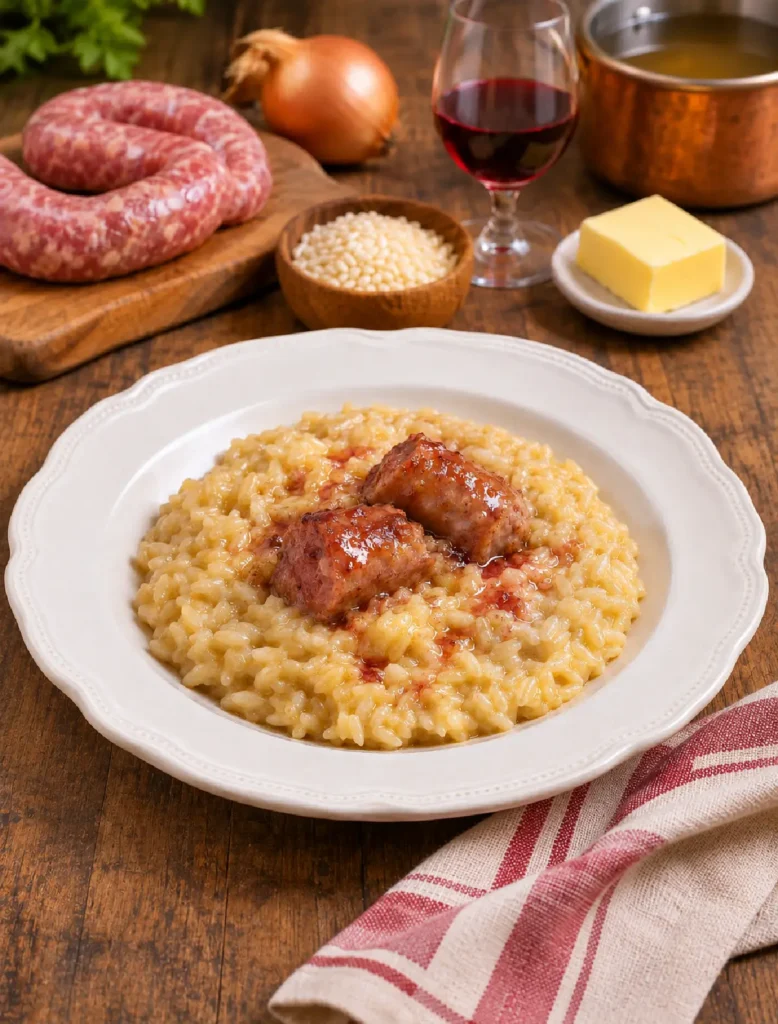
In Risotto alla Monzese, the sausage is not hidden among the grains of rice. Instead, it is served in pieces in a small hollow in the centre of the plate, together with its red wine cooking juices. The rice remains pale, without the saffron that characterises the neighbouring Risotto alla Milanese.
What gives this dish its distinctive character is Luganega di Monza, a fresh pork sausage that differs from other varieties of luganega because its filling contains grated cheese, meat stock and Marsala wine.
While the rice cooks in the stock, we prepare the sausage separately, allowing it to absorb the flavours of the red wine. The cooking juices are an essential part of the dish: with every forkful, they mingle with the rice, bringing together the savoury flavour of the meat and the notes of the wine.
Risotto alla Monzese: Italian Sausage Risotto
Description
A soft and creamy risotto made with Carnaroli rice, butter, onion and meat stock, served with pieces of Monza sausage and their red wine cooking juices.
Ingredients
Instructions
How to make Risotto alla Monzese
-
Prepare the stock and onion 🧅
Heat the meat stock in a saucepan and keep it warm over low heat throughout the preparation of the risotto.
Peel and finely chop the onion so that it softens during cooking without leaving noticeable pieces among the grains of rice.
Heat a separate pan of water for cooking the sausage.
-
Parboil the sausage 🍲
Prick the sausage casing in several places with a toothpick. If the ends are open, tie them with kitchen twine to prevent the filling from escaping.
Place the sausage in the water and let it simmer for 10 minutes to remove some of the fat. Avoid a vigorous boil, which could cause the casing to split.
-
Sauté the onion and toast the rice 🍚
While the sausage is cooking, melt the butter in a saucepan, add the chopped onion and cook over medium-low heat until lightly golden, taking care not to burn it.
Add the Carnaroli rice and toast it for 2-3 minutes, stirring gently so that all the grains come into contact with the hot base of the pan.
-
Cook the risotto 🥄
Pour in the first ladleful of hot stock and continue cooking over medium heat, maintaining a gentle simmer.
Gradually add more stock as the previous addition is absorbed, stirring regularly to prevent the rice from sticking to the bottom of the pan.
Cooking should take approximately 16-18 minutes, depending on the rice used. There is no need to use all the stock if the rice reaches the right consistency sooner.
-
Cook the sausage in red wine 🍷
While the risotto is cooking, drain the sausage, remove any kitchen twine and cut it into large pieces, allowing one or two pieces per serving.
Transfer the pieces to a pan, add the red wine and cook over medium heat for about 5 minutes, turning them occasionally.
Before turning off the heat, make sure the meat is fully cooked. If using a kitchen thermometer, the internal temperature should reach at least 71°C (160°F).
If necessary, continue cooking for a few more minutes, adding a little hot water if the cooking juices reduce too much.
Turn off the heat, cover the pan with a lid and let the sausage rest for 10 minutes, retaining all the cooking juices.
-
Finish the risotto 🥄
When the rice is al dente, taste and adjust the salt, taking into account the saltiness of both the stock and the sausage.
Turn off the heat and gently stir the risotto. If necessary, add a little hot stock to achieve a soft, creamy and flowing consistency, known in Italian as all'onda.
-
Plate and serve 🍽️
Divide the risotto among the plates and use the back of a spoon to create a small hollow in the centre of each serving.
Place one or two pieces of sausage in the hollow. Spoon the red wine cooking juices remaining in the pan over the sausage, allowing them to flow slightly onto the surrounding rice.
Serve immediately while hot.
Nutrition Facts
Servings 4
- Amount Per Serving
- Calories 590kcal
- % Daily Value *
- Total Fat 29g45%
- Saturated Fat 13g65%
- Sodium 1050mg44%
- Total Carbohydrate 62g21%
- Dietary Fiber 1.2g5%
- Sugars 1.8g
- Protein 18g36%
* Percent Daily Values are based on a 2,000 calorie diet. Your daily value may be higher or lower depending on your calorie needs.
Note
Storage
Risotto alla Monzese is best enjoyed freshly prepared, while the rice still retains its creamy consistency. If there are leftovers, cool them quickly, preferably within one hour, and refrigerate them in an airtight container for no more than 24 hours.
If possible, store the sausage separately with its cooking juices. When reheating the risotto, add a little hot stock to restore its soft consistency and heat it thoroughly. Avoid reheating it more than once.
Freezing cooked risotto is not recommended, as it may affect its texture.
How to substitute Luganega di Monza
Luganega di Monza has a distinctive flavour thanks to the grated cheese, meat stock and Marsala wine in its filling.
If it is unavailable, we can use another variety of fresh pork luganega or a mild fresh pork sausage, preferably without fennel, chilli or strongly flavoured seasonings.
Outside Italy, look for mild Italian-style fresh pork sausage, avoiding smoked, cured or precooked varieties. The result will still be different from the dish prepared with authentic Monza sausage.
Which rice to use
Carnaroli rice is particularly well suited to this recipe because it retains its texture during cooking while releasing the starch needed to create a creamy risotto.
Arborio or Vialone Nano rice can also be used, adjusting the cooking time and amount of stock according to the variety.
Which red wine to choose
Choose a dry red wine, preferably young, with a balanced flavour and moderate tannins. Barbera or a dry Bonarda from the Oltrepò Pavese area are two suitable options.
Avoid allowing the liquid to evaporate completely while cooking the sausage, as the red wine cooking juices are used to finish the risotto just before serving.
The saffron variation
Another version of sausage risotto made with saffron is popular in Brianza and is particularly associated with the Giubiana festival.
The version presented here keeps the rice plain and cooks the sausage separately in red wine, following the preparation described in Viaggio tra i sapori della Lombardia, published by ERSAF, Lombardy's regional agency for agriculture and forestry services.