Cook the Risotto 🥄
Reduce the heat and begin adding the hot beef stock, one ladleful at a time, stirring regularly. Allow most of the liquid to be absorbed before adding more, but do not let the rice dry out completely. Continue cooking for approximately 15–18 minutes after toasting, checking the rice from about 13–14 minutes onwards. Taste a few grains: they should be tender on the outside, with a slight resistance in the centre, but without a hard or chalky core. Towards the end, keep the risotto slightly looser than the desired final consistency, as the rice will continue absorbing liquid while resting.
5 Finish with Butter and Monte Veronese 🧀
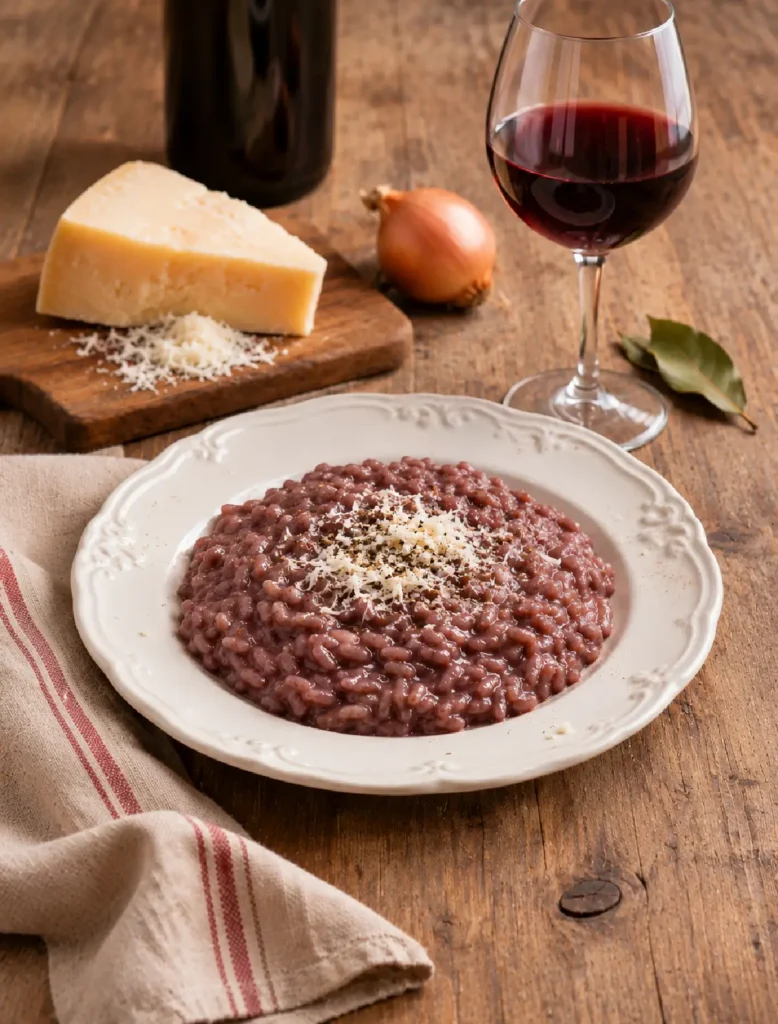
Turn off the heat and add the remaining 20 g (0.7 oz) of butter, preferably cold and cut into small pieces, along with the grated aged Monte Veronese cheese. Stir vigorously or gently shake the saucepan back and forth until the butter and cheese are fully incorporated. If the risotto becomes too thick, add a little hot stock. The finished risotto should have a flowing consistency, known in Italian as all'onda: when the pan is moved, the rice should flow gently in a wave.
6 Rest and Serve 🍽️
Cover the saucepan and leave the risotto to rest for about one minute. Give it a final stir, check the consistency and divide it among serving plates. Serve immediately, while the rice is still hot and the sauce remains smooth and well combined.
Servings 4
- Amount Per Serving
- % Daily Value *
- Total Fat 18g28%
- Saturated Fat 11g56%
- Sodium 850mg36%
- Total Carbohydrate 75g25%
- Dietary Fiber 2g8%
- Sugars 5g
- Protein 14g29%
* Percent Daily Values are based on a 2,000 calorie diet. Your daily value may be higher or lower depending on your calorie needs.
Note
Choosing the Right Rice
Vialone Nano Veronese IGP is particularly well suited to this recipe. If it is unavailable, Carnaroli rice is the best alternative, as it holds its shape during cooking and produces a creamy risotto. Arborio rice can also be used, although it tends to soften more quickly and requires closer attention. Cooking times may vary depending on the variety.
Substituting Amarone Wine
Amarone della Valpolicella DOCG is the defining ingredient of this dish. If you cannot find it, Valpolicella Ripasso DOC is the closest alternative, although it is generally lighter and less concentrated. The finished risotto will taste different from the original, but the wine will still come from the same geographical area. Avoid sweet wines, which would alter the balance of flavours.
Alternatives to Monte Veronese Cheese
Aged Monte Veronese can be replaced with Parmigiano Reggiano or Grana Padano, both of which are widely available internationally. Use the same quantity, keeping in mind that each cheese will give the risotto a slightly different flavour.
Beef Stock or Vegetable Stock
The recipe we follow uses beef stock, which adds depth and body to the risotto. However, a light vegetable stock can also be used, as in other Veronese versions. Whichever you choose, keep it hot throughout cooking and avoid using an overly salty stock, as its flavour will become more concentrated and cheese will be added at the end.
Getting the Perfect Flowing Consistency
The amount of stock is approximate. You may not need all of it, or you may need a little extra. The risotto should never become dry or compact. Keep it slightly loose before adding the butter and cheese, allowing them to blend smoothly into the rice.
Storage
Risotto all'Amarone is best enjoyed immediately after cooking. If you have leftovers, cool them quickly and transfer them to a covered container in the refrigerator, preferably within one hour. Eat within 24 hours, reheating only once until thoroughly hot throughout. A little stock can help loosen the rice during reheating, although the original texture will not be fully restored. Do not leave cooked rice at room temperature for extended periods.
Keywords:
Italian red wine risotto, Amarone risotto, risotto with red wine, Verona risotto, risotto with Amarone wine, Vialone Nano risotto, Venetian risotto
The History of Amarone and the Legend of the Forgotten Barrel
In 1936, an episode said to have taken place in the cellars of Villa Mosconi in Arbizzano became part of Valpolicella's winemaking folklore. Adelino Lucchese, a cellar worker at the Cantina Sociale Valpolicella, reportedly discovered that a barrel of Recioto had continued fermenting longer than expected. Recioto was the area's traditional sweet wine, made from grapes left to dry before fermentation. In that particular barrel, however, the yeasts had consumed most of the sugars, producing a dry, powerful wine quite different from what had been intended. According to the story, Lucchese exclaimed, "This isn't an Amaro, it's an Amarone!"
It is an appealing story, and one still told in Valpolicella, but it does not fully explain the wine's origins. Archival research conducted by Marina Valenti has uncovered documents indicating that Amarone was being produced before 1936. The complete fermentation of dried grapes was therefore not simply the result of a fortunate mistake. Lucchese's story may have helped popularise the name, while the production of dry wines from dried grapes already had a history of its own in Valpolicella's cellars.
Amarone's commercial success took several decades. Recioto continued to hold an important place in local wine production, while Amarone had yet to achieve its present reputation. The year 1953 is often cited as a significant milestone in its commercial development. In 1968, the wine received DOC recognition, initially within the Recioto della Valpolicella designation. DOCG status followed in 2010, after years of expanding production and growing international recognition.
From Wine to Risotto: A More Recent Veronese Tradition
It is much harder to establish when Amarone first began to be used in risotto. There is no widely accepted historical record identifying a particular chef or trattoria as the creator of the dish. What we do know is that the recipe became established in Veronese restaurants, bringing together the wine of Valpolicella and the long-standing rice-growing tradition of the plains around Verona.
Risotto all'Amarone gradually became a familiar presence on local menus and one of the dishes through which Verona introduces visitors to its cuisine. Its popularity eventually led to an initiative to recognise its connection with the city. In February 2024, the Consorzio Tutela Vini Valpolicella announced the dish's candidacy for Denominazione Comunale (De.Co.) recognition, supported by local restaurants and establishments including Caffè Monte Baldo, Al Calmiere and Trattoria Pane e Vino.
The De.Co. recognition was granted on 27 September 2024, alongside that of broccolo di Novaglie, a local variety of broccoli. According to the Municipality of Verona, Risotto all'Amarone had become one of the city's most requested dishes among visitors. Denominazione Comunale recognises a food's connection with local gastronomic traditions, without requiring every version served in Veronese kitchens to be identical. Over time, chefs and restaurateurs have developed their own interpretations, while keeping Amarone as the defining ingredient.