Amarone della Valpolicella gives this risotto its deep red colour, which gradually darkens as the rice absorbs the wine. Its distinctive flavour remains noticeable, with fruity notes and a slightly bitter edge, softened by the butter and aged Monte Veronese cheese added during the final stirring. On the plate, the grains remain separate, coated in a thick, glossy sauce.
To prepare Risotto all’Amarone, we use Vialone Nano Veronese IGP, a short-grain rice variety that absorbs cooking liquid and releases starch while retaining its texture. We gently cook the onion in butter with a bay leaf, toast the rice and pour in the Amarone. Once the wine has been absorbed, we continue cooking with hot beef stock, adding it gradually. Off the heat, we stir in the remaining butter and Monte Veronese until everything comes together.
In the kitchens of Valpolicella, wine is not only served alongside food but also used as an ingredient. Risotto all’Amarone brings together the region’s celebrated red wine, rice grown on the plains around Verona and cheese produced in the nearby mountains. It is a dish found on the menus of local trattorias and restaurants, particularly during the colder months.
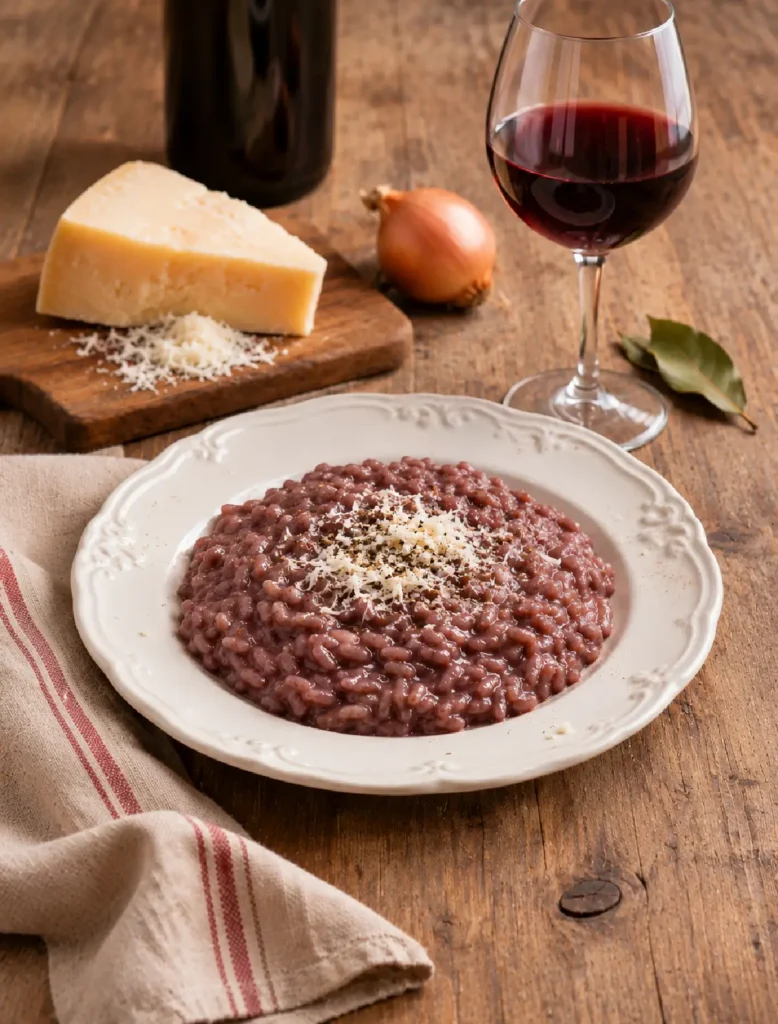
Risotto all’Amarone Italian Red Wine Risotto
Description
A deep-red Italian risotto made with Vialone Nano Veronese rice, Amarone della Valpolicella wine and aged Monte Veronese cheese. A traditional speciality from Verona, finished with butter and grated cheese.
Ingredients
Instructions
How to Make Risotto all'Amarone
-
Prepare the Onion Base 🧅
Finely chop the onion and melt 30 g (1.1 oz) of butter in a large, heavy-bottomed saucepan. Add the onion and bay leaf, then cook gently over low heat for about 5–7 minutes, stirring occasionally. The onion should become soft and translucent without browning. If it begins to stick, add a tablespoon of hot stock. Remove the bay leaf before adding the rice.
-
Toast the Rice 🍚
Add the Vialone Nano rice to the saucepan and increase the heat slightly. Stir for about 2–3 minutes, until the grains are thoroughly heated and slightly translucent around the edges. Do not add any liquid at this stage: the rice should toast in the butter and onion mixture without sticking to the pan.
-
Add the Amarone 🍷
Pour in all the Amarone at once, stirring gently. Keep the heat at medium-high for a few minutes, until the sharp alcoholic aroma becomes less noticeable and the liquid begins to reduce. The rice will gradually take on its characteristic deep red colour. Season lightly with salt and black pepper, remembering that the beef stock and cheese will also contribute flavour and saltiness.
-
Cook the Risotto 🥄
Reduce the heat and begin adding the hot beef stock, one ladleful at a time, stirring regularly. Allow most of the liquid to be absorbed before adding more, but do not let the rice dry out completely. Continue cooking for approximately 15–18 minutes after toasting, checking the rice from about 13–14 minutes onwards. Taste a few grains: they should be tender on the outside, with a slight resistance in the centre, but without a hard or chalky core. Towards the end, keep the risotto slightly looser than the desired final consistency, as the rice will continue absorbing liquid while resting.
-
Finish with Butter and Monte Veronese 🧀
Turn off the heat and add the remaining 20 g (0.7 oz) of butter, preferably cold and cut into small pieces, along with the grated aged Monte Veronese cheese. Stir vigorously or gently shake the saucepan back and forth until the butter and cheese are fully incorporated. If the risotto becomes too thick, add a little hot stock. The finished risotto should have a flowing consistency, known in Italian as all'onda: when the pan is moved, the rice should flow gently in a wave.
-
Rest and Serve 🍽️
Cover the saucepan and leave the risotto to rest for about one minute. Give it a final stir, check the consistency and divide it among serving plates. Serve immediately, while the rice is still hot and the sauce remains smooth and well combined.
Nutrition Facts
Servings 4
- Amount Per Serving
- Calories 555kcal
- % Daily Value *
- Total Fat 18g28%
- Saturated Fat 11g56%
- Sodium 850mg36%
- Total Carbohydrate 75g25%
- Dietary Fiber 2g8%
- Sugars 5g
- Protein 14g29%
* Percent Daily Values are based on a 2,000 calorie diet. Your daily value may be higher or lower depending on your calorie needs.
Note
Choosing the Right Rice
Vialone Nano Veronese IGP is particularly well suited to this recipe. If it is unavailable, Carnaroli rice is the best alternative, as it holds its shape during cooking and produces a creamy risotto. Arborio rice can also be used, although it tends to soften more quickly and requires closer attention. Cooking times may vary depending on the variety.
Substituting Amarone Wine
Amarone della Valpolicella DOCG is the defining ingredient of this dish. If you cannot find it, Valpolicella Ripasso DOC is the closest alternative, although it is generally lighter and less concentrated. The finished risotto will taste different from the original, but the wine will still come from the same geographical area. Avoid sweet wines, which would alter the balance of flavours.
Alternatives to Monte Veronese Cheese
Aged Monte Veronese can be replaced with Parmigiano Reggiano or Grana Padano, both of which are widely available internationally. Use the same quantity, keeping in mind that each cheese will give the risotto a slightly different flavour.
Beef Stock or Vegetable Stock
The recipe we follow uses beef stock, which adds depth and body to the risotto. However, a light vegetable stock can also be used, as in other Veronese versions. Whichever you choose, keep it hot throughout cooking and avoid using an overly salty stock, as its flavour will become more concentrated and cheese will be added at the end.
Getting the Perfect Flowing Consistency
The amount of stock is approximate. You may not need all of it, or you may need a little extra. The risotto should never become dry or compact. Keep it slightly loose before adding the butter and cheese, allowing them to blend smoothly into the rice.
Storage
Risotto all'Amarone is best enjoyed immediately after cooking. If you have leftovers, cool them quickly and transfer them to a covered container in the refrigerator, preferably within one hour. Eat within 24 hours, reheating only once until thoroughly hot throughout. A little stock can help loosen the rice during reheating, although the original texture will not be fully restored. Do not leave cooked rice at room temperature for extended periods.