Note
Choosing the Right Rice
Riso Nano Vialone Veronese IGP is the traditional choice for risotto all'isolana. Its grains absorb stock well while maintaining a pleasant texture during cooking. If it is unavailable, Arborio rice is a practical alternative that is easier to find internationally. Check the cooking instructions on the package and adjust the amount of stock if necessary.
Choosing the Meat
For this version, we use pork loin and lean veal in the proportions specified by the Fiera del Riso di Isola della Scala recipe. Remove any tough connective tissue before cutting the meat, and keep the cubes small and evenly sized to ensure consistent cooking.
Adjusting the Stock
The traditional recipe uses 800 ml of stock for 400 g of rice. We prepare 1 litre so that the additional 200 ml can be used if the meat's cooking juices begin to dry out or if the rice needs more liquid. Always keep the stock hot to avoid interrupting the cooking process.
How Much Cinnamon to Use
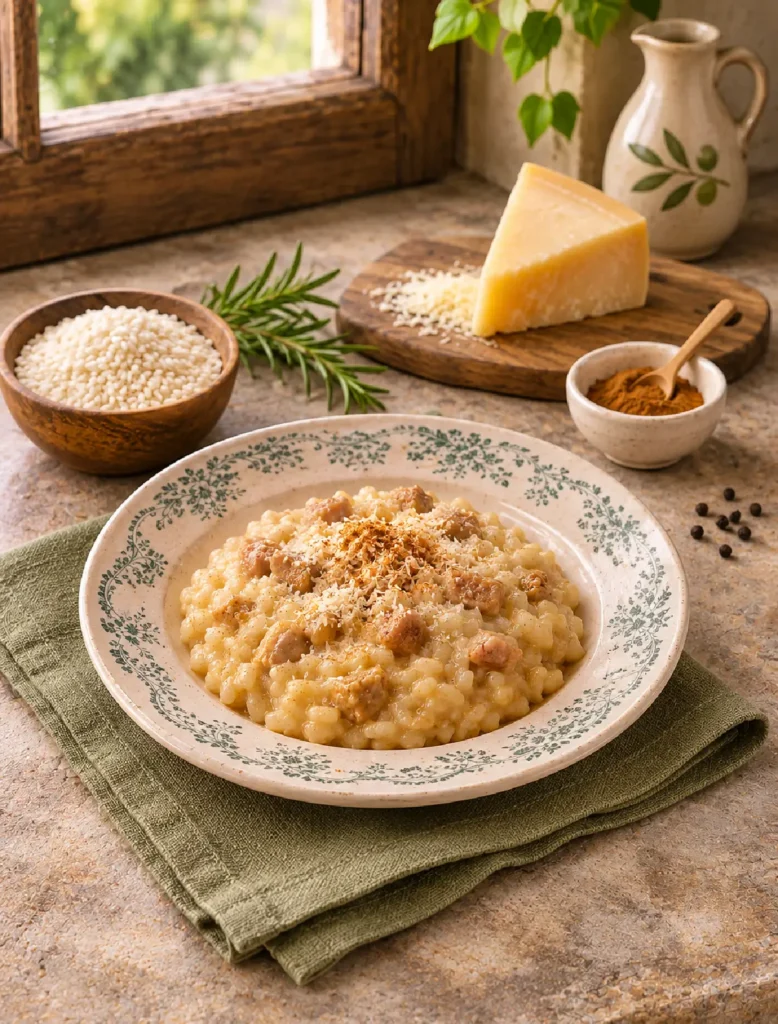
The cinnamon should be barely noticeable and should not overpower the flavour of the meat or cheese. Start with a small pinch, mixing it into the grated Grana Padano before adding it to the risotto. You can increase the amount slightly according to your taste.
Storage and Reheating
Risotto all'isolana is best enjoyed immediately after cooking. If you have leftovers, cool them quickly and store them in a sealed container in the refrigerator for no longer than 24 hours. To reheat, transfer the risotto to a pan with a little hot stock and stir until thoroughly heated throughout. Do not reheat more than once.
Can You Freeze It?
We do not recommend freezing the finished risotto, as the rice tends to lose its texture after thawing. However, you can prepare the meat mixture in advance, cool it quickly and freeze it in a suitable container for approximately 2 months. Thaw it in the refrigerator and reheat thoroughly before using.
Keywords:
risotto all'isolana, Italian pork and veal risotto, Verona risotto, Veneto risotto, Italian meat risotto, Vialone Nano rice, traditional Italian risotto, risotto with pork
Before the Fiera del Riso, there were the garzeghe, celebrations held in the countryside around Isola della Scala to mark the end of the harvest. After weeks of working in the rice fields, people gathered to eat and celebrate together. During the 1960s, as local agriculture faced a difficult period, the idea emerged of organising an event dedicated to the rice grown in the area.
The first Sagra del Riso took place in the autumn of 1967, on the initiative of Mayor Aldo Filippi. Pietro Secchiati, a well-known local cook, was asked to prepare a recipe for the event. Risotto was already a familiar dish in local homes and trattorias, where each family and cook had their own way of preparing it.
The earliest kitchens at the fair were organised around a wood-fired oven and large copper cooking pots. Gianni Mantovani, together with his sons Omar and Michele, recalled how the work was divided: one person kept the fire burning, another prepared the stock, and a third looked after the meat mixture. The Mantovani family participated in the event for generations, winning the award for the best risotto all'isolana on several occasions.
Nella Gualdi, a long-standing cook at Trattoria Triestina, recalled in a 2017 interview that her family had been preparing risotto col tastasal for four generations. She remembered her father-in-law Ernesto, who cooked for the celebrations on 4 November, when First World War veterans were offered a free risotto meal. She also spoke about the women who worked in the rice fields, for whom rice could form part of their wages.
On 6 April 1985, Mayor Vittorino Stanzial signed the Carta d'identità del Risotto all'Isolana, a document establishing the dish's official recipe. It recalled the commission given to Secchiati in 1967 and stipulated that his recipe should be adopted for subsequent editions of the fair. The document specified ingredient quantities and preparation methods, including 200 g of pork and 200 g of veal for every kilogram of rice.
In 2016, for the event's fiftieth anniversary, Veronese chef Giorgio Gioco helped revise the recipe. The amount of pork increased to 600 g per kilogram of rice, while the veal remained at 200 g. The proportions of butter, cheese and stock were unchanged.
In 2024, the Municipality of Isola della Scala granted risotto all'isolana De.Co. recognition, a municipal designation acknowledging its local culinary heritage, together with the traditional Pilaf all'Isolana cooking method. In 2025, the recognition was extended to the Mastri Risottari, the expert risotto cooks associated with the fair. During the event, these cooks work with large pots and prepare risotto for hundreds of people, carefully managing the heat and the amount of stock throughout cooking.