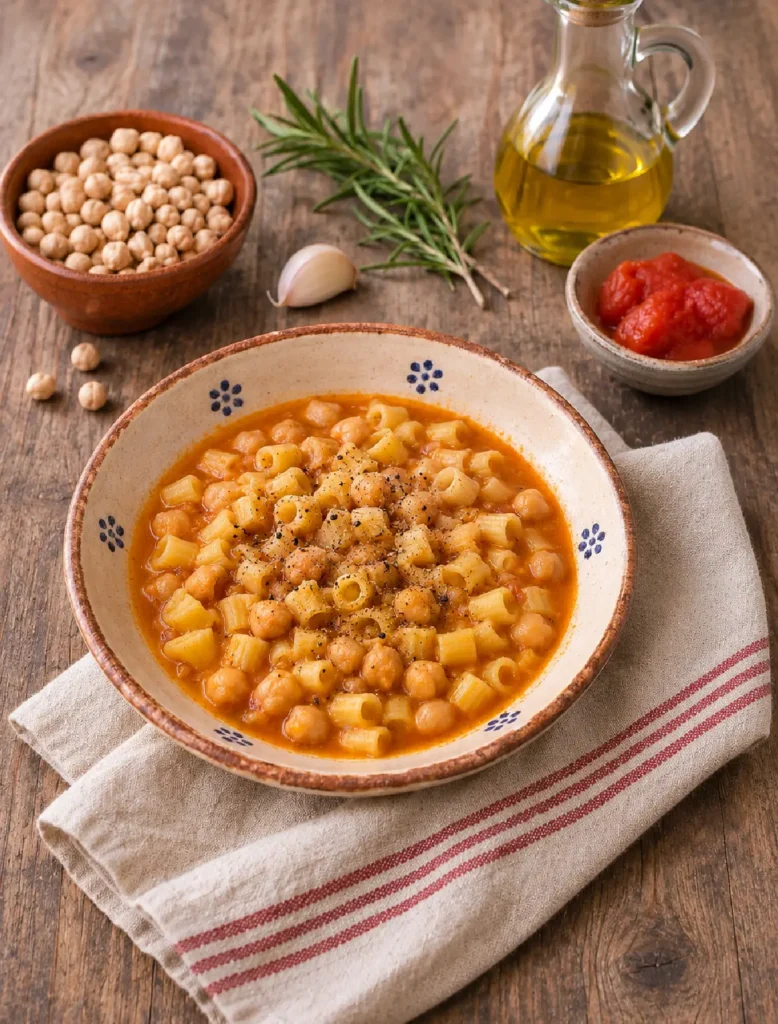
Servings 4
- Amount Per Serving
- % Daily Value *
- Total Fat 13g20%
- Saturated Fat 2g10%
- Total Carbohydrate 75g25%
- Dietary Fiber 11g44%
- Sugars 10g
- Protein 21g42%
* Percent Daily Values are based on a 2,000 calorie diet. Your daily value may be higher or lower depending on your calorie needs.
Note
Using Canned Chickpeas
To save time, replace the 300 g (10.6 oz) of dried chickpeas with approximately 700–750 g (24.7–26.5 oz) of canned chickpeas, drained. Rinse them thoroughly, then simmer for 10–15 minutes in hot water with the rosemary before adding them to the garlic and anchovy base. This eliminates both the overnight soaking and the long cooking time.
Choosing the Pasta
Cannolicchi are the traditional pasta shape used in the reference recipe. If they are unavailable, ditalini are an excellent substitute and are easier to find in many countries, particularly in the United States. Cooking times will depend on the pasta shape and brand.
Adjusting the Consistency
This soup thickens quickly, especially after cooking. If you prefer a looser consistency, stir in a little hot water before serving. Add it gradually to avoid diluting the flavour.
Storage
Allow the soup to cool promptly, then refrigerate in an airtight container for up to 1–2 days. The pasta will continue absorbing liquid and become softer. Reheat thoroughly in a saucepan, adding a little water to loosen the soup.
If preparing ahead, it is better to store the cooked chickpeas and their seasoned broth separately, adding and cooking the pasta just before serving. The chickpea base, without pasta, can also be frozen for approximately 2–3 months.
Keywords:
Roman chickpea and pasta soup, Italian chickpea soup, pasta e ceci, chickpea pasta soup, Roman pasta soup, Italian pasta and chickpeas, Ada Boni recipe
Pasta e Ceci Through the History of Rome
In the first century BC, the Roman poet Horace wrote in his Satires about the pleasure of walking through Rome freely, without servants or the obligations that came with an important public position. In the evening, he returned home to a simple meal of leeks, chickpeas and lagana, an early form of pasta. The passage appears in the sixth satire of Book I, which also reflects on social differences and Horace's pride in his modest origins. We cannot know how closely that meal resembled today's Roman chickpea soup, but chickpeas and preparations made from flour were already being eaten together.
Chickpeas were also familiar to Romans who bought food in the streets. The poet Martial mentions a vendor selling cooked chickpeas in his Epigrams. The humble legume is even connected to one of Rome's most famous historical figures, Marcus Tullius Cicero. According to Plutarch, one of Cicero's ancestors had a growth on his nose resembling a chickpea, or cicer in Latin, which supposedly gave the family its name. When friends suggested that the young orator should change it, he refused, determined to make the name famous.
To find pasta e ceci recorded in a cookbook specifically devoted to Roman cuisine, we must move forward to the twentieth century. Ada Boni, born in Rome in 1881, founded the domestic and cookery magazine Preziosa in 1915. Ten years later, she published Il talismano della felicità, which became one of Italy's best-known cookbooks. Her next major work, La cucina romana, appeared in 1929 and gathered numerous dishes from the city's culinary traditions. Among them was pasta e ceci, including the anchovy-based seasoning used in this recipe.
A few decades later, chickpea soup made an appearance in Italian cinema. In Mario Monicelli's 1958 film I soliti ignoti, internationally known as Big Deal on Madonna Street, a group of thieves plans to rob a pawnshop in Rome. After breaking through the wrong wall, however, they find themselves in an apartment kitchen. The robbery fails, and their only reward is a pot of pasta e ceci. There is also a story about how the dish came to appear in the scene. According to a recollection attributed to cinematographer Tonino Delli Colli, actor Marcello Mastroianni suggested replacing the pasta and bean soup originally planned for the script with pasta e ceci, one of his favourite dishes.