
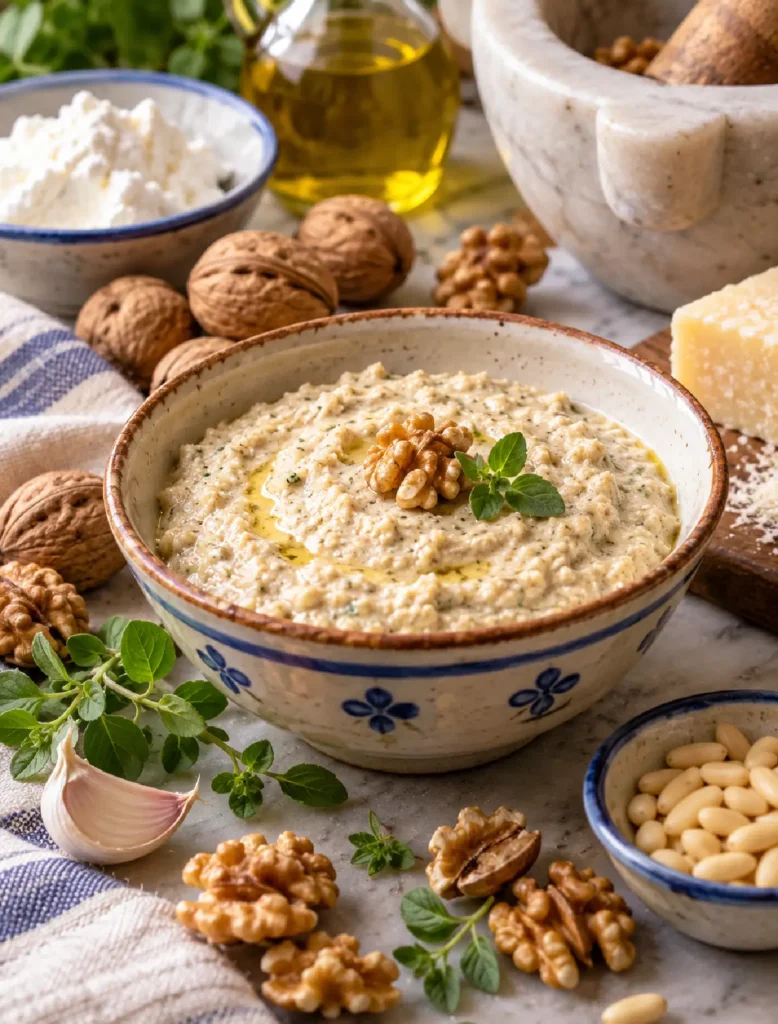
A traditional Ligurian sauce made with walnuts, prescinseua, pine nuts and marjoram. Traditionally prepared with a mortar and pestle, it has a creamy, slightly coarse texture and is particularly well suited to herb-filled pansoti.
Cut 50 g of white bread crumb into small pieces and place them in a bowl with 70 g of whole milk. Leave to soften for about 5 minutes, then mash with a fork until the mixture is soft. Set aside any milk that has not been absorbed.
Bring a small saucepan of water to the boil and add 160 g of walnut kernels. Blanch for about 1 minute, then drain. Once cool enough to handle, remove any dark skins that come away easily. There is no need to peel every walnut completely.
Place half a garlic clove, with the inner green germ removed, in a mortar together with 20 g of pine nuts and a pinch of salt. Work with the pestle until the mixture becomes fairly fine.
If using a blender or small food processor, add the same ingredients and pulse briefly. Continue adding the remaining ingredients in the order described below, working in short bursts to prevent the sauce from overheating.
Gradually add the walnuts, crushing them with the pestle until you obtain a soft mixture that still has a slightly coarse texture. If your mortar is small, work in batches and transfer the crushed mixture to a large bowl as you go.
If using a blender, pulse briefly and stop before the walnuts turn into a completely smooth paste.
Transfer the walnut, garlic and pine nut mixture to a large bowl if you have not already done so. Add the softened bread and 2 g of fresh marjoram leaves, then mix thoroughly.
If the mixture seems too thick, gradually add any milk left over from soaking the bread.
Add 60 g of prescinseua and 30 g of finely grated Parmigiano Reggiano, stirring until well combined. Gradually pour in 35 g of extra virgin olive oil, mixing with a spoon until the sauce becomes creamy while retaining a slightly coarse texture.
Taste and adjust the salt if necessary.
If using a blender, you can also incorporate these ingredients in the container, provided it is large enough. Continue working in short pulses.
Salsa di noci is served without cooking it. When the pasta is almost ready, loosen the amount of sauce you need with a little hot pasta cooking water, adding it gradually until it reaches a consistency suitable for coating the pasta.
If using the optional butter, add 10 g of butter together with the hot pasta water and stir until melted. Add the drained pasta and toss gently, without returning the sauce to the heat.
Prescinseua and substitutes: Prescinseua gives the sauce its characteristic slightly tangy flavour. If you cannot find it, use well-drained whole-milk ricotta. The resulting sauce will have a milder taste.
Walnut skins: Briefly blanching the walnuts makes it easier to remove some of their darker skins, which contribute to their slightly bitter flavour. There is no need to remove every trace of skin, as a little bitterness is normal in this sauce.
Consistency: The sauce should be creamy but does not need to be perfectly smooth. If it is too thick, add a little hot pasta cooking water, one tablespoon at a time. Avoid thinning it too much before serving.
Storage: Transfer the freshly prepared sauce to a clean, covered container and refrigerate immediately at 4°C (40°F) or below. For best quality and as a precaution, consume within 24 hours. Do not leave it at room temperature for more than 2 hours. The sauce contains fresh dairy products and is not cooked after preparation.
Serving: This recipe makes approximately enough sauce for four servings of pasta. Do not heat the sauce directly in a pan. Instead, combine it with freshly drained pasta, using a little cooking water to loosen it.
In Liguria, walnuts have long been used for much more than cakes and baked goods. Crushed with other ingredients, they form the basis of a sauce closely associated with home cooking, when the mortar and pestle were everyday kitchen tools.
Known locally as sarsa de noxe, walnut sauce is found in different parts of the region. The recipes published by Agriligurianet, the Ligurian Region's agricultural and food portal, reflect this variety. One includes prescinseua, pine nuts, marjoram and even a little butter, while another takes a simpler approach.
These differences are part of the way the sauce has been prepared and passed down in Ligurian households.
The most famous pairing is with pansoti, Ligurian pasta filled with a mixture of herbs and greens. The filling often has a slightly bitter flavour, which works particularly well with the richness of the walnut sauce.
This combination is especially associated with eastern Liguria. In 2013, the town of Rapallo awarded Pansotti con salsa di noci its De.Co. (Denominazione Comunale) recognition, documenting the ingredients and characteristics of the local preparation.
The recognised Rapallo version is not, however, the only way the dish is prepared. Across Liguria, local and family recipes continue to differ, particularly in the herbs used for the filling and the ingredients included in the sauce.
Pesto Genovese is undoubtedly Liguria's best-known sauce, but salsa di noci has a character of its own.
Basil is the defining ingredient of pesto, together with olive oil, cheese, garlic and pine nuts. In salsa di noci, the walnuts determine both the flavour and the texture. The colour is different too: rather than pesto's green, walnut sauce has a pale, ivory-coloured appearance.
Both belong to Liguria's tradition of preparing sauces with a mortar and pestle, although they remain two distinct preparations.
Salsa di noci is recognised as a PAT (Prodotto Agroalimentare Tradizionale), an Italian Traditional Agri-food Product, of Liguria. This recognition documents its established place in regional food culture, but does not prescribe one mandatory recipe with fixed quantities.
Agriligurianet publishes two versions of the sauce, with differences in ingredients and proportions. The recipe presented here takes the first version as its reference, with quantities adapted for four servings.