Servings 4
- Amount Per Serving
- % Daily Value *
- Total Fat 12g19%
- Saturated Fat 2g10%
- Sodium 130mg6%
- Total Carbohydrate 77g26%
- Dietary Fiber 5g20%
- Sugars 6g
- Protein 14g29%
* Percent Daily Values are based on a 2,000 calorie diet. Your daily value may be higher or lower depending on your calorie needs.
Note
The amount of extra virgin olive oil is not fixed in the PAT recipe. Use enough to create a generous coating over the bottom of the pan without submerging the ingredients. For this reason, the stated calorie count is also an estimate and will vary according to the amount of oil used.
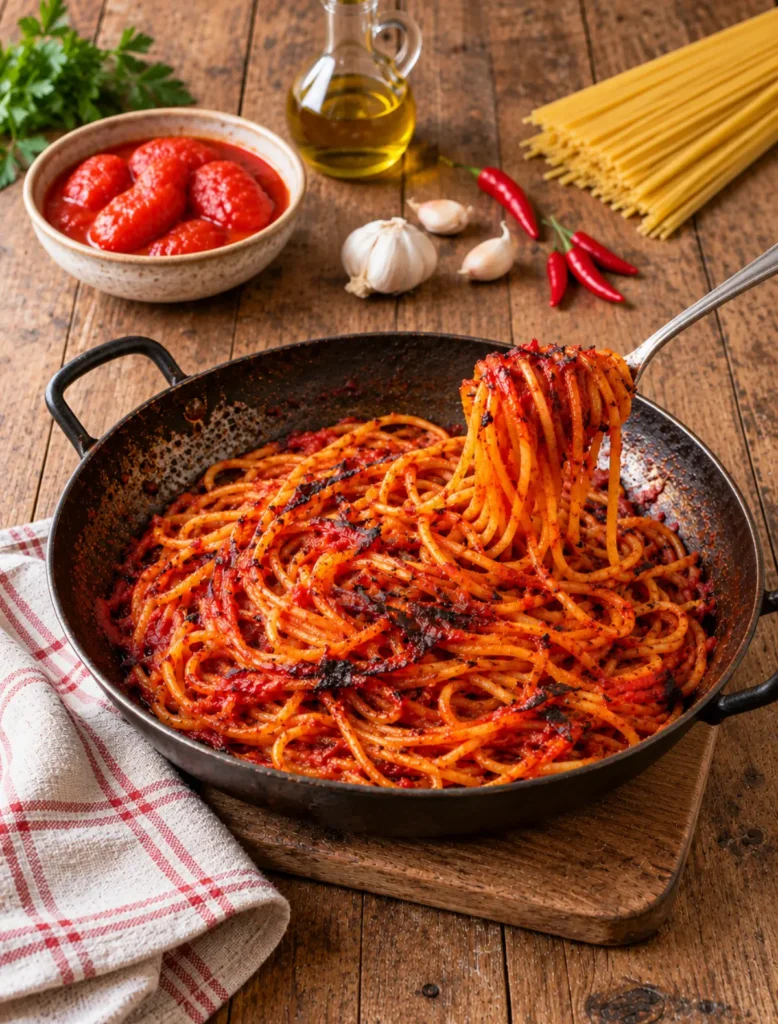
The iron pan is important for developing the characteristic char of Spaghetti all’Assassina. It should be wide enough to hold the spaghetti lengthways once softened. When the bottom begins to dry, do not rush to turn the pasta. Give some of the strands enough time in contact with the iron to brown before moving them.
Adjust the chilli to your taste, but do not leave it out entirely. The heat is part of the identity of the dish and is also tied to the story behind its unusual name.
Keywords:
Spaghetti all’Assassina, Bari pasta, Puglia recipes, spicy Italian pasta, tomato spaghetti, PAT recipe, charred spaghetti, Italian pasta recipe
But Which Is the Real Assassina?
If you have seen Spaghetti all’Assassina being made before, you may notice something different about our recipe. It is not a mistake: we followed the preparation used as the reference for Puglia’s PAT (Traditional Agri-Food Product) recognition.
You probably know the Assassina where dry spaghetti goes straight into the pan. Here, however, the spaghetti sees boiling water for just a few moments: as soon as it becomes flexible enough to bend, it is drained and moved to the iron pan with the tomato. That is how the preparation is described in the PAT documentation.
👉 So where did the Assassina cooked entirely in the pan come from? We looked into its story.