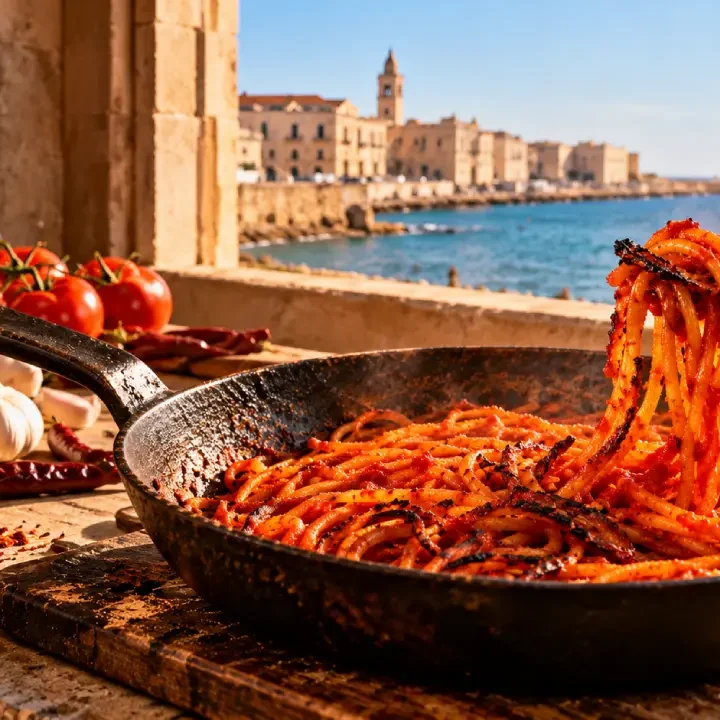
Today, Spaghetti all’Assassina is almost always shown starting directly in an iron pan. Dry spaghetti, tomato added little by little, then those moments when you have to stop stirring and wait for the pasta to start sizzling.
In Enzo Francavilla’s account, however, things happened differently in 1967.
The spaghetti went into boiling water first. Not for long, just enough to make it flexible enough to bend. Only then did it go into the pan with the tomato.
Almost sixty years later, this is the preparation used as the reference for the recognition of Spaghetti all’Assassina as a PAT (Traditional Agri-Food Product) of Puglia.
It all started at Al Sorso Preferito
We are in Bari in 1967. Enzo Francavilla, a cook originally from Foggia, had recently taken over Al Sorso Preferito when two customers asked him for something tasty and substantial.
Francavilla recalled using what he had available. He crushed peeled tomatoes with his hands, put olive oil, garlic and plenty of chilli into an iron pan and let the garlic darken. By the time the tomatoes went in, the pan was extremely hot.
The spaghetti spent only a few moments in boiling water. As soon as it could bend without breaking, Francavilla drained it and transferred it to the pan, where it finished cooking in the tomato.
“You’re an assassin”
The two customers tasted the spaghetti and noticed one thing above all: it was extremely hot. They called Francavilla an “assassin”.
According to his account, then, the name did not come from spaghetti being “murdered” by the heat, burnt pasta or any of the other explanations later built around it. There was simply enough chilli to give the people who had ordered it a hard time.
The name stuck, and the spaghetti began appearing elsewhere in Bari. By 1993 it was recognizable enough to be mentioned as spaghetti “all’assassina” in Enzo Biagi’s I come Italiani.
The old iron pan that was never washed
There was another detail in Francavilla’s kitchen that shows just how much the preparation of this dish has changed.
It was called a sartàscene, a thin iron pan that was not washed as we would wash a pan today. It was greased and rubbed down, sometimes with paper, leaving an oily coating over the surface.
It is difficult to imagine a pan like that in a modern professional kitchen. Today it has largely been replaced by the heavier, thicker Lyonnaise-style iron pan. As the tomato dries and the spaghetti remains in contact with the hot iron, some strands brown much faster than others. Those are the dark, crisp sections you want in an Assassina.
When only a few places in Bari were still making it
By the 1980s, Spaghetti all’Assassina had become harder to find in Bari restaurants. It never disappeared completely: the PAT documentation mentions Al Sorso Preferito, of course, but also Marc’Aurelio, Taverna Verde, Refugium Peccatorum and La Bella Bari among the places that continued to make it.
Things changed considerably in 2013 with the creation of the Accademia dell’Assassina. A group of enthusiasts began tasting the versions served in Bari restaurants, comparing them and discussing how the dish should be made. Assassina returned to restaurant menus and gradually began attracting attention beyond Bari.
But what was returning to the table did not quite match Francavilla’s account.
The dry spaghetti now went straight into the iron pan. It cooked as a tomato-based liquid was added little by little, with time between each addition for the pasta to start sizzling against the hot surface again.
This is the image of Spaghetti all’Assassina that has become familiar in recent years.
So does the spaghetti go into water first or not?
It depends on which point in the dish’s history we are looking at.
In the preparation attributed to Francavilla, the spaghetti is briefly softened in water before finishing its cooking in the tomato. In the version that became famous during the dish’s revival, it starts completely dry and cooks in the pan while tomato liquid is gradually added.
The distinction also appears in the PAT documentation. Variations that developed over time include the use of passata, a so-called “tomato broth”, risotto-style cooking and more pronounced charring. The recipe promoted by the Accademia is also described as slightly different from Francavilla’s version.
There is no need to choose one and erase the other. The later version also tells us what happened to Assassina when Bari began looking for it again.
If you want to try the preparation attributed to Francavilla, 👉 you can find our Spaghetti all’Assassina recipe here, based on the version used as the reference for PAT recognition.
And the revival did not stop at restaurants.
In 2015, Gabriella Genisi published Spaghetti all’assassina, one of her novels featuring Lolita Lobosco. The investigation revolved around the death of a chef and the Bari recipe. In 2021, the story reached television: Spaghetti all’Assassina became the title of the third episode of the first season of Le indagini di Lolita Lobosco.
By then, the name had begun travelling well beyond Bari.
At the Fiera del Levante in 2024, there was even a Spaghetti all’Assassina championship, with sixteen restaurants competing. During the final, an interview with Francavilla was shown in which he once again described the preparation he had made in 1967. He was also presented with a commemorative plaque.
Two years later came PAT recognition.
The recipe chosen for PAT recognition
In 2026, Spaghetti all’Assassina joined Puglia’s PAT list, with Bari identified as its area of origin.
That pot of water, which may surprise anyone familiar only with the more recent Assassina, appears again in the official documentation. The preparation used as the reference is the one attributed to Francavilla: hand-crushed peeled tomatoes, garlic, chilli, olive oil, an iron pan and spaghetti immersed in boiling water only until flexible enough to bend.
The risotto-style technique and dry spaghetti going directly into the iron pan do not disappear from the story. They belong to the decades in which the dish changed, almost vanished from restaurant menus, was rediscovered and eventually became far more famous than Francavilla could probably have imagined in 1967.
His Assassina, however, began with a pot of water beside the iron pan.