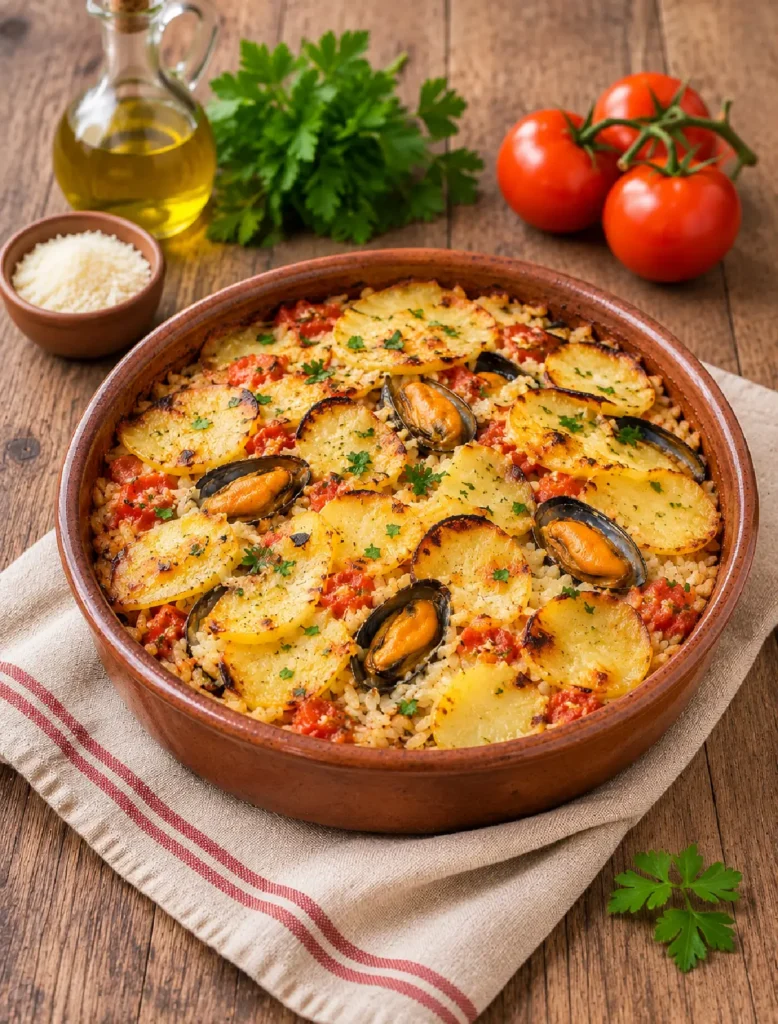
Rice, Potatoes and Mussels or Potatoes, Rice and Mussels?
Ask someone from Bari what this dish is called and you might get an immediate answer. Ask their neighbour and you could hear something different. Some insist on riso, patate e cozze, while others prefer patate, riso e cozze. And it's probably best not to reverse the order in front of someone who has strong opinions on the subject.
Bari food writer Sandro Romano has discussed this little disagreement on several occasions. It even found its way into popular entertainment. In an episode of the Italian television comedy Love Bugs, Bari-born actor Emilio Solfrizzi used the name patate, riso e cozze. Most viewers probably didn't give it a second thought. In Bari, such details tend to attract more attention.
Then there's the dialect name, tièdde, which refers to the cooking vessel itself. The Italian word tiella comes from the Latin tegella, meaning a shallow pan or baking vessel. Over time, the name of the container became the name of the food cooked inside it.
Is Tiella Really Related to Spanish Paella?
The resemblance between the names has encouraged a popular theory: Tiella Barese is supposedly descended from Spanish paella, introduced to Puglia during periods of Spanish rule in southern Italy.
It's an appealing story. Perhaps a little too appealing.
There is no documentary evidence establishing a direct connection between the two dishes. Sandro Romano is among those who have questioned the theory, pointing out the differences in their preparation. Potatoes also complicate the timeline: they reached Europe from the Americas and only gradually became part of the Italian diet.
Nobody knows exactly when someone first prepared a dish resembling today's tiella. It may have developed through the meeting of inland farming traditions and the cooking of coastal communities. That's a plausible explanation, but assigning the dish a precise birthplace, date or inventor would be speculation.
How Many Mussels Are in Your Tiella?
Today, we're used to seeing generous baking dishes with mussels scattered throughout the layers. That wasn't necessarily always the case.
According to an account published by La Cucina Italiana, the number of mussels in a family's tiella was once considered a possible indication of its financial circumstances. Families who could afford more used plenty. Those watching their spending made do with fewer.
There are even stories of versions prepared without mussels at all.
It's difficult to establish how widespread this practice was, or whether it belonged to particular households or periods. Still, it's an intriguing detail, especially considering how essential mussels seem to the dish today.
Sunday Lunch and the Neighbourhood Oven
There was a time when preparing Sunday lunch might also involve a walk to the local bakery.
In homes without a domestic oven, families could take their prepared baking dishes to communal or neighbourhood ovens and collect them once cooked. This practice wasn't unique to Bari or to tiella. Similar arrangements existed in several parts of southern Italy.
The bakery was also a meeting place. People waited their turn, exchanged a few words and checked whether their food was ready. Some accounts of local traditions also mention using the residual heat of wood-fired ovens.
Then came the journey home, hopefully without spilling Sunday lunch along the way.
The Mayor of Bari, Fiorello and an Empty Baking Dish
In June 2023, during a live segment on the Italian television programme Viva Rai2!, Bari's then mayor Antonio Decaro decided to give television presenter Fiorello a gift.
A freshly baked tiella? Not quite.
He presented him with an empty baking dish, together with instructions for preparing rice, potatoes and mussels. The idea was straightforward: rather than bringing Fiorello a ready-made meal, he would teach him how to make it himself.
The episode was also covered by Gambero Rosso, which took the opportunity to discuss places in Bari where visitors could try the dish.
Traditional Recognition and Historic Cookbooks
Tiella was part of Puglian home cooking long before it received any official recognition. By the twentieth century, it had already found its way into regional cookbooks.
Among the authors who documented it were Giovanni Panza in La checine de nononne, published in 1982, and Luigi Sada in La cucina della terra di Bari, published in 1991. These books provide valuable records of how a domestic preparation was described and passed down beyond the family kitchen.
In 2017, the dish was included in Puglia's official list of Traditional Agri-Food Products (PAT) under the name Teglia al forno con patate riso e cozze.
As for the argument about which ingredient should come first in the name, official recognition did nothing to settle it. It would have been surprising if it had.