The first thing you notice when Tiella Barese comes out of the oven is its golden crust. Underneath, the potatoes have softened and the rice has absorbed the juices from the mussels, picking up flavour as everything cooks together. Pieces of tomato peek through the layers, along with the mussel shells that make this dish instantly recognisable.
In Bari, this dish is also known simply as tiella, after the baking vessel traditionally used to prepare it. What makes it unusual is that almost everything goes into the oven raw. There’s no need to boil the rice beforehand or cook the potatoes separately. The mussels are opened by hand and left attached to one half of their shells, then arranged in the dish with the rice, thinly sliced potatoes, tomatoes and onions. Garlic, parsley, olive oil and a generous sprinkling of grated Pecorino provide the seasoning.
It sounds straightforward, and in many ways it is, but the amount of liquid needs attention. Too little and the rice may remain undercooked; too much and liquid collects at the bottom, leaving the layers soggy. We prefer to let the tiella rest for a few minutes after taking it out of the oven. That makes it easier to serve a portion with all the ingredients together, rather than ending up with nothing but rice and potatoes on the plate.
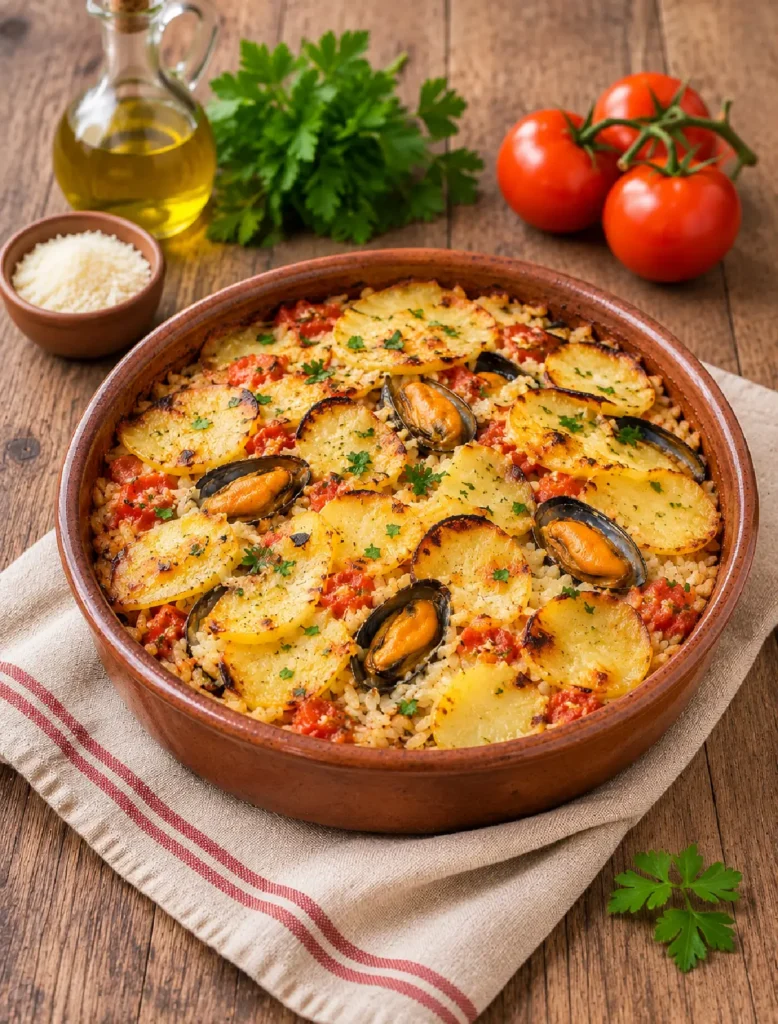
Tiella Barese with Rice, Potatoes and Mussels
Description
A traditional dish from Puglia featuring layers of rice, potatoes and mussels baked together with tomatoes, onions and Pecorino cheese.
Ingredients
Instructions
How to Make Rice, Potatoes and Mussels
-
Prepare the Herb Mixture 🌿
Wash and dry a generous handful of parsley. Finely chop it together with the 2 garlic cloves, then divide the mixture into two equal portions.
-
Clean and Open the Mussels 🦪
Check the mussels and discard any with broken shells or those that remain open after being gently tapped. Remove the beards, scrub the shells thoroughly and rinse under cold running water.
Using a suitable small knife, carefully open the raw mussels over a bowl to collect the liquid released from the shells. Discard the empty half of each shell, leaving the mussel attached to the other half.
Strain the collected liquid through a fine sieve lined with clean food-safe cheesecloth to remove any sand or shell fragments. Set aside.
-
Prepare the Vegetables and Rinse the Rice 🥔
Peel the 2 large onions and slice them thinly. Wash the 500 g of tomatoes and cut them into small pieces.
Peel the 500 g of potatoes and slice them evenly, approximately 3–5 mm thick (about 1/8–1/5 inch). A mandoline can help produce uniform slices.
Rinse the 300 g of rice under cold running water, then drain thoroughly.
-
Assemble the First Layer 🧅
Spread all the sliced onions over the bottom of a round baking dish, approximately 30 cm (12 inches) in diameter, with sides at least 6 cm (2.5 inches) deep.
Sprinkle with half the garlic and parsley mixture, then add 250 g of tomatoes and a handful of grated Pecorino.
Season with just a small pinch of salt, remembering that the mussel liquid and Pecorino will already contribute saltiness.
-
Add the Potatoes and Rice 🍚
Arrange 250 g of sliced potatoes over the seasoned onions, forming an even layer.
Spread all 300 g of rinsed rice over the potatoes, distributing it evenly without allowing it to pile up.
-
Arrange the Mussels 🦪
Place the mussels over the rice, with the half-shells facing down and the mussel meat facing up.
Scatter over the remaining garlic and parsley mixture, followed by the remaining 250 g of tomatoes.
-
Finish the Layers and Add the Liquid 💧
Cover with the remaining 250 g of sliced potatoes, arranging them evenly across the surface. Drizzle generously with olive oil.
Weigh the strained mussel liquid and add enough cold water to reach 750 g in total. Slowly pour the liquid around the edges of the baking dish to avoid disturbing the layers.
Do not add any more salt. As the rice cooks, it will absorb the natural saltiness of the mussel liquid.
-
Bake and Serve 🔥
Place the baking dish in a preheated conventional oven at 180°C (350°F) and bake for approximately 50–60 minutes.
Check that the potatoes are tender, the rice is fully cooked and the liquid has been absorbed. If necessary, continue baking for a few more minutes, making sure the dish does not become excessively dry.
Remove from the oven and leave to rest for approximately 10–15 minutes before serving.
Nutrition Facts
Servings 6
- Amount Per Serving
- Calories 370kcal
- % Daily Value *
- Total Fat 12g19%
- Saturated Fat 4g20%
- Sodium 400mg17%
- Total Carbohydrate 56g19%
- Dietary Fiber 4g16%
- Sugars 7g
- Protein 12g24%
* Percent Daily Values are based on a 2,000 calorie diet. Your daily value may be higher or lower depending on your calorie needs.
Note
Mussels: Buy live mussels from a reputable fishmonger and keep them refrigerated until preparation. Opening them raw is part of the traditional method, but they must be thoroughly cooked before eating.
Rice: Arborio rice is a practical choice for this recipe. The historical recipe simply specifies rice without naming a particular variety.
Tomatoes: Choose small, ripe tomatoes. Cherry or grape tomatoes are convenient alternatives if traditional Puglian varieties are unavailable.
Baking dish: Use a round baking dish approximately 12 inches (30 cm) in diameter and at least 2.5 inches (6 cm) deep. Oven-safe earthenware, ceramic or metal are suitable. Avoid springform pans, which may leak.
Liquid: The total 750 g includes both the strained mussel liquid and the added cold water. Do not add another 750 g of water on top of the liquid collected from the mussels.
Salt: Use sparingly, as both the mussels and Pecorino contribute saltiness.
Baking: The 50–60 minute cooking time is approximate. Both the rice and potatoes must be fully cooked. Extend the baking time if necessary.
Storage: Cool leftovers promptly and refrigerate within 2 hours at 4°C (40°F) or below. Ideally, eat within 24 hours and reheat thoroughly only once.