Note
Prescinseua is a traditional Ligurian fresh curd cheese with a soft texture and slightly tangy flavour. If unavailable, well-drained ricotta can be used, although the resulting pie will have a milder flavour.
Allowing the dough to rest is essential for achieving thin, elastic pastry sheets. If the dough begins to shrink while rolling, let it relax for a few minutes before continuing.
The Swiss chard must be well drained and completely cool before assembling the pie. Excess moisture can prevent the bottom pastry from baking properly.
Torta Pasqualina can be prepared in advance. Once completely cooled, store it in a covered container in the refrigerator for 2–3 days. Before serving, allow it to lose its chill briefly or reheat it gently in the oven.
Keywords:
Torta Pasqualina, Italian Easter Pie, Ligurian Easter Pie, Genoese Easter Pie, Swiss Chard Pie, Italian Savoury Pie
From Gattafura to Torta Pasqualina
In 1570, Bartolomeo Scappi published his Opera, one of the great cookbooks of the Italian Renaissance. Among the dishes he described was a Genoese gattafura, a pie filled with greens and cheese that is often considered a predecessor of Torta Pasqualina.
The name itself deserves a story. Gattafura sounds rather unusual today, yet for centuries it was associated with the filled pies of Ligurian cooking. Behind that name lies a culinary tradition built around vegetables, fresh cheeses and handmade pastry, long before Torta Pasqualina took on the form we recognise today.
Vegetable pies have always held an important place in Genoese cooking. Torta Pasqualina, however, was a dish for special occasions. Not so much because its ingredients were particularly expensive, but because of the work involved. Rolling pastry until almost transparent, arranging the delicate layers without tearing them and sealing such a large pie was hardly something to squeeze into a busy afternoon.
Thirty-Three Pastry Layers, According to Tradition
There is one number that inevitably comes up whenever Torta Pasqualina is discussed: 33, representing the years of Christ's life. According to tradition, that was the number of pastry layers used to prepare the pie for Easter.
Thirty-three sheets of handmade pastry. Just imagining the work involved helps explain why this preparation was reserved for a special occasion. The layers had to be exceptionally thin, and cooks even used a curious trick to separate the upper sheets: blowing air between them before sealing the pie.
The number 33 has survived mainly as part of the popular story surrounding the dish. In Genoese homes, the number of layers has varied according to family habits, the time available and the skill of the person preparing the pastry. Perhaps the most fascinating part is not establishing exactly how many layers were used, but appreciating the patience required to make them.
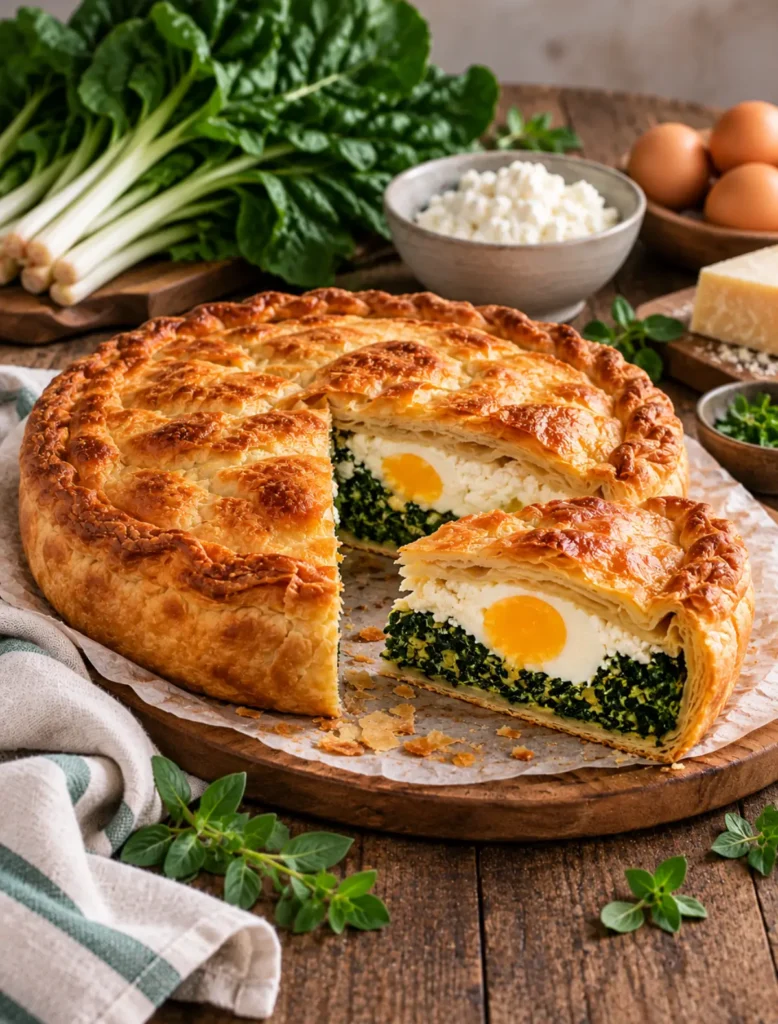
And speaking of Genoese traditions, there is another pie often confused with Torta Pasqualina: Torta Cappuccina. At first glance, the two look remarkably similar, but cutting into them reveals the difference. In Torta Cappuccina, the filling ingredients are mixed together, whereas in Torta Pasqualina the layers remain distinct.
Two different ways of preparing a vegetable pie, each showing just how varied and interesting Ligurian cooking can be.