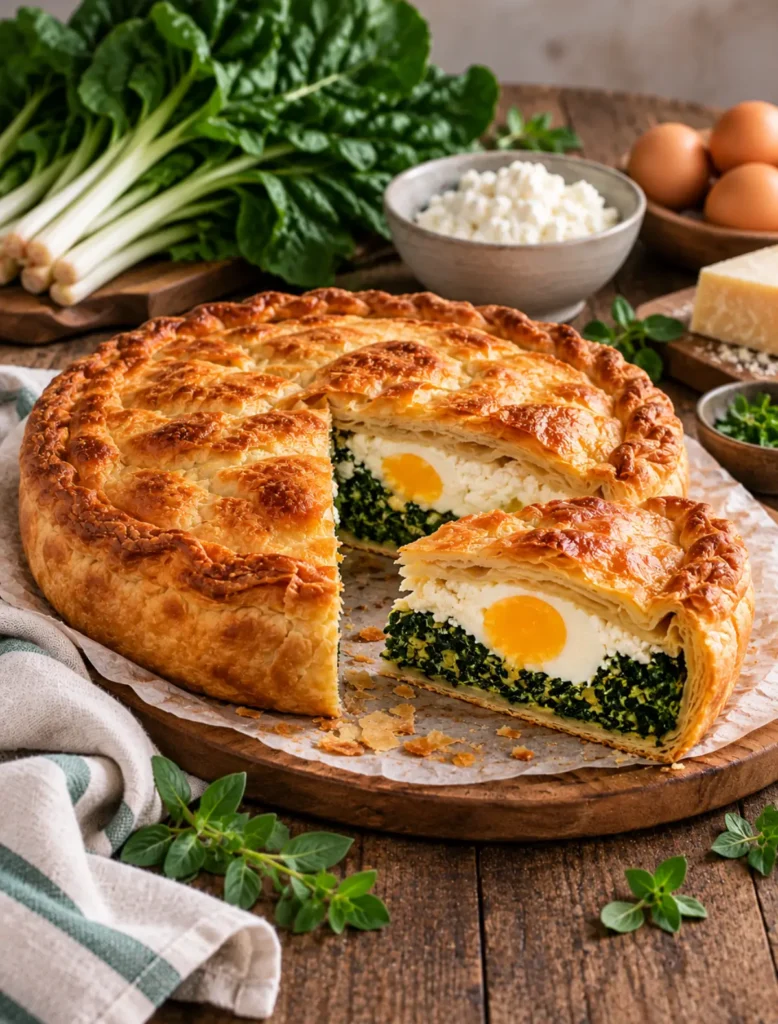
The first thing you notice when cutting into Torta Pasqualina is the eggs. The firm yellow yolks appear between the green Swiss chard and the pale layer of cheese, all enclosed in delicate pastry that breaks gently under the knife. In Genoa, this savoury pie is closely associated with Easter, but it is especially convenient for Easter Monday: it can be prepared ahead, travels well and tastes just as good at room temperature.
For the filling, we use Swiss chard, fresh marjoram and prescinsêua, a traditional Ligurian fresh curd cheese with a slightly tangy flavour. Well-drained ricotta makes a suitable substitute when prescinseua is unavailable, although the flavour will be different. The vegetables and cheese are arranged in separate layers, while whole eggs are placed in hollows made in the filling. This is what creates those distinctive yellow circles when the pie is sliced.
The homemade pastry, known in Italian as pasta matta, is made with flour, water, olive oil and salt, then rolled into exceptionally thin sheets and layered one over another. In the oven, the surface turns golden and crisp while the filling cooks gently inside. Once baked, we let the pie rest before slicing it. Cutting it while it is too hot can cause the slices to fall apart, just when we want to reveal the pattern made by the eggs.
Torta Pasqualina Italian Easter Pie
Description
Torta Pasqualina is a traditional Ligurian savoury pie made with delicate layers of homemade pastry, Swiss chard, prescinseua cheese and whole eggs. Our version keeps the vegetable and cheese fillings separate and is ideal for preparing ahead for Easter or Easter Monday.
Ingredients for a 26 cm (10-inch) round baking pan
For the Pastry
For the Filling
For the Pan and Pastry Layers
Instructions
How to Make Torta Pasqualina
-
Prepare the Homemade Pastry 🥣
Place the Manitoba flour in a large bowl. Add the room-temperature water, 15 g of extra virgin olive oil and a pinch of salt. Mix until a dough begins to form, then transfer it to a work surface and knead for approximately 10 minutes, until smooth, soft and elastic. If the dough initially feels slightly firm, continue kneading rather than adding more flour.
-
Divide the Dough and Let It Rest ⏳
Divide the dough into 6 portions, making the portion for the first pastry sheet slightly larger than the others. Shape each portion into a smooth ball and arrange them on a lightly floured tray. Cover with cling film or a slightly damp kitchen towel to prevent the surface from drying out. Leave to rest at room temperature for 30 minutes.
-
Cook the Swiss Chard 🥬
Wash the Swiss chard thoroughly, remove the toughest parts of the stalks and cut the leaves into strips. Heat a little extra virgin olive oil in a large pan, add the Swiss chard and cook over medium-low heat for approximately 8–10 minutes, stirring frequently.
If necessary, cover the pan for the first few minutes to help the leaves wilt. Then remove the lid and allow the liquid released by the vegetables to evaporate completely.
-
Season the Swiss Chard 🌿
Transfer the cooked Swiss chard to a colander and allow it to cool slightly. If it still contains excess moisture, squeeze it gently, then chop it roughly with a knife.
Place the Swiss chard in a bowl and add the grated Parmigiano Reggiano, finely chopped fresh marjoram, salt and black pepper. Mix well and allow the mixture to cool completely. Do not add eggs to the vegetables.
-
Prepare the Prescinseua 🥣
If the prescinseua contains a significant amount of whey, let it drain briefly in a colander. Transfer it to a bowl and stir gently with a spoon until smooth.
If using ricotta instead, make sure it is thoroughly drained. Keep the cheese separate from the Swiss chard mixture.
-
Roll Out the First Three Pastry Sheets 🫓
Lightly grease a 26–28 cm (10–11 inch) round baking pan with extra virgin olive oil.
Roll out the largest dough portion with a rolling pin until exceptionally thin. The sheet should be large enough to cover the base and sides of the pan, with some pastry extending beyond the rim.
To make it even thinner, gently stretch it over the backs of your lightly oiled hands, taking care not to tear it.
Place the first pastry sheet in the pan and brush it with a very thin layer of olive oil. Roll out two more sheets and place them on top, brushing a little oil between each layer. Do not oil the surface of the third sheet, as it will be in direct contact with the filling.
-
Arrange the Filling in Separate Layers 🥬
Spread the seasoned Swiss chard evenly over the pastry base, smoothing it with the back of a spoon.
Add the prescinseua and carefully spread it over the vegetables, keeping the two layers clearly separate rather than mixing them together.
-
Add the Whole Eggs 🥚
Using the back of a spoon, make 4 evenly spaced hollows in the prescinseua layer.
Crack each egg into a small bowl, one at a time, and gently slide it into a hollow, taking care to keep the yolk intact. Sprinkle the eggs with a little salt.
-
Cover the Pie with the Remaining Pastry 🥧
Roll out the remaining three dough portions into very thin sheets.
Carefully place the first sheet over the filling without pressing down on the eggs, then brush it lightly with olive oil. Add the other two sheets, brushing a thin layer of oil between them. Avoid pressing the pastry layers together, so they can remain slightly separated during baking.
Trim only the excess pastry, then fold the edges inward to create a sealed, rolled border. Lightly brush the surface with olive oil.
If large air pockets form, make one or two small holes in the top pastry, away from the eggs.
-
Bake the Torta Pasqualina 🔥
Preheat the oven to 180°C (350°F), conventional setting.
Place the pan on a lower-middle oven shelf and bake for approximately 50 minutes, checking the colour during the final 10 minutes. The pastry should be golden and crisp, with the base fully cooked.
If the top begins to brown too quickly, loosely cover it with baking parchment without pressing down on the pastry. Extend the baking time slightly if necessary, making sure the filling is fully set.
-
Let the Pie Rest and Serve 🍽️
Remove the Torta Pasqualina from the oven and leave it to cool in the pan for approximately 30 minutes.
Carefully remove it from the pan and slice it with a sharp knife, cutting through the eggs where possible to reveal their distinctive cross-sections.
Serve warm or at room temperature.
Nutrition Facts
Servings 8
- Amount Per Serving
- Calories 350kcal
- % Daily Value *
- Total Fat 18g28%
- Saturated Fat 7g35%
- Sodium 430mg18%
- Total Carbohydrate 32g11%
- Dietary Fiber 3g12%
- Sugars 3g
- Protein 16g32%
* Percent Daily Values are based on a 2,000 calorie diet. Your daily value may be higher or lower depending on your calorie needs.
Note
Prescinseua is a traditional Ligurian fresh curd cheese with a soft texture and slightly tangy flavour. If unavailable, well-drained ricotta can be used, although the resulting pie will have a milder flavour.
Allowing the dough to rest is essential for achieving thin, elastic pastry sheets. If the dough begins to shrink while rolling, let it relax for a few minutes before continuing.
The Swiss chard must be well drained and completely cool before assembling the pie. Excess moisture can prevent the bottom pastry from baking properly.
Torta Pasqualina can be prepared in advance. Once completely cooled, store it in a covered container in the refrigerator for 2–3 days. Before serving, allow it to lose its chill briefly or reheat it gently in the oven.