Note
Ribollita takes time mainly because the cannellini beans need to soak and the soup needs to rest with the bread. Plan to start at least a day ahead. After soaking, cook the beans until tender but not falling apart and keep their cooking water: you will need it both to purée some of the beans and to adjust the consistency of the soup.
Stale, unsalted Tuscan bread is the traditional choice. If you cannot find it, use a rustic bread with a firm crumb, preferably low in salt and at least a couple of days old. Avoid sandwich bread, very soft rolls and enriched breads: once soaked, they will not give the Ribollita the same texture.
During the long cooking of the vegetables, add the bean cooking water gradually. Before the resting stage, the soup needs enough liquid for the bread to absorb, but it should not become brothy.
The following day, the Ribollita will be considerably thicker. Reheat it gently and stir frequently from the bottom. If it has become too dry, add a very small amount of hot water at a time. The finished Ribollita should remain thick, with the bread completely incorporated into the soup.
The registered recipe calls for a little more than half of the cannellini beans to be passed through a sieve. A food mill is a practical alternative; if you do not have one, an immersion blender also works. Add only enough cooking water to produce a pourable purée.
Keywords:
Tuscan Ribollita, Ribollita, Tuscan soup, Italian bread soup, Tuscan kale soup, cannellini bean soup, Italian soup
Artusi and That “Peasant-Style” Soup
In 1891, Pellegrino Artusi published Science in the Kitchen and the Art of Eating Well. Recipe no. 58 is a “Tuscan lean peasant-style soup” (Zuppa toscana di magro alla contadina) that looks remarkably familiar today: white beans, Tuscan kale, cabbage or Savoy cabbage, Swiss chard, potato and stale bread.
As he often does, Artusi has something to say beyond the recipe itself. The rather humble name seems to amuse him, and he remarks that although the soup calls itself “peasant-style”, he is certain everyone, even gentlemen, will enjoy it if it is prepared with due care.
The word Ribollita does not appear. Trying to pin down an exact birth date for the dish quickly becomes difficult anyway. Much earlier, in seventeenth-century Florence, Giovanni Del Turco had already written about a soup of onions and cabbage poured over slices of bread. The recipes are not the same, but bread and cooked vegetables had been sharing the same bowl long before anyone committed a recipe called Ribollita to paper.
In 2001, Ribollita Went to the Notary
The story takes an unusual turn in 2001. The Florence Delegation of the Italian Academy of Cuisine researched Ribollita in Florentine trattorias, compared different preparations and, on 24 May, registered a recipe with a notarial deed.
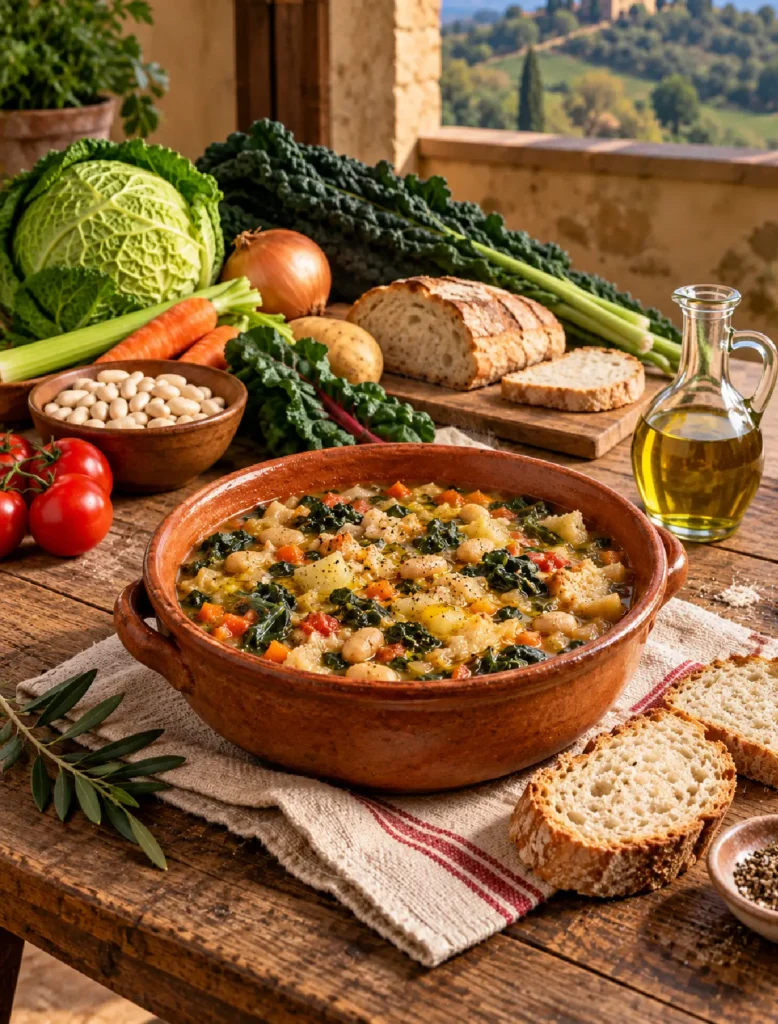
It includes cannellini beans, Tuscan kale, Savoy cabbage, Swiss chard, potatoes, tomatoes, onions, carrots, celery and stale bread. This is the recipe we have chosen as the reference for our version.
Of course, Tuscan families were cooking Ribollita long before a notary became involved. Florence remains the place most closely associated with the dish, while bread soup and related preparations also belong to the tables of other parts of central Tuscany. A home-cooked dish was never likely to emerge from every kitchen in exactly the same way.
And Then There Is Raw Onion
Extra virgin olive oil and black pepper are the more familiar finishing touches. But in Tuscany you may also find fresh raw onion served alongside Ribollita.
Slice it and add a little directly to the bowl. Against the hot, soft and very thick soup, the onion stays crisp and decidedly pungent.
It is not exactly a subtle addition. For those who love it, that is probably the point.