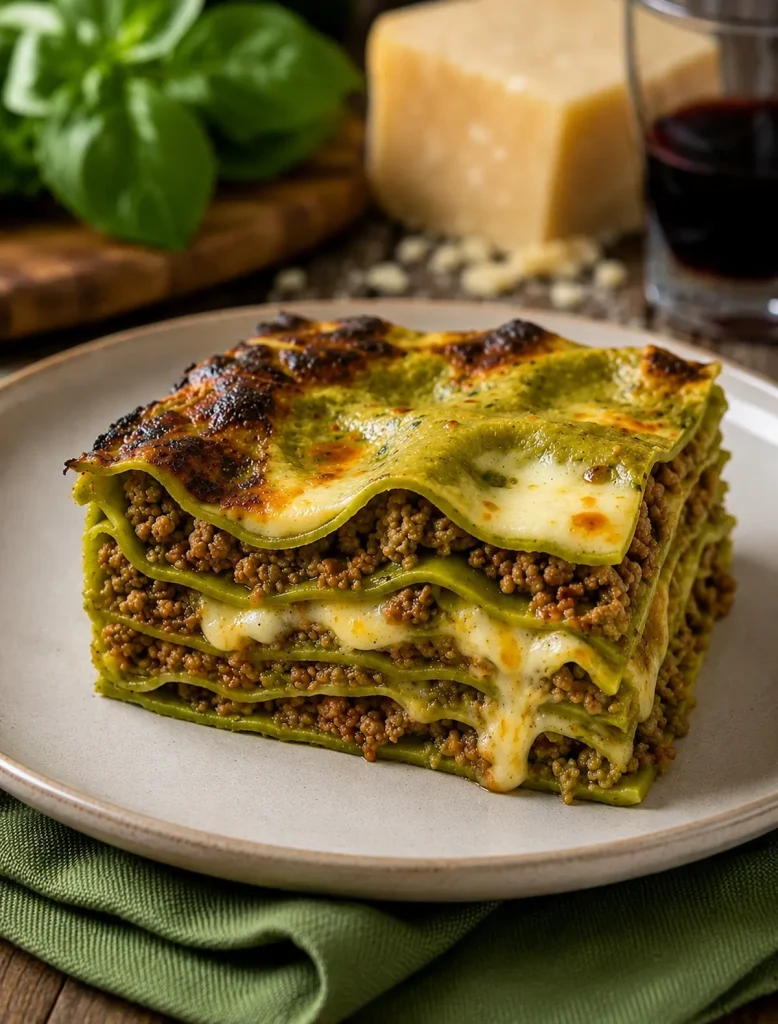
Assemble the Seven Layers of Lasagna 🧱
Use a rectangular baking dish measuring approximately 25 × 30 cm (10 × 12 inches).
Spread a thin layer of béchamel over the bottom of the dish, then add the first layer of green egg pasta.
Spoon over some of the ragù, add a layer of béchamel, and finish with a sprinkling of grated Parmigiano Reggiano.
Continue in the same order — pasta, ragù, béchamel, and Parmigiano — until you have created seven layers of pasta.
Distribute the ingredients evenly without making the individual layers too thick. This keeps the pasta, ragù, and béchamel balanced in every serving.
For the top layer, add a generous amount of ragù and béchamel, then finish with grated Parmigiano Reggiano. As the lasagna bakes, these ingredients will create its characteristic golden, gratinated surface.
5 Bake the Lasagna Until Golden 🔥
Preheat the oven to 180°C (350°F).
Place the baking dish on the center rack and bake for approximately 40 minutes.
During the final few minutes, check the surface. It should be golden and lightly gratinated without burning.
If the top is browning too quickly before the lasagna has finished cooking, loosely cover the baking dish with aluminum foil and continue baking.
6 Let the Lasagna Rest Before Slicing 🍽️
Remove the lasagna from the oven and let it rest for 5–10 minutes before slicing.
This short resting time allows the layers to settle and the ragù and béchamel to thicken slightly, making it easier to cut neat portions without the layers sliding apart.
Slice and serve while still hot.
Servings 6
- Amount Per Serving
- % Daily Value *
- Total Fat 65.4g101%
- Saturated Fat 30.5g153%
- Sodium 1054mg44%
- Total Carbohydrate 72.8g25%
- Dietary Fiber 4.3g18%
- Sugars 9.2g
- Protein 57.8g116%
* Percent Daily Values are based on a 2,000 calorie diet. Your daily value may be higher or lower depending on your calorie needs.
Note
If You Can't Find Green Egg Pasta Sheets
Green egg pasta is one of the defining features of traditional Bolognese Lasagna. If you cannot find it, you can use regular egg pasta sheets instead. The lasagna will still work well, although it will be less faithful to the traditional Bolognese version.
If you prefer to make the pasta from scratch, follow the Green Egg Pasta Sheet recipe.
If You Use Store-Bought Béchamel
You can also make this lasagna with store-bought béchamel sauce. You will need approximately 800 g (30 oz) for this recipe.
The béchamel should be soft and fluid enough to spread easily between the layers. If your store-bought béchamel is too thick, transfer it to a bowl and whisk in a small amount of milk at a time until it reaches the right consistency.
Do not make it too thin: it should spread easily over the pasta without becoming watery.
Give the Ragù Enough Time
Cook the ragù over very low heat for about 2 hours. By the end of cooking, it should be well reduced but not completely dry. Some moisture is important because the sauce helps soften and flavor the pasta as the lasagna bakes.
If the ragù becomes too dry during cooking, add a little water at a time.
How to Store Bolognese Lasagna
You can prepare the lasagna ahead of time and keep it well covered in the refrigerator for 1–2 days.
For longer storage, you can freeze it either before or after baking. In both cases, protect it well from air and use a freezer-safe container.
If freezing baked lasagna, let it cool completely before placing it in the freezer. Thaw it in the refrigerator before reheating thoroughly.
If freezing the assembled lasagna before baking, thaw it in the refrigerator before following the regular baking instructions.
Keywords:
Bolognese lasagna, traditional Bolognese lasagna, green lasagna, green egg pasta lasagna, lasagna alla Bolognese, Bolognese ragù, béchamel sauce, Bolognese cuisine, Emilia-Romagna cuisine, traditional Italian lasagna