Bolognese Lasagna is one of the most iconic dishes of Emilia-Romagna. The traditional recipe brings together four essential components: green egg pasta, Bolognese ragù, béchamel sauce, and Parmigiano Reggiano.
The key to a well-balanced lasagna is getting each of these components right. The ragù should be rich and reduced but not dry, the béchamel should be creamy and fluid enough to spread easily, and the pasta sheets should be thin enough to absorb the sauces as the lasagna bakes.
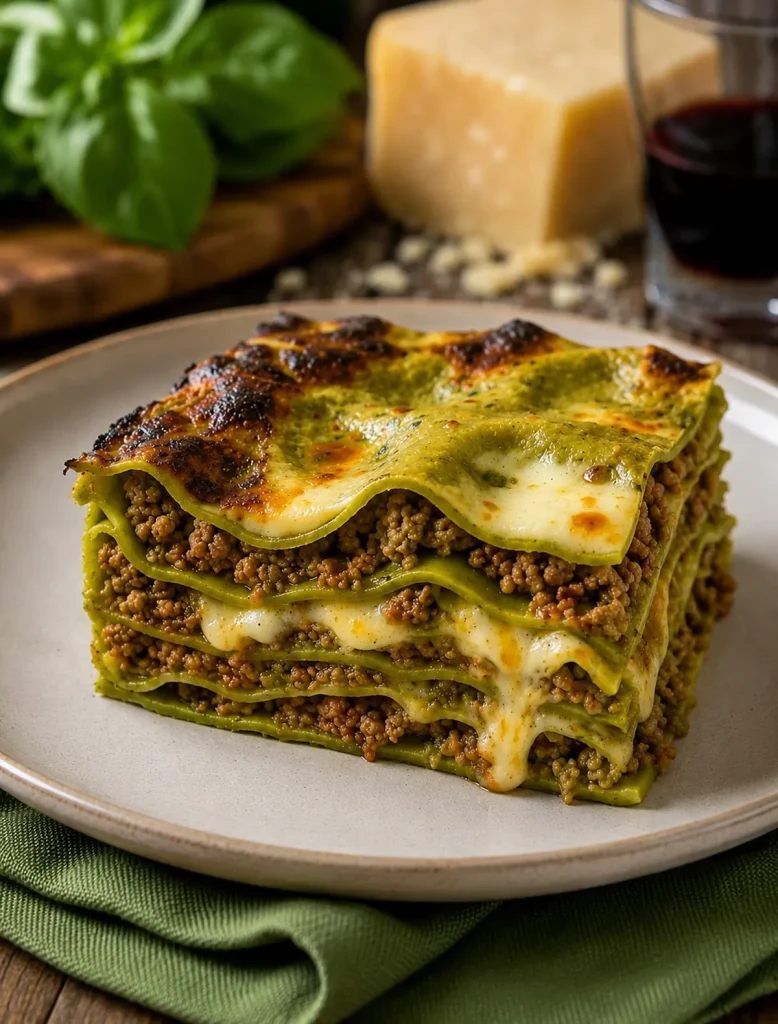
This version is made with seven layers, alternating green pasta sheets with ragù, béchamel, and Parmigiano Reggiano. Baking brings everything together and creates a golden, lightly gratinated surface.
You can buy ready-made green egg pasta sheets or make them from scratch. If you want to prepare your own, follow the Green Egg Pasta Sheet recipe.
Bolognese Lasagna with Spinach Pasta: Traditional Italian Recipe
Description
Bolognese Lasagna is a classic dish from Emilia-Romagna made with green egg pasta, slow-cooked Bolognese ragù, béchamel, and Parmigiano Reggiano. The ingredients are arranged in seven layers and baked until the top is golden and lightly gratinated.
Ingredienti
For the Bolognese Ragù
For the Béchamel Sauce
Per assemblare le lasagne
Instructions
How to Make Bolognese Lasagna with Spinach Pasta
-
Prepare the Bolognese Ragù 🍖
Finely chop the onion, carrot, and celery. Cut the pancetta into small pieces.
Heat the extra virgin olive oil in a large saucepan over medium heat. Add the pancetta and cook slowly until it has released some of its fat and is lightly browned.
Add the chopped vegetables, reduce the heat, and cook gently, stirring occasionally, until they are soft. Do not let them burn, especially the onion, as excessive browning can add a bitter note to the ragù.
Add the ground beef and pork. Break up the meat thoroughly with a wooden spoon and cook until the liquid released by the meat has evaporated and the meat is well browned.
Pour in the red wine and let it evaporate completely. Before moving on, make sure you can no longer smell the sharp aroma of alcohol.
Add the tomato passata and warm vegetable broth. If you are using water instead of broth, pour the measured water into the empty passata bottle, shake it to collect any tomato left inside, and add it to the ragù.
Stir, partially cover the saucepan, and cook over very low heat for about 2 hours. Check the ragù occasionally and, if it becomes too dry before it is ready, add a little water at a time.
During the last few minutes of cooking, add the milk and stir well. Let it cook briefly, then season with salt.
The ragù is ready when it is thick and well reduced but still moist enough to spread easily between the layers of pasta.
-
Prepare a Smooth and Creamy Béchamel 🥛
While the ragù is cooking, prepare the béchamel.
Melt the butter in a saucepan over low heat. Add all the flour and immediately whisk until you have a smooth, lump-free mixture.
Gradually pour in the milk while continuing to whisk. Move the whisk in the same direction throughout, and continue stirring over low heat until the béchamel is creamy and fluid enough to spread easily between the layers.
Season with salt and, if using it, add a small amount of ground nutmeg. Whisk briefly until the sauce is completely smooth.
Transfer the béchamel to a bowl and cover the surface directly with plastic wrap to prevent a skin from forming.
-
Prepare the Pasta, Béchamel, and Parmigiano for Assembly 🧀
Once the ragù and béchamel are ready, prepare everything you need to assemble the lasagna.
If the béchamel has cooled and become too thick, whisk it briefly. If necessary, add a small splash of milk to bring it back to a soft, easily spreadable consistency.
Have the green egg pasta sheets and grated Parmigiano Reggiano ready before you begin assembling the layers.
-
Assemble the Seven Layers of Lasagna 🧱
Use a rectangular baking dish measuring approximately 25 × 30 cm (10 × 12 inches).
Spread a thin layer of béchamel over the bottom of the dish, then add the first layer of green egg pasta.
Spoon over some of the ragù, add a layer of béchamel, and finish with a sprinkling of grated Parmigiano Reggiano.
Continue in the same order — pasta, ragù, béchamel, and Parmigiano — until you have created seven layers of pasta.
Distribute the ingredients evenly without making the individual layers too thick. This keeps the pasta, ragù, and béchamel balanced in every serving.
For the top layer, add a generous amount of ragù and béchamel, then finish with grated Parmigiano Reggiano. As the lasagna bakes, these ingredients will create its characteristic golden, gratinated surface.
-
Bake the Lasagna Until Golden 🔥
Preheat the oven to 180°C (350°F).
Place the baking dish on the center rack and bake for approximately 40 minutes.
During the final few minutes, check the surface. It should be golden and lightly gratinated without burning.
If the top is browning too quickly before the lasagna has finished cooking, loosely cover the baking dish with aluminum foil and continue baking.
-
Let the Lasagna Rest Before Slicing 🍽️
Remove the lasagna from the oven and let it rest for 5–10 minutes before slicing.
This short resting time allows the layers to settle and the ragù and béchamel to thicken slightly, making it easier to cut neat portions without the layers sliding apart.
Slice and serve while still hot.
Nutrition Facts
Servings 6
- Amount Per Serving
- Calories 1121kcal
- % Daily Value *
- Total Fat 65.4g101%
- Saturated Fat 30.5g153%
- Sodium 1054mg44%
- Total Carbohydrate 72.8g25%
- Dietary Fiber 4.3g18%
- Sugars 9.2g
- Protein 57.8g116%
* Percent Daily Values are based on a 2,000 calorie diet. Your daily value may be higher or lower depending on your calorie needs.
Note
If You Can't Find Green Egg Pasta Sheets
Green egg pasta is one of the defining features of traditional Bolognese Lasagna. If you cannot find it, you can use regular egg pasta sheets instead. The lasagna will still work well, although it will be less faithful to the traditional Bolognese version.
If you prefer to make the pasta from scratch, follow the Green Egg Pasta Sheet recipe.
If You Use Store-Bought Béchamel
You can also make this lasagna with store-bought béchamel sauce. You will need approximately 800 g (30 oz) for this recipe.
The béchamel should be soft and fluid enough to spread easily between the layers. If your store-bought béchamel is too thick, transfer it to a bowl and whisk in a small amount of milk at a time until it reaches the right consistency.
Do not make it too thin: it should spread easily over the pasta without becoming watery.
Give the Ragù Enough Time
Cook the ragù over very low heat for about 2 hours. By the end of cooking, it should be well reduced but not completely dry. Some moisture is important because the sauce helps soften and flavor the pasta as the lasagna bakes.
If the ragù becomes too dry during cooking, add a little water at a time.
How to Store Bolognese Lasagna
You can prepare the lasagna ahead of time and keep it well covered in the refrigerator for 1–2 days.
For longer storage, you can freeze it either before or after baking. In both cases, protect it well from air and use a freezer-safe container.
If freezing baked lasagna, let it cool completely before placing it in the freezer. Thaw it in the refrigerator before reheating thoroughly.
If freezing the assembled lasagna before baking, thaw it in the refrigerator before following the regular baking instructions.