Note
Choosing the Wine
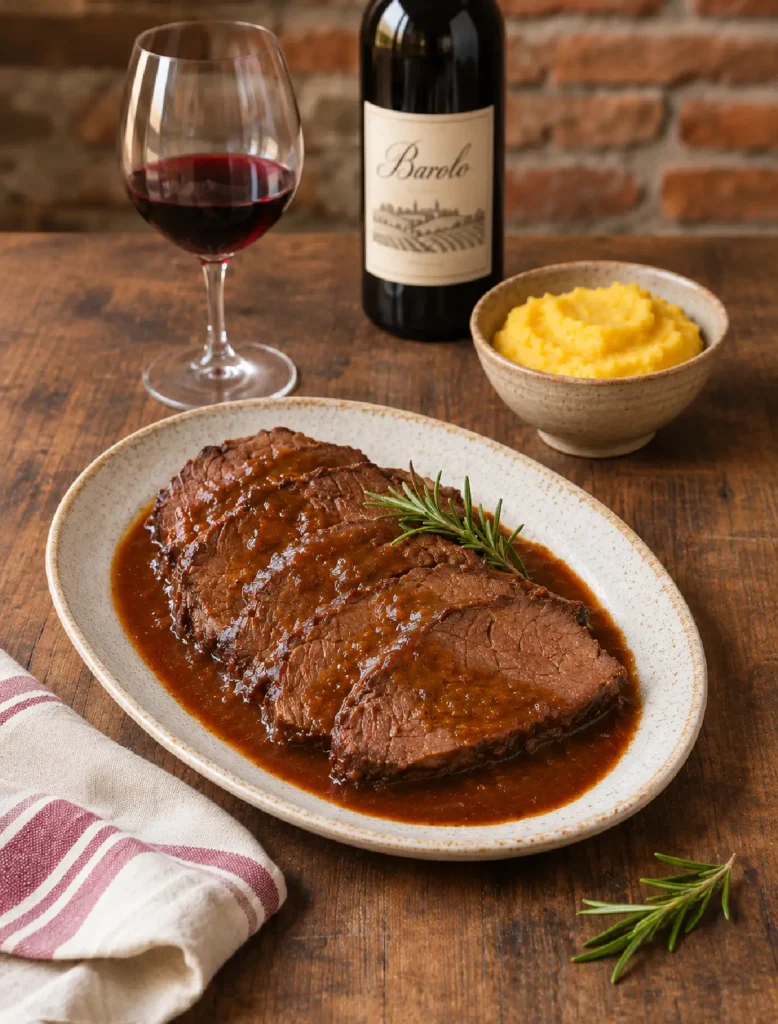
For an authentic Brasato al Barolo, the wine should be Barolo DOCG. There's no need to buy a particularly expensive bottle, but choose a wine of good quality, as its flavour will influence the finished sauce.
If you prefer a less expensive alternative, try Langhe Nebbiolo or Barbera d'Asti. Both can produce an excellent Italian red wine braised beef, although the dish would no longer strictly be Brasato al Barolo.
Alternatives to Cappello del Prete
Cappello del prete is particularly suitable for this recipe, but other beef cuts with enough connective tissue for slow cooking can also work.
In English-speaking countries, beef chuck roast is a practical alternative. Depending on local butchery terminology, certain cuts sold as blade roast or shoulder roast may also be suitable. These names are not always exact equivalents of the Italian cut.
In the UK, beef shin is another option for slow braising, although its shape and texture differ from cappello del prete.
👉 For a closer look at the different cuts, their characteristics and their names in other countries, read our article Which Beef Cut Is Best for Braising?
Making It Ahead
Brasato al Barolo is an excellent dish to prepare a day in advance. Once cooled, refrigerate it with its cooking sauce, preferably keeping the beef whole.
The following day, the chilled meat will also be easier to slice neatly.
To serve, slice the beef and gently reheat it in the sauce, avoiding prolonged boiling.
Storage
Store cooked Brasato al Barolo in an airtight container in the refrigerator, together with its sauce, for 2–3 days. Cool it promptly and refrigerate within 2 hours of cooking.
You can also freeze the beef, either whole or sliced, with its cooking sauce. For best quality, use within 2–3 months.
Thaw in the refrigerator and reheat thoroughly before serving.
What to Serve with Brasato al Barolo
Polenta is one of the most traditional accompaniments. Mashed potatoes, roast potatoes or chestnut purée also work well, especially during autumn and winter.
Keywords:
Italian red wine braised beef, Brasato al Barolo, Piedmontese beef stew, Barolo braised beef, Italian braised beef
From Glowing Embers to Piedmontese Tables
The Italian word brasato preserves a memory of a very different way of cooking. In older kitchens, meat could spend hours in a covered pot, with glowing embers placed underneath and sometimes even on top of the lid. Heat reached the pot gradually, long before cooks could adjust a flame with the precision of a modern stove.
The technique wasn't exclusive to Piedmont. French cooking has its own long tradition of braised meats, prepared slowly in covered vessels. What gave the Piedmontese version its particular identity was the wine, and not just any wine.
Barolo is now recognised far beyond Italy, but much of its reputation took shape during the nineteenth century. Two names regularly appear in that history: Giulia Colbert Falletti, the Marchioness of Barolo, and Camillo Benso, Count of Cavour. Both were connected, in different ways, with the development of winemaking in the Langhe hills. It was a period of significant change for Nebbiolo grapes and the wines produced from them.
There is no established date for the invention of Brasato al Barolo. Finding one would probably be difficult anyway. Cooking meat in wine was already a familiar practice, while Barolo was gradually gaining prestige. Bringing the two together didn't necessarily require someone to invent an entirely new recipe.
Did Cavour Really Eat Brasato al Barolo?
An intriguing story still circulates in Piedmontese culinary writing. On 29 April 1859, after rejecting the Austrian ultimatum demanding that the Kingdom of Sardinia disarm, Cavour is said to have celebrated with Brasato al Barolo.
The date itself matters in Italian history. The Second Italian War of Independence was about to begin. But when it comes to what Cavour actually ate that day, the evidence becomes much less certain.
The story of the celebratory brasato is often repeated, yet there is no sufficiently reliable historical testimony to establish that the Count really enjoyed this particular dish on that occasion.
His connection with Piedmontese wine is much better documented. At his Grinzane estate, where he also served as mayor for several years, Cavour took an interest in wine production. That helps explain why his name appears so frequently in accounts of Barolo's history.
A Wine with Strict Rules, a Dish Without a Single Recipe
Curiously, Barolo wine and the dish that bears its name have followed very different paths.
Barolo received DOC recognition in 1966 and DOCG status in 1980. Today, its production is governed by detailed regulations covering the use of Nebbiolo grapes, the geographical production area, winemaking and ageing requirements.
Nothing comparable exists for Brasato al Barolo. There is no single binding recipe requiring every Piedmontese household or cook to use exactly the same ingredients.
Versions differ, yet the dish remains recognisable. Wine has established part of its identity through written regulations; brasato has continued to live, above all, in people's kitchens.