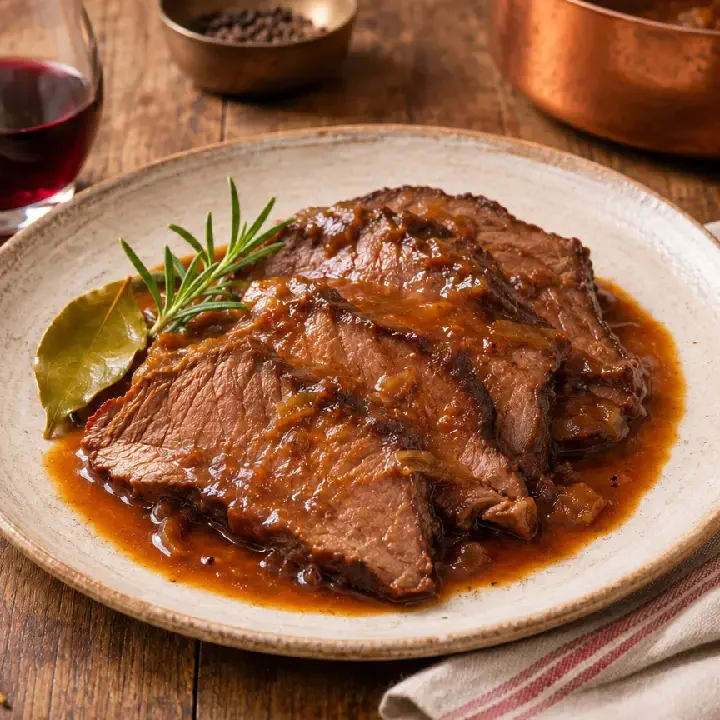
Choosing the right beef for a slow-cooked dish is not always as straightforward as it seems. One butcher might recommend chuck roast, another feather blade, while someone else will insist that beef cheeks produce the most tender result. All three can be excellent choices, but they won’t give you the same dish.
In Italian cooking, brasato is a whole cut of beef slowly cooked with wine, vegetables and aromatics, then usually sliced and served with its cooking sauce. It shares many characteristics with braised beef and American pot roast, although the ingredients and preparation can differ.
For a traditional Italian brasato that is tender enough to eat with a fork but still holds together when sliced, we would choose cappello del prete, a cut from the shoulder. In the United States, whole top blade roast is a useful cut to look for, while British butchers may recognise it as feather blade.
But there are other good options. Chuck roast, beef shin, beef cheeks and even some leaner cuts can all work, provided we understand how they behave during a long, gentle cook.
The important differences lie in the muscle structure, the amount of connective tissue, the distribution of fat and what happens to these elements as the beef cooks.
Top Blade Roast: The Italian Cappello del Prete
Cappello del prete is one of the cuts most closely associated with Italian brasato, particularly versions prepared with red wine. It comes from the shoulder and has a distinctive seam of connective tissue running through the muscle.
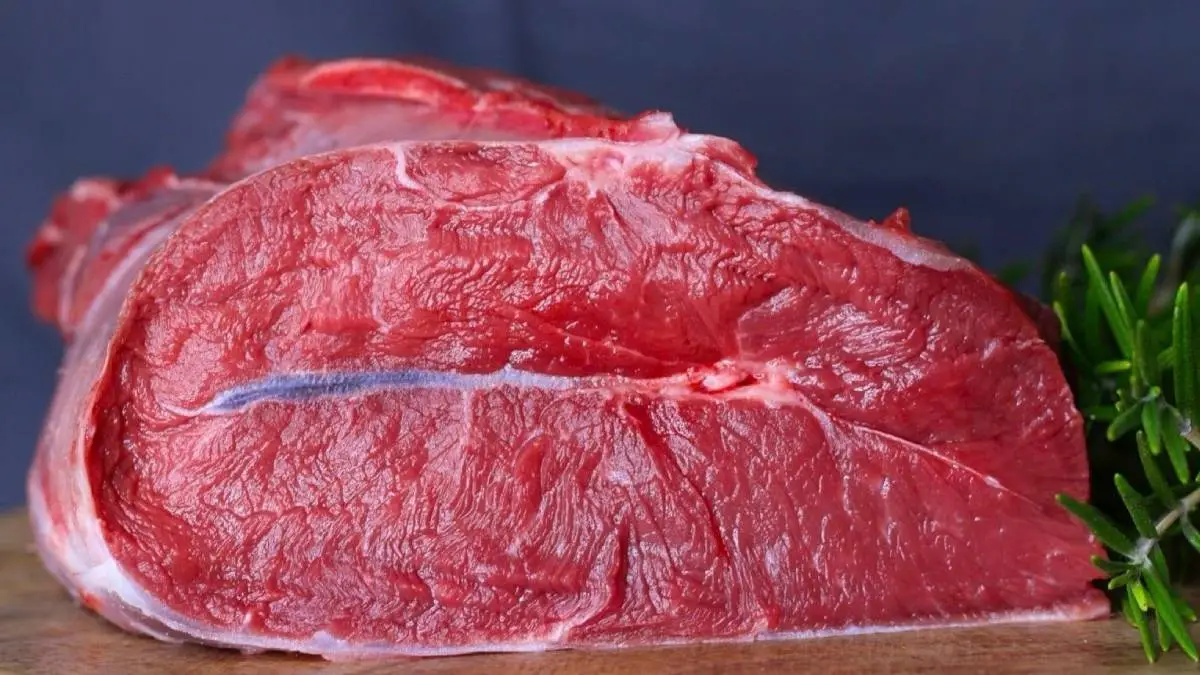
At first glance, that pale strip might look like something the butcher should remove. During slow, moist cooking, however, some of its collagen gradually converts into gelatin, contributing to the texture of the beef and its cooking sauce.
The cut has another advantage: it can be cooked whole and sliced into fairly neat portions once tender. That matters when we want to serve traditional brasato with a rich sauce, rather than meat that falls apart completely.
It is a recurring choice in the Barolo wine-braised beef recipes published by La Cucina Italiana.
That doesn’t mean it is impossible to overcook. Even a cut with plenty of connective tissue can become dry if subjected to excessive heat or cooked for too long.
What Should You Ask for Outside Italy?
In the United States, look for a whole top blade roast. In the United Kingdom, feather blade is a useful term.
These names are helpful starting points rather than guarantees that the meat has been cut and trimmed in exactly the same way as an Italian cappello del prete.
If neither is available, a suitable chuck roast can be a practical alternative. Explain to the butcher that you want a whole piece of beef for slow braising, ideally one that will remain firm enough to slice.
What Other Beef Cuts Work Well for Braising?
Not every braised beef dish needs the same texture. Some cuts produce neat slices, while others become so tender that they separate with a fork.
This is why choosing the cut should begin with the result we want on the plate.
Chuck Roast: An Alternative to Italian Reale di Manzo
Chuck comes from the front of the animal, primarily the shoulder and nearby muscles. It is widely used for braising and pot roast, particularly in North America.
In Italy, reale di manzo is one of the cuts worth considering for a similar result. It comes from the front of the animal, around the neck and rib region, although its precise boundaries and name can vary between Italian butchery traditions.
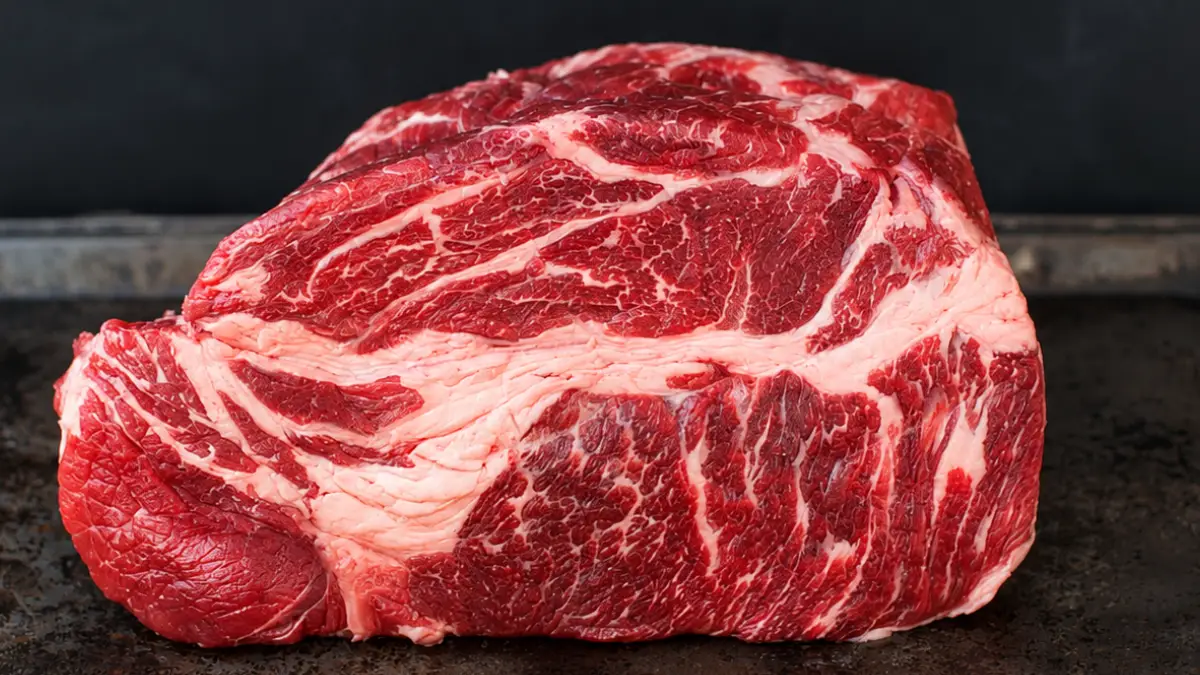
Depending on the specific cut, chuck and reale can contain a generous amount of connective tissue and fat distributed between different muscles. These characteristics make them well suited to slow cooking.
A suitable chuck roast may become beautifully tender, although its different muscles and seams can make the slices less uniform than those of a whole top blade roast.
We would choose these cuts for a hearty, flavourful braise where perfectly shaped slices are less important than tenderness and a rich cooking sauce.
The names chuck roast and reale di manzo are useful points of comparison, but they do not describe an exact anatomical match.
Other Beef Shoulder Cuts for Braising
The beef shoulder contains several muscles, each with different characteristics.
In Italian butcher shops, cuts such as brione may be suggested as alternatives to cappello del prete. Their suitability depends on the specific muscle and how the butcher has prepared it.
Outside Italy, there is little benefit in trying to translate every regional name literally.
Instead, ask for a whole shoulder cut suitable for slow cooking, with enough connective tissue to become tender while retaining some structure.
If you want to serve the finished beef in slices, mention that before buying it. A cut that works beautifully for pulled or shredded beef may not be the best choice for a traditional sliced brasato.
Beef Shin or Shank: A Cut Rich in Connective Tissue
Italian butchery names can be confusing, especially when the same cut is sold under different regional names.
Geretto, also commonly called stinco, comes from the lower part of the animal’s legs. It can be taken from either the front or hind leg and is generally known as beef shin in the United Kingdom or beef shank in the United States.
The Italian term muscolo is often used for the meaty portion of this cut, particularly when sold boneless. However, depending on the regional classification, it can also refer to other muscles from the shoulder or hindquarter.
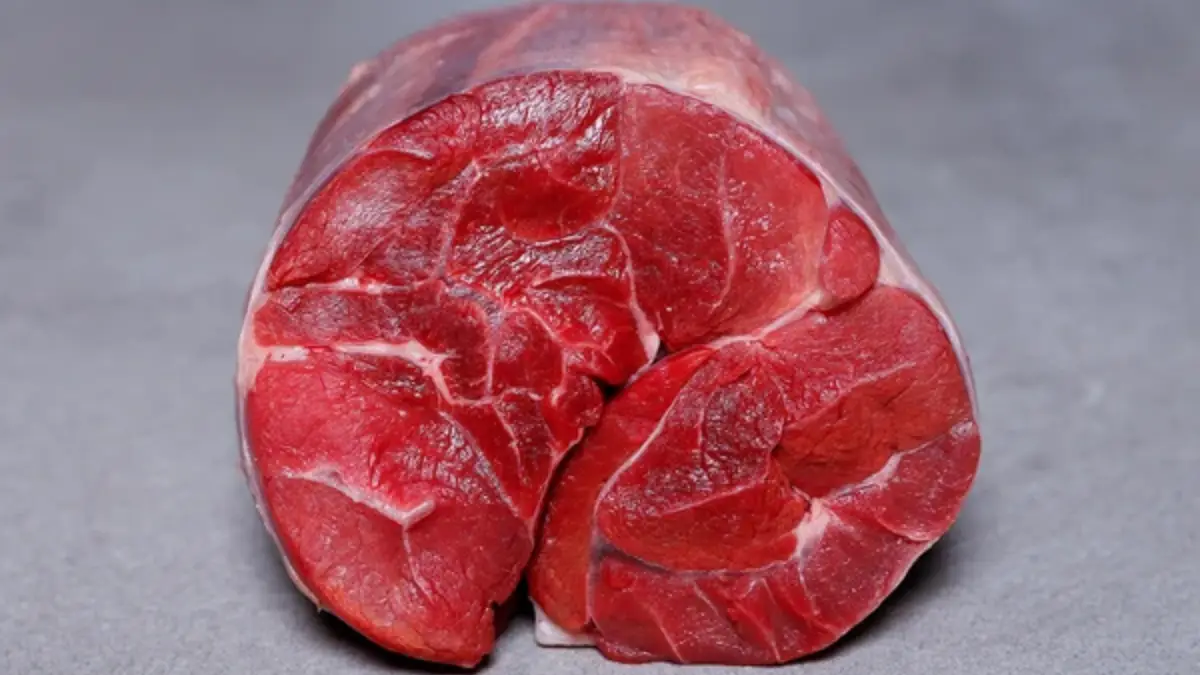
The photograph shows a boneless beef shin or shank, the type of cut we would look for when preparing a whole braised beef roast. The same cut can also be sold with the bone left in, while Italian butchers may use the name muscolo di manzo for the boneless meat.
Shin and shank contain substantial amounts of connective tissue. During prolonged, moist cooking, some of the collagen gradually converts into gelatin, helping the meat soften and giving the cooking liquid a fuller texture.
When the shank is cut crosswise with the bone left in, it produces the familiar cuts used for ossobuco. For a whole braised beef roast that we intend to slice, we can instead ask the butcher for a boneless beef shank, ideally tied to help it retain its shape.
The finished result will still differ from a traditional brasato made with cappello del prete. The meat may have a more irregular structure and can separate into fibres as it becomes tender.
We wouldn’t make it our first choice for neat slices, but it is excellent when we want very soft beef and a deeply flavoured sauce.
Beef Cheeks: Exceptionally Tender, but a Different Result
Beef cheeks are among the most rewarding cuts for slow braising.
The cheek muscles are used extensively by the animal and contain substantial connective tissue. With enough time and gentle heat, they can become remarkably soft.
The finished meat often has an almost melting texture, while the cooking sauce becomes rich and gelatinous.
But beef cheeks are not a direct replacement for cappello del prete.
Braised beef cheeks make an excellent dish in their own right, yet their shape and texture differ from a traditional Italian brasato served in slices.
If tenderness and a luxurious sauce matter more than presentation, however, they are well worth considering.
Can You Use Lean Beef Cuts for Braising?
Not all beef used for brasato comes from the shoulder or leg.
Italian recipes sometimes call for noce, a relatively lean cut from the hindquarter. Other lean cuts, including girello, are also used in certain preparations.
These cuts tend to have a more uniform shape and can produce tidy slices. Their main limitation is that they generally contain less connective tissue and intramuscular fat than many shoulder cuts.
That doesn’t make them unsuitable for braising.
A lean cut can become tender with appropriate cooking, but it often offers less margin for error. If cooked too aggressively or for too long, the muscle fibres may lose considerable moisture, leaving the meat dry even when surrounded by sauce.
In English-speaking countries, some cuts sold as beef round or silverside may be used for slow cooking, although their precise characteristics vary.
We would therefore avoid treating all lean cuts as interchangeable.
If we were choosing between a lean round roast and a well-marbled shoulder cut for our first Italian brasato, we would generally prefer the shoulder.
Why Does Connective Tissue Matter So Much?
A cut that is naturally tender when raw is not necessarily the best choice for a long braise.
It sounds contradictory until we consider what happens to the meat during cooking.
Muscles that perform more work often contain greater amounts of connective tissue. One of its main structural proteins is collagen.
During prolonged cooking with heat and moisture, some collagen gradually converts into gelatin. This is one reason why cuts that initially seem tough can become pleasantly tender.
But there is a limit.
While connective tissue softens, muscle fibres also contract and lose water. Cooking beef for longer does not automatically make it juicier.
It is possible to produce meat that falls apart easily but tastes dry when eaten without sauce. The sauce can improve the eating experience, but it cannot restore all the moisture lost from the fibres.
This is why a good braising cut still needs gentle cooking. A vigorous boil can be just as unhelpful for chuck roast as it is for cappello del prete.
How to Choose Beef for Braising at the Butcher
When buying beef for braising, the leanest and most expensive piece is not necessarily the best option.
Look at the structure of the meat.
Some intramuscular fat can contribute to a pleasant eating texture, while connective tissue is especially useful in cuts intended for long cooking.
For traditional sliced brasato, we prefer a whole piece of beef with a reasonably even thickness. Very thin sections may cook faster than the centre, making it harder to achieve a consistent result.
The size also matters.
For approximately four to six servings, a boneless roast weighing around 1–1.5 kg (2.2–3.3 lb) is often practical, although the ideal quantity depends on the cut and the portions you want to serve.
If your butcher doesn’t recognise the word brasato, there is no need for a complicated explanation.
You can simply ask for a whole beef roast suitable for slow cooking in wine and stock, with enough structure to be sliced after cooking.
That tells the butcher far more than asking for any cut suitable for a stew.
Beef Cut Names in Italy, the UK and the US
One of the difficulties of following an Italian brasato recipe abroad is that beef cuts do not always have direct translations.
Butchery systems differ between countries, and even familiar terms can refer to cuts prepared in different ways.
Here are the most useful names to know.
Cappello del prete: Look for whole top blade roast in the United States or feather blade in the United Kingdom. The aim is to find a whole shoulder muscle suitable for slow cooking, ideally retaining its characteristic connective tissue seam.
Reale di manzo: A suitable chuck roast is often a practical alternative, although chuck covers a broad range of muscles and is not an exact translation of reale.
Muscolo, stinco or geretto: Stinco and geretto generally refer to the lower leg cut known as beef shin in British English and beef shank in American English. The Italian term muscolo may refer to its boneless meaty portion, but can also be used more broadly. For a whole roast intended for slicing, ask for a boneless piece suitable for slow braising.
Guancia di manzo: This is beef cheek in English. The correspondence is relatively straightforward, and the cut is widely used for braising.
Punta di petto: Usually known as brisket. Its thickness, fat content and trimming can vary considerably, so it is worth checking exactly which portion is being sold.
Is Flat Iron Steak the Same as Cappello del Prete?
This is an important distinction, especially when shopping in the United States.
Flat iron steak comes from the same top blade muscle associated with cappello del prete. However, it is normally prepared by removing the central connective tissue seam and dividing the muscle into steaks.
That makes it a different product, generally intended for quicker cooking.
For a traditional Italian brasato, we would look for a whole top blade roast rather than individual flat iron steaks.
In the UK, feather blade is a useful name to ask for, but it is still worth checking how the butcher has trimmed the meat.
Braised Beef, Pot Roast and Italian Brasato: What’s the Difference?
The terms overlap, but they do not always describe identical dishes.
Braising is a cooking method in which food is cooked slowly in a covered vessel with a relatively small amount of liquid. The technique is used in many cuisines.
Pot roast is especially familiar in North America and generally refers to a whole piece of beef slowly cooked with liquid, often alongside vegetables.
Italian brasato follows the same broad principle, but wine, aromatics and regional traditions play an important role in its character. Brasato al Barolo, for example, is closely associated with Piedmont and uses Barolo wine as a defining ingredient.
For readers outside Italy, thinking of brasato as an Italian wine-braised beef roast is a useful starting point.
The cooking methods are related, but the flavour and presentation depend on the recipe.
Which Beef Cut Should You Choose?
If we want traditional Italian brasato with tender slices that still hold their shape, cappello del prete is our preferred choice.
Outside Italy, a whole top blade roast or feather blade is worth looking for first. A suitable chuck roast is a practical alternative, especially when a richer, more rustic texture is welcome.
Boneless beef shin or shank and beef cheeks are excellent when we want exceptionally soft meat and a gelatinous sauce, even if the finished dish looks different from classic sliced brasato.
Leaner cuts, such as those from the round, can also be braised, but they require greater attention to cooking time and temperature.
There is no single cut that produces the best result in every recipe. The right choice depends on whether we want neat slices, meat that falls apart with a fork, or a particularly rich sauce.
Knowing that difference makes choosing beef at the butcher much easier.