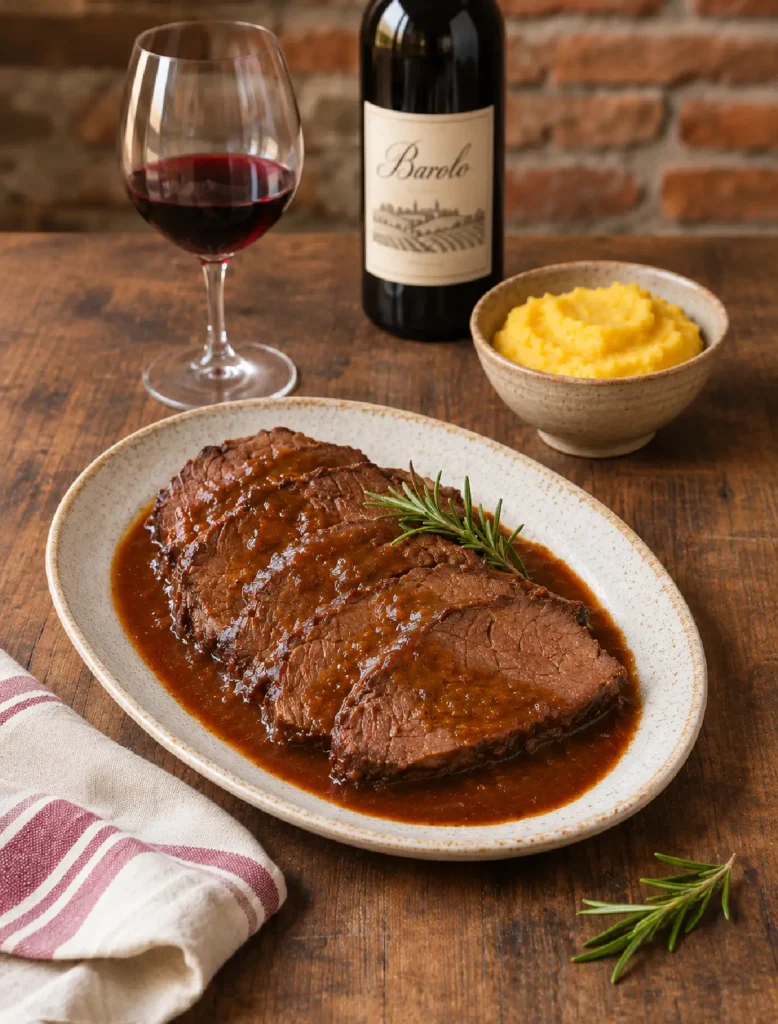
You can recognise a good Brasato al Barolo as soon as you start slicing it. The beef yields easily to the knife, the slices stay tender, and a dark sauce made from wine and vegetables spreads across the plate. It’s not something you can decide to make at the last minute. Between marinating and cooking, you’ll need to allow plenty of time.
We use cappello del prete, an Italian beef cut with a seam of connective tissue running through it. During the long cooking process, that tissue softens and helps give the meat its tender texture. We leave the beef overnight in Barolo wine with celery, carrot, onion, thyme and rosemary. Before cooking, we pat it dry so it can brown properly rather than steam in the remaining marinade. The wine goes into the pot afterwards, along with the vegetables. From there, it’s mostly a matter of keeping the heat low and giving the beef enough time.
Once cooked, the beef needs a short rest before slicing. Meanwhile, we turn the cooking juices and vegetables into a sauce to spoon over the meat. In Piedmont, Brasato al Barolo is often served with polenta, although a simple bowl of mashed potatoes works just as well.
Brasato al Barolo
Description
Beef marinated overnight in Barolo wine with vegetables and herbs, then browned and slowly braised until tender. Served in slices with a rich sauce made from the cooking juices.
Ingredients
For the Marinade
For Cooking
Instructions
How to Make Brasato al Barolo
-
Prepare the Vegetables 🥕
Wash the celery and carrot, peel the onion and cut all the vegetables into large pieces. Place the beef in a large glass or stainless-steel container, then add the vegetables, thyme and rosemary.
-
Marinate the Beef 🍷
Pour the Barolo wine into the container, trying to submerge the beef completely. Cover and refrigerate for 12 hours. If the wine doesn't fully cover the meat, turn it a couple of times during marinating.
-
Drain and Dry the Beef 🥩
Remove the beef from the marinade and pat it thoroughly dry with kitchen paper. Strain the wine through a sieve and set it aside, keeping the vegetables and herbs separately. Don't discard anything, as everything will be used during cooking.
-
Brown the Beef 🔥
Choose a heavy-bottomed casserole or Dutch oven large enough to hold the beef without leaving too much space around it. Heat a little extra virgin olive oil and brown the meat on all sides, turning it with tongs or two spatulas.
Allow approximately 8–10 minutes, adjusting the heat so the surface develops a deep brown colour without burning.
-
Add the Vegetables 🧅
Temporarily remove the beef from the casserole and place it on a plate. Add the drained vegetables to the same pot and cook for a few minutes, stirring until they begin to soften and take on some colour.
Return the beef to the casserole and add the thyme and rosemary.
-
Add the Barolo and Begin Cooking 🍲
Pour in the reserved marinade, bring it to a boil and let it boil for a few minutes. Reduce the heat, add a little salt and cover with the lid.
The liquid should barely simmer, with only occasional small bubbles rather than a vigorous boil.
-
Slowly Braise the Beef ⏳
Cook for approximately 3 hours, turning the beef every 40–45 minutes. Check the cooking liquid occasionally. If it reduces too much, add a little hot water to prevent the vegetables from sticking to the bottom.
Keep the heat low and steady throughout.
After 3 hours, test the beef by inserting a fork or long skewer into the thickest part. If you still feel considerable resistance, continue cooking for another 20–30 minutes before checking again.
The exact cooking time will depend on the shape and thickness of the beef.
-
Prepare the Sauce 🥣
Once the beef is tender, remove it from the casserole and place it on a cutting board. Loosely cover it with a sheet of aluminium foil, resting the foil over the meat without wrapping it completely, and leave it to rest while you prepare the sauce.
Remove the thyme and rosemary stems from the cooking liquid. Blend the vegetables and juices with an immersion blender until smooth.
If the sauce is too thin, simmer it uncovered for a few minutes to reduce. If it's too thick, add a little hot water. Taste and adjust the salt and black pepper.
-
Slice and Serve the Beef 🍽️
Allow the beef to rest for a total of approximately 10–15 minutes before cutting it into slices about 1 cm thick, slicing against the grain.
Arrange the slices on a serving platter and spoon the hot sauce over them. Serve Brasato al Barolo with polenta or mashed potatoes.
Nutrition Facts
Servings 4
- Amount Per Serving
- Calories 600kcal
- % Daily Value *
- Total Fat 32g50%
- Saturated Fat 11g56%
- Sodium 350mg15%
- Total Carbohydrate 8g3%
- Dietary Fiber 1g4%
- Sugars 3g
- Protein 52g104%
* Percent Daily Values are based on a 2,000 calorie diet. Your daily value may be higher or lower depending on your calorie needs.
Note
Choosing the Wine
For an authentic Brasato al Barolo, the wine should be Barolo DOCG. There's no need to buy a particularly expensive bottle, but choose a wine of good quality, as its flavour will influence the finished sauce.
If you prefer a less expensive alternative, try Langhe Nebbiolo or Barbera d'Asti. Both can produce an excellent Italian red wine braised beef, although the dish would no longer strictly be Brasato al Barolo.
Alternatives to Cappello del Prete
Cappello del prete is particularly suitable for this recipe, but other beef cuts with enough connective tissue for slow cooking can also work.
In English-speaking countries, beef chuck roast is a practical alternative. Depending on local butchery terminology, certain cuts sold as blade roast or shoulder roast may also be suitable. These names are not always exact equivalents of the Italian cut.
In the UK, beef shin is another option for slow braising, although its shape and texture differ from cappello del prete.
Making It Ahead
Brasato al Barolo is an excellent dish to prepare a day in advance. Once cooled, refrigerate it with its cooking sauce, preferably keeping the beef whole.
The following day, the chilled meat will also be easier to slice neatly.
To serve, slice the beef and gently reheat it in the sauce, avoiding prolonged boiling.
Storage
Store cooked Brasato al Barolo in an airtight container in the refrigerator, together with its sauce, for 2–3 days. Cool it promptly and refrigerate within 2 hours of cooking.
You can also freeze the beef, either whole or sliced, with its cooking sauce. For best quality, use within 2–3 months.
Thaw in the refrigerator and reheat thoroughly before serving.
What to Serve with Brasato al Barolo
Polenta is one of the most traditional accompaniments. Mashed potatoes, roast potatoes or chestnut purée also work well, especially during autumn and winter.