
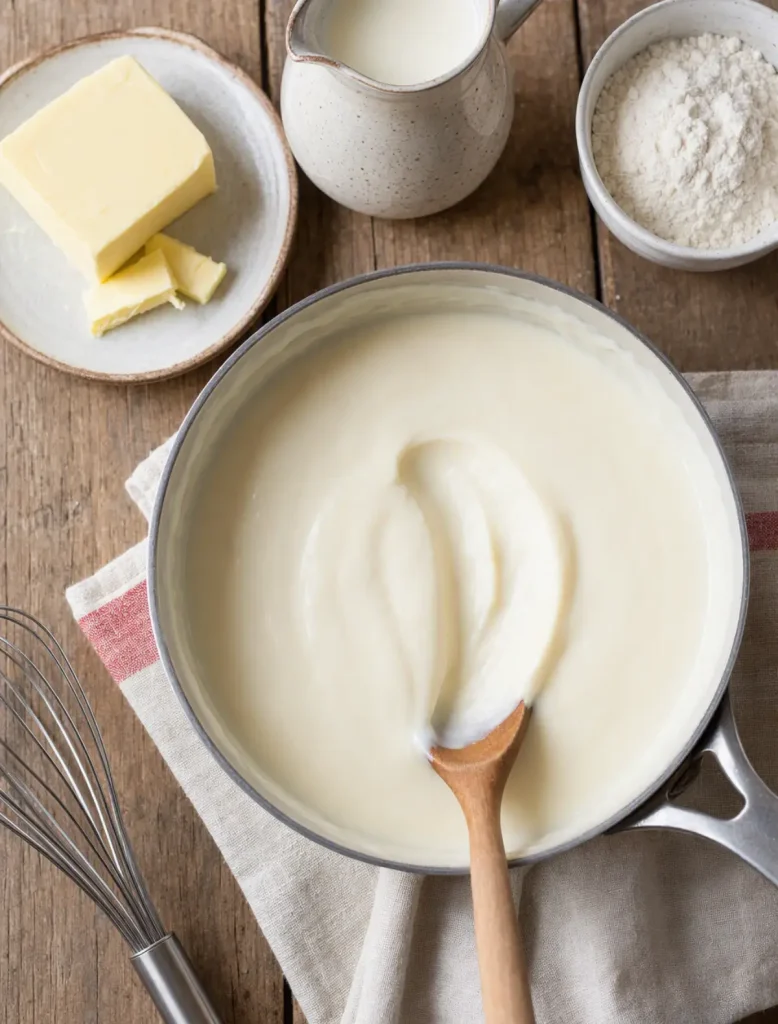
This homemade béchamel sauce is made with milk, butter, and flour in about 15 minutes. A smooth and versatile white sauce that's ideal for lasagna, baked pasta, gratins, and casseroles.
Place the butter in a small, heavy-bottomed saucepan and melt it completely over low heat, without allowing it to fry or brown.
Add the flour all at once and immediately whisk until the mixture is smooth and evenly combined.
Cook the roux over low heat for 1–2 minutes, whisking continuously. The flour should cook briefly without browning. For a classic white béchamel, the roux should remain very pale.
Start by adding a small amount of milk and whisk immediately until the mixture is completely smooth.
Continue adding the milk a little at a time, making sure each addition is fully incorporated before adding more. During this stage, keep whisking in the same direction, using a steady, continuous motion to work the mixture evenly.
Once the sauce becomes more fluid, you can add the remaining milk more quickly while continuing to whisk.
The milk can be used straight from the refrigerator; there's no need to warm it beforehand.
Continue cooking over medium-low heat, whisking regularly and making sure to reach the bottom and edges of the saucepan.
Once the béchamel begins to thicken, reduce the heat slightly and continue cooking until the sauce is smooth, creamy, and still pourable.
Keep in mind that the béchamel will thicken slightly as it cools.
Season with salt and, if you like, a small amount of freshly grated nutmeg. Whisk for a few more seconds, then remove the sauce from the heat.
Use immediately, or transfer the béchamel to a bowl and cover the surface directly with plastic wrap to prevent a skin from forming as it cools.
Adjust the consistency depending on how you plan to use the sauce. For lasagna and baked pasta, it's usually better to keep the béchamel fairly fluid so it spreads easily between the layers and continues cooking in the oven. For gratins and casseroles, you can let it thicken a little more.
If lumps form, whisk the sauce vigorously as soon as you notice them. If necessary, you can also pass the béchamel through a fine-mesh strainer for an extra-smooth consistency.
If the béchamel becomes too thick, whisk in a small amount of milk at a time until it reaches the consistency you need.
To store the béchamel, let it cool and transfer it to an airtight container, or cover its surface directly with plastic wrap. Keep it refrigerated and preferably use it within 2–3 days. Reheat it gently while whisking, adding a little milk if necessary to restore its creamy consistency.
Béchamel can also be frozen, although its texture may become slightly separated or grainy after thawing. Let it thaw slowly in the refrigerator, then reheat it gently while whisking. If necessary, add a small amount of milk to help bring the sauce back together.
Nutmeg is optional, but a small amount adds aroma without overpowering the delicate flavor of the sauce. For the best result, grate it fresh just before adding it.