Servings 4
- Amount Per Serving
- % Daily Value *
- Total Fat 20g31%
- Saturated Fat 9g45%
- Sodium 150mg7%
- Total Carbohydrate 10g4%
- Dietary Fiber 1g4%
- Sugars 2g
- Protein 50g100%
* Percent Daily Values are based on a 2,000 calorie diet. Your daily value may be higher or lower depending on your calorie needs.
Note
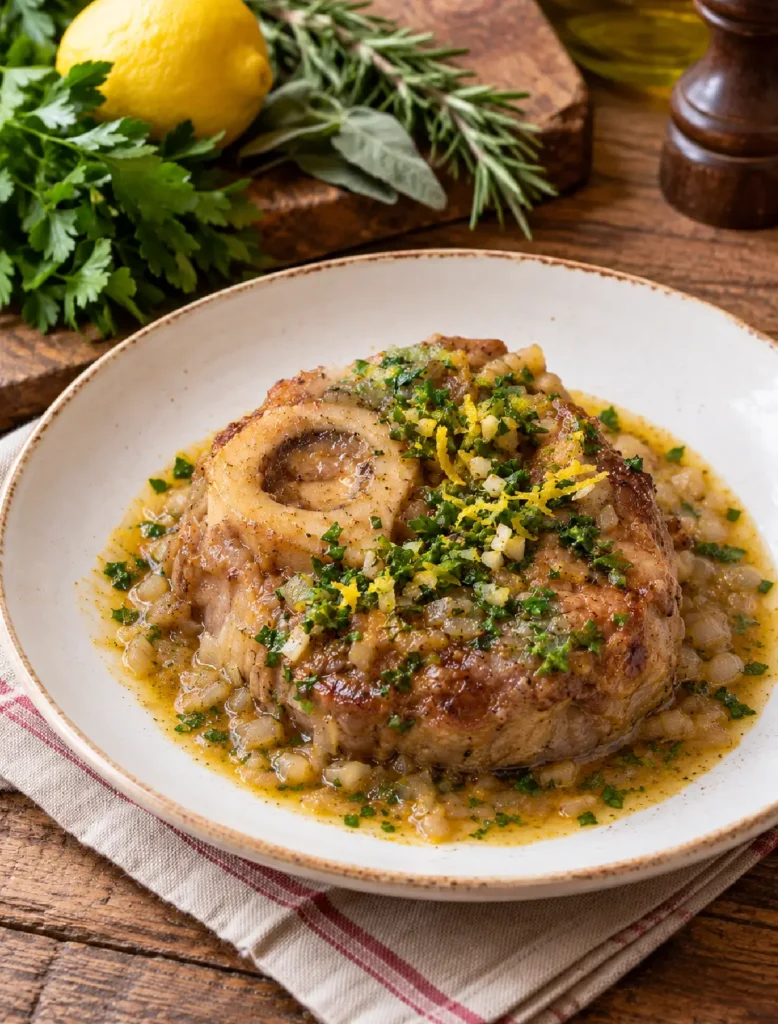
The outer membrane of the ossobuchi contracts when exposed to heat. Making a few small cuts before coating the meat with flour helps prevent the slices from curling during browning and slow cooking.
Use a pan wide enough to arrange the ossobuchi in a single layer. The cooking liquid should not completely cover them: add hot stock a little at a time and only when the sauce needs it. The aim is a concentrated cooking sauce rather than a broth.
The ossobuchi are ready when the meat is very tender and begins to pull easily away from the bone. Cooking time can vary slightly depending on the thickness of the slices. If the meat still offers resistance after 90 minutes, continue cooking, adding a little stock whenever necessary.
Prepare the gremolata only towards the end of cooking. When zesting the lemon, avoid the white pith underneath, which can be bitter. Adding the gremolata shortly before serving keeps its aromas fresher and more distinct.
If you serve the ossobuco with Risotto alla Milanese, treat the two preparations as a single dish: place the risotto alongside the meat and spoon the ossobuco cooking sauce over the meat.
Keywords:
ossobuco alla milanese, ossobuco recipe, veal ossobuco, veal shank, gremolata, Milanese cuisine, Lombardy recipes
We do not know exactly when ossobuco first appeared, but by the end of the nineteenth century it was already well established in Milanese cooking. In 1879 Giuseppe Sorbiatti included it in his Memoriale della Cuoca, describing it as a dish “very commonly used in Milan”. The reference is particularly interesting because the book was intended for family cooking, not just the grand dining tables of the period.
A few years later came an even more famous account. In 1891 Pellegrino Artusi devoted recipe number 358 of Science in the Kitchen and the Art of Eating Well to “Osso buco”. Before explaining how to prepare it, he presents it as a speciality of Lombard cuisine and, with a touch of irony, suggests leaving its preparation to the Milanese rather than risking their mockery.
The recipes, however, have not remained identical over time. Differences are already apparent when comparing Sorbiatti and Artusi, and the dish continued to appear in different forms over the following decades. It is one of those cases where tradition is not a recipe frozen in time, but a dish that continued to be cooked in the homes and trattorias of the city.
That connection with Milan eventually received formal recognition. In 2007, the Municipality of Milan recognised Ossobuco as a De.Co. (Denominazione Comunale), placing it among the preparations that represent the city's culinary heritage.