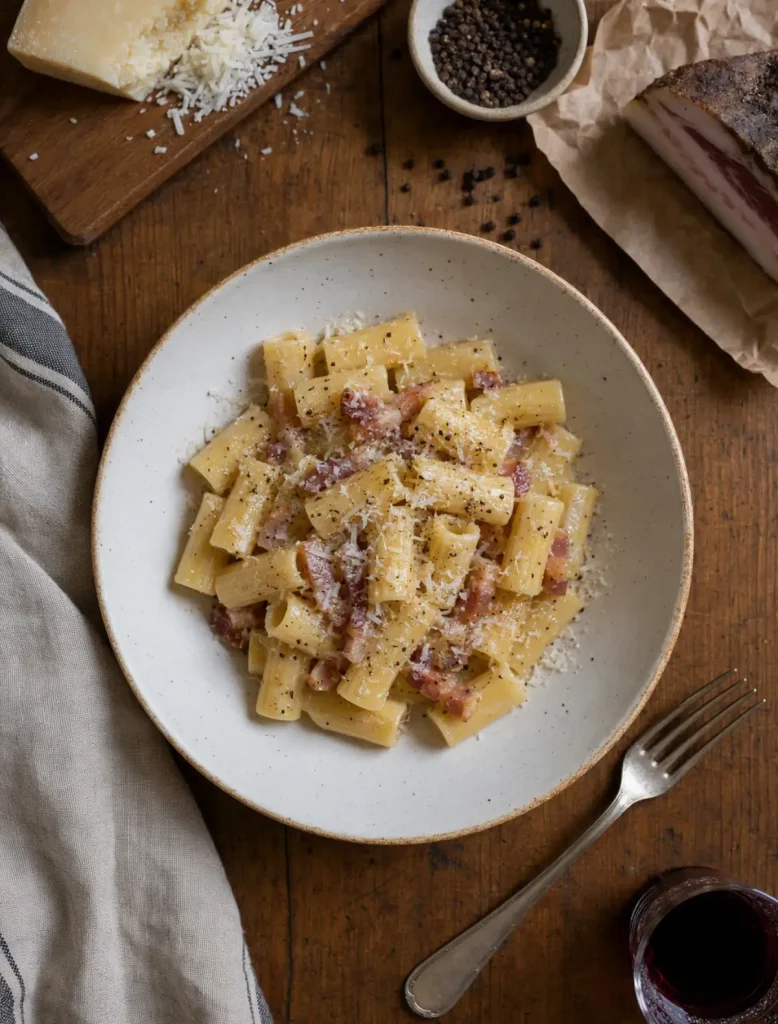
Finish Cooking the Pasta in the Guanciale Fat 💧
Return the skillet with the rendered guanciale fat to the heat and add a ladleful of pasta cooking water.
Stir or swirl the skillet to begin forming an emulsion, then transfer the pasta directly to the skillet.
Finish cooking over medium-high heat, tossing and stirring frequently. Add more pasta water a little at a time and only as needed until the pasta is al dente and a fluid, well-emulsified sauce remains in the pan.
4 Toss the Pasta with Pecorino Off the Heat 🧀
Once the pasta is al dente, turn off the heat and allow the temperature to drop slightly for a few seconds.
Add the finely grated Pecorino Romano a little at a time, together with some freshly ground black pepper, and toss the pasta vigorously.
If the sauce becomes too thick, add a small amount of pasta cooking water and continue tossing until you have a smooth, creamy sauce that coats the pasta.
Keep the skillet off the heat during this step. Excessive heat can cause the proteins in the Pecorino to tighten too quickly, resulting in clumps instead of a smooth sauce.
5 Add the Guanciale and Finish with Black Pepper 🍽️
Add the golden guanciale, reserving a small amount for serving if desired, and toss briefly to combine.
Plate immediately and finish each serving with the remaining guanciale, freshly ground black pepper, and, if desired, a little extra grated Pecorino Romano.
Serve Pasta alla Gricia as soon as it is ready, while the sauce is still creamy and the guanciale retains its texture.
Servings 4
- Amount Per Serving
- % Daily Value *
- Total Fat 41.5g64%
- Saturated Fat 16.4g82%
- Sodium 995mg42%
- Total Carbohydrate 57.7g20%
- Dietary Fiber 2.4g10%
- Sugars 2.9g
- Protein 20.4g41%
* Percent Daily Values are based on a 2,000 calorie diet. Your daily value may be higher or lower depending on your calorie needs.
Note
How to Make Creamy Pasta alla Gricia
The creaminess of Pasta alla Gricia depends mainly on the final tossing and emulsification of the rendered guanciale fat, Pecorino Romano, and starchy pasta water. Add the pasta water gradually: it is much easier to loosen a sauce that is too thick than to correct one that has become too watery.
If the sauce initially looks too loose, keep tossing the pasta before adding more Pecorino. The movement of the pasta and the starch in the cooking water will gradually help the sauce come together.
How to Prevent the Pecorino from Clumping
Add the Pecorino Romano off the heat, after allowing the temperature of the pasta to drop slightly. Excessive heat can cause the cheese to tighten quickly and form clumps instead of a smooth sauce. If necessary, add a small amount of pasta cooking water and continue tossing until the desired consistency is reached.
When to Add the Black Pepper
For the best aroma, grind the black pepper just before using it. Add some while tossing the pasta with the Pecorino, then finish each serving with another grind of pepper just before serving.
How to Store Pasta alla Gricia
Pasta alla Gricia is best served immediately, while the sauce is creamy and the guanciale retains its texture. If you have leftovers, store them in a tightly sealed container in the refrigerator for up to 1 day. Keep in mind that once chilled and reheated, the Pecorino sauce will have a different consistency from freshly prepared Gricia.
Keywords:
Pasta alla Gricia, Gricia recipe, traditional Pasta alla Gricia, pasta with guanciale and Pecorino, guanciale pasta, Pecorino Romano pasta, traditional Lazio pasta, Lazio cuisine, traditional Italian pasta
Pasta alla Gricia: The Origins and History of a Lazio Classic
As with many traditional Italian dishes, the exact origins of Pasta alla Gricia are not documented with certainty. Over time, several theories have emerged about both where the dish originated and how it got its name.
One of the most widespread theories connects Gricia to Grisciano, a small village that is now part of the municipality of Accumoli, not far from Amatrice. Another interpretation associates the dish with the cooking traditions of shepherds in the Apennine area, who could rely on substantial, easily preserved ingredients such as dried pasta, guanciale, and aged cheese while traveling with their flocks.
The origin of the word “gricia” is also debated. One theory links it to gricio, a term historically used in Rome for certain food merchants who came from German- or Swiss-speaking areas. A direct connection between this term and the name of the pasta dish, however, has not been established with certainty.
Gricia is also frequently associated with Pasta all'Amatriciana, since the two dishes share key ingredients, particularly guanciale and Pecorino Romano. Because Gricia contains no tomato, it is sometimes informally described as “white Amatriciana.” However, Gricia has its own identity and history and should not simply be considered a tomato-free version of Amatriciana.
What defines the dish today is above all the simplicity of its preparation. Guanciale provides the rendered fat for the sauce, Pecorino Romano contributes saltiness and helps create the creamy coating, while black pepper adds its characteristic aromatic bite. Starchy pasta water brings these elements together without the need for cream, butter, or other added fats.
Four elements — pasta, guanciale, Pecorino Romano, and black pepper — are enough to create one of the most recognizable dishes in Lazio's pasta tradition.