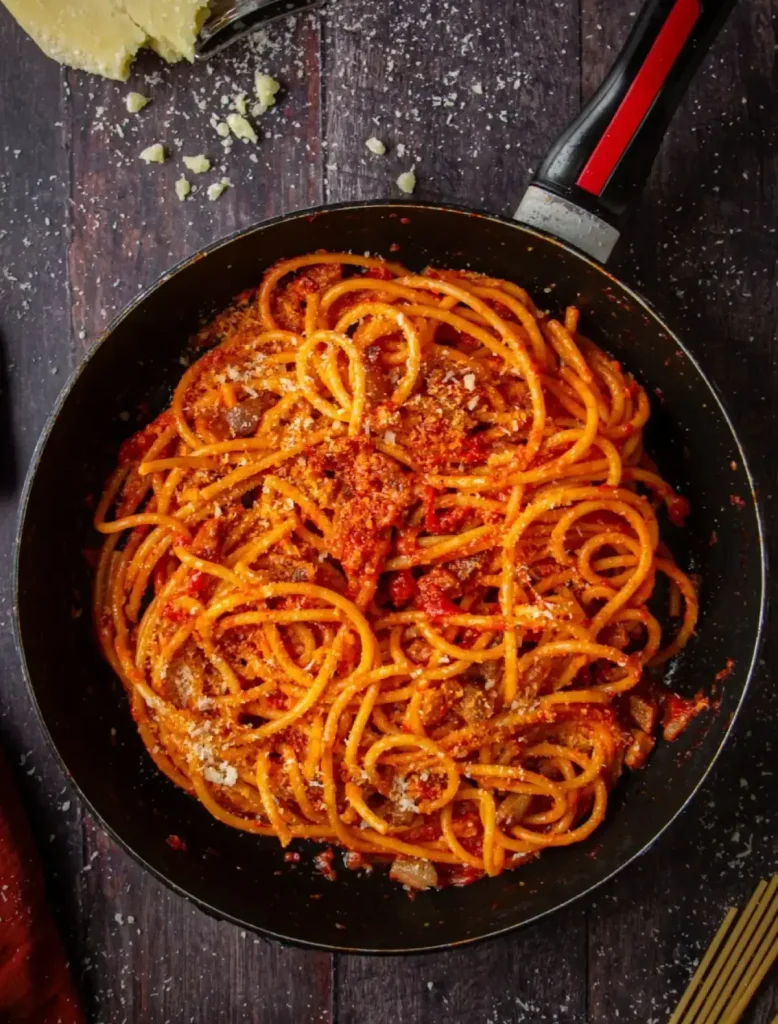
Spaghetti all’Amatriciana is one of the most representative dishes of Lazio cuisine and a specialty deeply rooted in the culinary tradition of Amatrice. The recipe brings together a small number of carefully balanced ingredients: guanciale, tomato, Pecorino Romano, and pasta.
The guanciale is slowly cooked with a small amount of extra virgin olive oil, allowing its fat to render while the meat turns golden. After the pan is deglazed with white wine, the guanciale is removed and the tomato and chili pepper are cooked in the same flavorful base.
The spaghetti are then tossed with the sauce and guanciale, while Pecorino Romano adds the characteristic savory finish.
Spaghetti all’Amatriciana: Traditional Recipe from Amatrice
Description
Spaghetti all’Amatriciana is a traditional specialty from Amatrice made with guanciale, tomato, and Pecorino Romano. The guanciale is slowly cooked with a small amount of extra virgin olive oil and deglazed with white wine before being combined with the tomato sauce that defines this classic dish from Lazio.
Ingredients
Instructions
How to Make Spaghetti all’Amatriciana
-
Cut and Slowly Cook the Guanciale in Olive Oil 🥓
Remove the rind from the guanciale and, if necessary, brush away any excess seasoning from the surface. Cut it first into slices about 0.2 inch (0.5 cm) thick, then into strips.
Add 5 g of extra virgin olive oil to a large frying pan, making sure it is wide enough to hold the spaghetti later, then add the guanciale.
Cook over low heat, stirring occasionally, so that the fat renders gradually.
Continue cooking until the foam released by the guanciale has subsided and the strips have reached a golden-yellow color.
-
Deglaze the Guanciale with White Wine 🍷
Pour 30 ml (2 tbsp) dry white wine into the frying pan and allow the alcohol to evaporate completely.
Once the guanciale is golden, remove it from the frying pan and set it aside, leaving the rendered fat and cooking juices in the pan.
-
Cook the Tomatoes and Chili Pepper in the Guanciale Fat 🍅
Remove the stem and seeds from the fresh chili pepper.
Add the canned peeled tomatoes to the same frying pan, crush them roughly, and add the chili pepper.
Bring the sauce to a boil and cook over relatively high heat for about 10–20 minutes, stirring occasionally, until the tomatoes have reduced to a creamy consistency.
Taste and add salt only if necessary.
Return most of the golden guanciale to the frying pan and cook for another 5–10 minutes, reserving a few strips for serving.
-
Cook the Spaghetti and Reserve the Pasta Water 🍝
Meanwhile, bring a large pot of water to a boil and salt it lightly, keeping in mind the natural saltiness of the guanciale and Pecorino Romano.
Add the spaghetti and cook until very al dente.
Before draining, reserve about 1 cup of pasta cooking water to adjust the consistency of the sauce if needed.
-
Finish Cooking the Spaghetti in the Sauce 🔥
Remove the chili pepper from the sauce if you left it whole, then transfer the spaghetti directly to the frying pan.
Finish cooking for about 1–2 minutes, tossing or stirring frequently so that the pasta becomes thoroughly coated with the sauce.
If the sauce becomes too dry, add a small amount of pasta cooking water at a time, using only as much as necessary.
-
Finish the Sauce with Pecorino Romano 🧀
Turn off the heat and allow the temperature to drop slightly for a few seconds.
Add the grated Pecorino Romano PDO a little at a time and toss until it is evenly distributed throughout the pasta.
If necessary, add a small amount of pasta cooking water to keep the sauce well combined.
-
Finish with Guanciale and Pecorino 🍽️
Divide the spaghetti among the plates immediately.
Finish each serving with the reserved guanciale and, if desired, a little more grated Pecorino Romano.
Serve Spaghetti all’Amatriciana as soon as they are ready, while the sauce still coats the pasta well and the guanciale retains its texture.
Nutrition Facts
Servings 4
- Amount Per Serving
- Calories 670kcal
- % Daily Value *
- Total Fat 34g53%
- Saturated Fat 13g65%
- Sodium 850mg36%
- Total Carbohydrate 63g21%
- Dietary Fiber 4g16%
- Sugars 5g
- Protein 22g44%
* Percent Daily Values are based on a 2,000 calorie diet. Your daily value may be higher or lower depending on your calorie needs.
Note
Why This Recipe Uses Olive Oil
Extra virgin olive oil is one of the ingredients included in the official Amatriciana Tradizionale TSG specification. This recipe uses only a small amount, while most of the fat in the sauce comes from the guanciale as it cooks.
Guanciale or Pancetta?
Guanciale is one of the defining ingredients of Amatriciana Tradizionale and should not be replaced with pancetta if you want to remain faithful to the recognized preparation. The official specification specifically calls for Amatrice-style guanciale aged for at least 30 days.
Why White Wine Is Used
White wine is included among the ingredients specified for Amatriciana Tradizionale TSG. It is added while cooking the guanciale and allowed to evaporate before the tomato is introduced.
Fresh or Dried Chili Pepper
The official specification allows fresh or dried chili pepper and/or black pepper. This recipe uses fresh chili pepper, added with the tomato. You can therefore substitute dried chili pepper while keeping the preparation consistent with the specification.
Spaghetti or Bucatini?
Spaghetti have a particularly strong connection with the tradition of Amatrice. Documentation referenced in the TSG specification also includes a recipe for Spaghetti all’Amatriciana published by the Pro Loco of Amatrice.
In Rome, Amatriciana has also become strongly associated with bucatini, but this recipe uses spaghetti to maintain the more direct connection with the Amatrice tradition.
How to Store Spaghetti all’Amatriciana
Spaghetti all’Amatriciana are best served immediately, particularly for the texture of the guanciale and Pecorino. If you have leftovers, store them in a tightly sealed container in the refrigerator for up to 1 day.
Once reheated, both the sauce and guanciale will inevitably have a different texture from the freshly prepared dish.