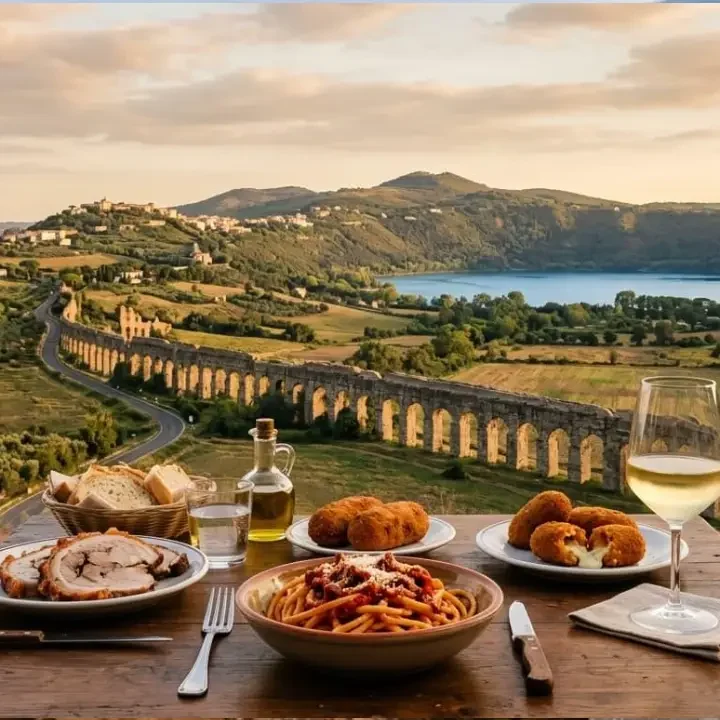
Four names are enough to understand just how influential Lazio cuisine has become: Carbonara, Amatriciana, Cacio e Pepe and Gricia. These dishes are now famous far beyond Italy and have become almost inseparable from the culinary image of Rome.
But travel beyond the capital and you’ll find a very different side of the region. There are the soups and olive oil of Tuscia, the legumes and cheeses of Ciociaria, the centuries-old olive-growing tradition of Sabina, the recipes of the Rieti area, the specialties of the Castelli Romani, as well as chestnuts, seafood from the coast and a long list of rustic dishes that originated far from Rome’s trattorias.
The distinction is actually quite simple: Roman cuisine and Lazio cuisine are not exactly the same thing. Roman food is an enormously important part of the region’s culinary identity, but stopping at Rome means leaving quite a lot out.
Rome Gets the Spotlight, but Lazio Has Much More to Offer
Rome has such a strong culinary identity that it has almost come to represent the entire region on its own. Carbonara, supplì, Coda alla Vaccinara and Carciofi alla Giudia enjoy a level of fame that few specialties from other parts of Lazio can match.
Travel just a short distance, however, and both ingredients and traditions begin to change. To the north lies Tuscia, around Viterbo, a land of olive groves, hazelnut orchards, chestnut woods and legumes. In Sabina, extra virgin olive oil plays a central role, while farther south Ciociaria has preserved a rural cuisine built around fresh pasta, vegetables, legumes, lamb and mutton, and local cheeses.
Then there is the Rieti area, along with the Castelli Romani and a coastline stretching from Montalto di Castro all the way to the Gulf of Gaeta. Treating all Lazio cuisine as Roman cuisine would be a little like visiting Rome, seeing the Colosseum and deciding you’ve seen the whole city.
Tuscia: Acquacotta and the Flavors of the Countryside
In Tuscia, food remains closely connected to the land. One of its most representative dishes is acquacotta, a rustic soup with roots in the local farming tradition, made from simple ingredients such as bread, vegetables, olive oil and whatever the land had to offer.
There isn’t just one version of acquacotta, and that’s hardly surprising. A dish born in the countryside naturally changed with the seasons, the village and, most importantly, whatever happened to be available at home. The same is true of many traditional legume and grain soups, where chickpeas, lentils, beans and farro take center stage rather than appearing as simple side ingredients.
The Viterbo area is also strongly associated with chestnuts, hazelnuts and extra virgin olive oil, ingredients that are still an important part of both local agriculture and cooking.
Sabina: Fregnacce and Extra Virgin Olive Oil
In Sabina, you only have to look at the landscape to understand the importance of the olive tree. Olive growing has ancient roots here, and olive oil has been part of everyday cooking for generations.
Among the area’s traditional specialties are fregnacce alla sabinese, a rustic type of homemade pasta prepared from a very simple dough. As with so many dishes born from rural cooking, it didn’t take a long list of ingredients to put something filling on the table.
Flour, water, olive oil, legumes and vegetables from the garden were everyday staples and naturally found their way into local recipes. Fregnacce are one of the most interesting examples and, perhaps more importantly, they’re a piece of local tradition that can still be easily recreated at home.
Rieti: Amatriciana, Gricia and the Shepherding Tradition
In the Rieti area, the landscape becomes more mountainous and the local cuisine reflects a long history of shepherding. This is also where you’ll find Amatrice, the small town that gave its name to one of Italy’s most famous pasta dishes.
The Amatriciana we know today combines pasta, guanciale, tomato and Pecorino. Before tomato-based Amatriciana became established, a white pasta preparation made with guanciale and cheese was already found in the area. Today, this is identified with Gricia and is closely associated with the shepherding traditions of the central Apennines.
Today, both dishes are immediately associated with Roman cooking as well, and you’ll find them on trattoria menus throughout the capital. Their roots, however, lead beyond Rome. If one dish had to represent this part of Lazio, Amatriciana would be an obvious choice: a recipe that traveled from a small town in the Rieti area to tables around the world.
Ciociaria: Sagne e Fagioli and Country Cooking
In Ciociaria, traditional cooking has deep rural roots, with vegetables, legumes, homemade pasta, lamb and mutton, and local cheeses playing an important role.
One particularly representative dish is sagne e fagioli, homemade pasta with beans. Sagne are rustic strips of fresh pasta, usually made simply with flour and water and cut into irregular pieces. Combined with beans, they become a hearty, inexpensive meal made from ingredients that were once readily available in local homes.
Cheese is important here too, particularly varieties connected with sheep farming and sheep’s milk. Ciociaria’s food may be much less familiar outside Lazio than Roman cuisine, but a bowl of sagne e fagioli is enough to show how much the region’s cooking changes as you move away from the capital.
Rome: Carbonara and the Classics of the Capital
And then, of course, there’s Rome.
If you had to choose one dish to represent the worldwide popularity of Roman cooking, Carbonara would be difficult to beat. Eggs, guanciale, Pecorino Romano and black pepper: very few ingredients, which also means very little room for mistakes. The crucial moment comes when the egg mixture meets the pasta away from direct heat: too much heat can cook the eggs too quickly and make the sauce lose its creamy consistency.
But Roman cuisine certainly doesn’t end with Carbonara. There’s Cacio e Pepe, along with the quinto quarto tradition represented by Coda alla Vaccinara, Trippa alla Romana and pajata. Then there are supplì, Saltimbocca alla Romana, sautéed chicory and puntarelle.
Even the humble artichoke gets two completely different treatments: tender Carciofi alla Romana and crisp Carciofi alla Giudia, the latter deeply connected to Rome’s Jewish culinary tradition.
Roman cuisine is varied enough to fill entire menus on its own, but head beyond the city and the ingredients start changing surprisingly quickly.
Castelli Romani: Ciambelline al Vino
Just a few miles outside Rome, the atmosphere already begins to change. The Castelli Romani have long been associated with fraschette, local wine and the kind of food meant to be shared without too much ceremony.
One of the area’s characteristic treats is ciambelline al vino, rustic wine cookies traditionally served at the end of a meal, often alongside a glass of wine. The recipe couldn’t be much simpler: flour, sugar, oil and wine. The dough is shaped into little rings, coated with sugar and baked until crisp. The result is a dry, crunchy cookie traditionally enjoyed with a glass of wine.
The connection with wine is hardly accidental. Frascati, Marino and the other towns of the Castelli Romani have centuries of winemaking behind them, so finding a little wine inside a traditional sweet makes perfect sense.
The Lazio Coast: Traditional Fish Brodetto
Lazio has a long stretch of coastline along the Tyrrhenian Sea, yet seafood is often missing from the popular image of the region’s cuisine. In Civitavecchia, Anzio, Terracina and the other towns along the Tyrrhenian Sea, things naturally look quite different.
One traditional preparation is brodetto di pesce, a fish stew with roots in local fishing communities. It can be made with several varieties of seafood, including fish that historically fetched lower prices at the market. The ingredients are very different from those found inland, but the underlying principle is familiar: use what is available and waste as little as possible.
Here, guanciale and Pecorino give way to fish, shellfish and mollusks. Along the coast, this side of Lazio cooking is anything but marginal, even though it receives far less attention abroad than Rome’s most famous dishes.
Gulf of Gaeta: Tiella
In Gaeta, there’s one specialty that’s difficult to confuse with anything else: tiella. Two thin layers of dough enclose a filling that changes depending on the version, with traditional variations featuring octopus, anchovies, squid or vegetables.
It originated as a practical, filling meal, and many versions are still prepared today. Octopus tiella is probably among the best known, but talking about a single recipe would be misleading. In Gaeta, tiella is really an entire family of preparations.
The octopus version, in particular, has ingredients and textures completely different from the dishes that made Lazio famous abroad. And that’s exactly what makes Gaeta’s culinary tradition so interesting.
One Region, Many Food Traditions
Rome has had an enormous influence on the food of Lazio, and its specialties have become famous far beyond the region. It’s easy to understand why Carbonara, Cacio e Pepe, supplì and artichokes have ended up taking most of the spotlight. Outside the capital, however, people have been cooking for centuries with ingredients, customs and recipes that can be remarkably different.
There is homemade pasta, hearty legume soups, seafood, wine cookies and dishes shaped by generations of shepherding. Some recipes have traveled far enough to become famous throughout Italy and beyond; others have remained closely tied to the towns and homes where they originated.
Rather than looking for a single dish that could somehow represent everything, it makes more sense to see Lazio cuisine for what it really is: a collection of very different local food traditions, all belonging to the same region.
Ready to bring a taste of Lazio to your kitchen? Discover all the Lazio recipes on DishToHub.