
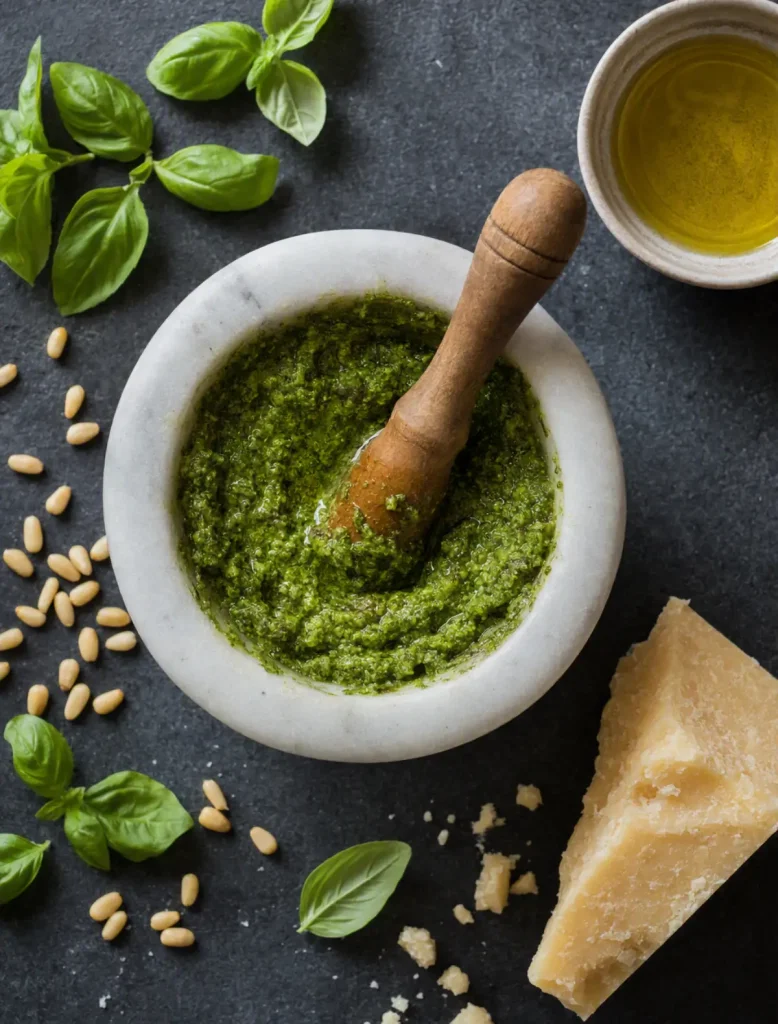
A quick recipe made with just a few ingredients, although a little care goes a long way when you want a creamy, well-balanced pesto with a beautiful green colour. Here you’ll find both the traditional mortar-and-pestle method and the quicker blender version.
Place the garlic clove and a pinch of coarse sea salt in a marble mortar. Crush them with a wooden pestle until you have a smooth, creamy paste.
Add the pine nuts and continue crushing until they are completely incorporated and the mixture is smooth and even.
Gradually add the Genovese basil leaves, previously washed and carefully dried. Using the pestle, work the leaves against the sides of the mortar with gentle circular motions. The coarse salt already in the mixture will help break down the basil leaves without being too aggressive.
The salt acts as a natural abrasive, helping release the basil’s essential oils and giving the pesto its characteristic aroma. Work gently and avoid crushing the basil for longer than necessary, as this helps preserve both its fresh fragrance and vibrant green colour.
Continue until the mixture is soft, well blended and intensely aromatic.
Gradually add the Parmigiano Reggiano and Pecorino Fiore Sardo, continuing to work the mixture gently with the pestle until the cheese is fully incorporated.
Slowly drizzle in the extra virgin olive oil, continuing to mix with gentle movements.
Keep working the pesto until you have a creamy, well-blended sauce that still has a slightly textured consistency.
Your traditional Pesto alla Genovese made with a mortar and pestle is ready to use.
To keep your pesto bright green, it’s important to prevent the basil from heating up while you blend it. If possible, place the blender jug and blades in the freezer for about 15–20 minutes before you begin.
Wash the Genovese basil leaves and dry them thoroughly, gently patting them with a clean kitchen towel. Make sure no water remains on the leaves, as excess moisture can encourage oxidation and cause the basil to darken.
Place the garlic clove, pine nuts and coarse sea salt in the blender. Add half of the extra virgin olive oil and some of the basil leaves.
Blend using short pulses of just a few seconds at a time, pausing between each one. Gradually add the remaining basil and continue pulsing until you have a creamy, fragrant green mixture.
Avoid running the blender continuously. The heat generated by the blades can encourage oxidation, causing the basil to lose its characteristic bright green colour.
Slowly drizzle in the remaining extra virgin olive oil, continuing to blend in short pulses.
Stop as soon as the pesto becomes creamy while still retaining a slightly textured consistency.
With the blender switched off, add the finely grated Parmigiano Reggiano and Pecorino Fiore Sardo.
Stir them in with a spoon until completely incorporated. If necessary, give the pesto one final, very quick pulse, just enough to bring everything together without warming it up.
Taste the pesto and adjust the salt if necessary, remembering that both Parmigiano Reggiano and Pecorino are naturally quite salty.
Your Pesto alla Genovese is ready. If you’re using it for pasta, transfer the pesto to a bowl and loosen it with one or two tablespoons of pasta cooking water. Add the drained pasta and toss until evenly coated.
Never heat pesto directly in the pan. Too much heat can affect its colour, aroma and fresh flavour.
Never heat pesto directly over the stove. When using it to dress pasta, transfer it to a bowl and loosen it with a little pasta cooking water. This will make it creamier and help it coat the pasta more evenly.
If you’re not using the pesto straight away, transfer it to a clean glass jar, smooth the surface and cover it with a thin layer of extra virgin olive oil to reduce contact with the air and help prevent it from darkening. Store it in the refrigerator and use within 4–5 days.
For longer storage, you can freeze the pesto in individual portions using small containers or cups. It will keep in the freezer for about 6 months. When you’re ready to use it, allow it to thaw slowly in the refrigerator.
When making pesto with a mortar and pestle, don’t pound the basil too aggressively. Use gentle circular movements, working the pestle along the sides of the mortar. This helps release the basil’s aromas without tearing or crushing the leaves more than necessary.
The basil should be completely dry before you begin. Water left on the leaves can encourage oxidation and affect the pesto’s colour.
You can adjust the amount of garlic to suit your taste, but leaving it out completely takes the recipe away from the character of traditional Pesto alla Genovese.
The DOP ingredients listed in the recipe contribute to its traditional flavour, but if you can’t find them, choose the best-quality alternatives available. With a recipe this simple, the quality of the ingredients really does make a difference.
Long before pesto as we know it today, Ligurian cooking already had a tradition of sauces prepared with a mortar and pestle. Garlic played an important role, and preparations such as agliata, a garlic-based sauce, belonged to a much older culinary tradition. Basil came later, gradually taking centre stage until its unmistakable aroma became inseparable from the food of Genoa.
One of the more colourful legends takes us to Pra’, on the western side of Genoa, where a friar is said to have created an early version of the sauce by crushing basil with other ingredients. It’s a charming story, but there is no historical evidence to confirm it as the true origin of pesto. For the first documented recipe, we have to move forward to the nineteenth century.
The first known written recipe appeared in Giovanni Battista Ratto’s La Cuciniera Genovese, published in 1863. Ratto described it as a “battuto d’aglio e basilico” — essentially a crushed mixture of garlic and basil — and the recipe already contained many of the ingredients we associate with pesto today: basil, garlic, pine nuts, cheese and olive oil.
It wasn’t quite the pesto we know today, however. Ratto’s version also included a little butter, added during the crushing process before the olive oil. Even basil wasn’t always essential: when it wasn’t available, marjoram and parsley could be used instead.
The choice of cheese also shows how much the recipe was still evolving. Some nineteenth-century versions included combinations that might seem surprising today, including Dutch cheese instead of the now-familiar pairing of Sardinian cheese and Parmigiano. It’s a useful reminder that pesto wasn’t born with one fixed recipe: it gradually developed and took shape in Ligurian kitchens over time.
What has endured is the mortar and pestle, the traditional crushing technique and the use of simple ingredients. Today, Pesto alla Genovese is one of Liguria’s most recognisable culinary symbols, but its story still carries something of Genoa’s old kitchens: recipes handed down over generations, local ingredients and a few legends that are difficult to separate completely from history.