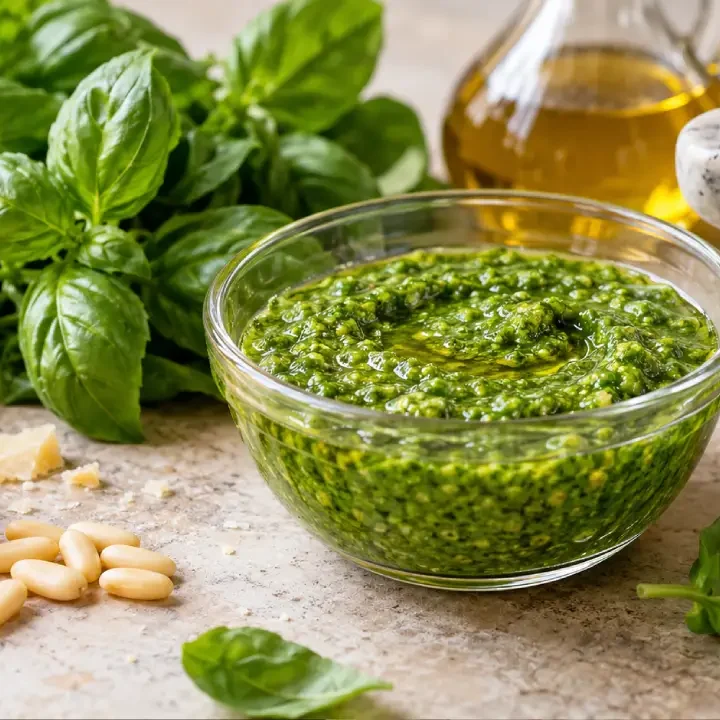
Freshly made pesto has a bright green color that does not always last very long. It can start to darken while we are making it in a blender or later, especially on the surface exposed to air.
This is normal: as soon as we break down the basil leaves, a series of reactions begins that gradually changes their color. We can slow them down considerably by paying attention to how we handle the basil and how we store the pesto.
Why does pesto turn brown?
When we crush or blend basil, we break open the cells in the leaves and expose them to oxygen. An enzyme naturally present in basil, polyphenol oxidase, also comes into play and contributes to browning.
Something similar happens when we cut an apple and leave the flesh exposed to air.
Then there is chlorophyll, which gives basil its green color. This can also change during preparation and over time. So there is no single reason why pesto loses its bright green color.
What matters to us in the kitchen is how we can slow it down.
Be careful how long you blend the basil
When the blender runs for too long, the movement of the blades gradually warms the pesto. It is better to work in short pulses and stop as soon as we have the consistency we want.
Before we begin, we prepare all the ingredients. We wash the basil gently, dry it thoroughly and only then start blending.
There is no need to turn the pesto into a perfectly smooth cream. Once it has the right consistency, continuing to blend it only works it more than necessary and raises the temperature further.
Another useful trick is to chill the blender bowl and blades beforehand, either in the refrigerator or briefly in the freezer. This is particularly useful in summer.
Some people add an ice cube to the blender to keep the temperature down, but we do not recommend it. The ice melts while the pesto is being blended and adds water to the mixture. It is better to chill the equipment first and keep the blending time as short as possible.
Working with a mortar is different. In our Pesto alla Genovese recipe, we use a marble mortar and wooden pestle: instead of being quickly chopped by blades, the basil leaves are gradually crushed against the sides of the mortar as the other ingredients are added. The process is slower and does not produce the same rise in temperature that can occur when a blender runs for too long. The texture is different too: pesto made in a mortar is less uniform and does not become a perfectly smooth cream.
Does blanching basil really keep it green?
Yes, it can work. Just a few seconds in boiling water followed by rapid cooling can limit one of the processes responsible for browning.
The color can remain beautifully green, but the basil has still been blanched. The texture of the leaves changes, and their aroma can also be affected by the brief exposure to boiling water.
It is a useful technique when preserving the green color is the main priority. For traditional pesto, we prefer to start with fresh basil leaves and use them raw.
What about lemon juice?
Lemon juice is also often recommended as a way to stop pesto from turning brown. Its acidity can indeed slow some of the reactions involved in the change of color.
We do not recommend adding lemon juice to pesto, though. It adds acidity and water, but above all it introduces a noticeable flavor that changes the pesto. It is also not part of the traditional Genovese recipe.
To keep pesto green, we prefer to concentrate on temperature, blending time and storage rather than adding lemon juice.
How to store pesto without letting it turn brown
If we leave freshly made pesto in a bowl, the surface is often the first part to darken. This is the part most exposed to air.
If we are not using the pesto straight away, we transfer it to a container that fits the amount we have made without leaving too much empty space. This reduces the amount of air in contact with the surface. We then cover the pesto with a thin layer of extra virgin olive oil, close the container and store it in the refrigerator.
Add pesto to pasta off the heat
There is no need to cook pesto with the pasta. Once the pasta is ready, we reserve a little cooking water, drain it and add the pesto away from the heat.
If the pesto is very thick, we add a little cooking water while mixing. There is no fixed amount: sometimes we need only a small splash, and sometimes none at all.
With our Trofie al Pesto with Potatoes and Green Beans, we wait until the trofie, potatoes and green beans are ready, drain everything and then add the pesto. We keep a little cooking water aside here too.