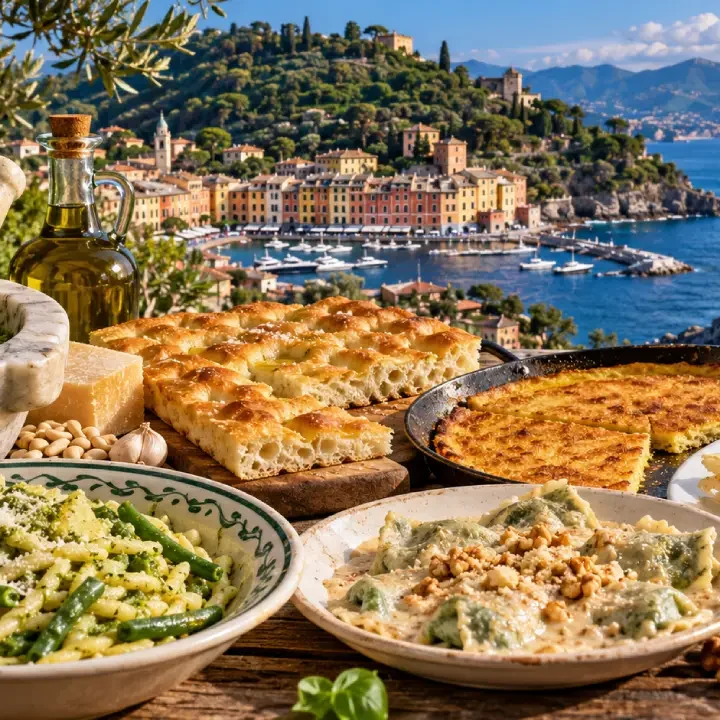
In Liguria, you only need to travel a few kilometres inland for the landscape to change. Behind the towns and villages along the coast, hills and mountains rise almost immediately, with terraced fields, olive groves, small vegetable gardens and villages scattered through the inland valleys.
Ligurian cuisine grew out of this geography. Fish comes from the sea, but an important part of the local table comes from the land: vegetables, pulses, chestnuts, mushrooms, aromatic herbs and olive oil. Chickpea flour, fresh pasta, focaccia and savoury pies complete the picture.
Genoa has given the region some of its best-known culinary symbols, beginning with pesto and focaccia. Travel towards the western or eastern Riviera, however, and both ingredients and recipes begin to change. Head into the mountains and another side of Ligurian cooking appears, one that has little to do with the idea of Liguria as an exclusively maritime cuisine.
Basil, olive oil and aromatic herbs
If there is one aroma immediately associated with Liguria, it is basil.
Basilico Genovese DOP is grown on the Tyrrhenian side of the region and finds its most famous expression in Pesto alla Genovese. Basil, garlic, pine nuts, cheese, salt and extra virgin olive oil are worked together in a mortar to make a sauce that has long since travelled beyond the borders of Liguria.
Pesto, however, also tells us something about the broader character of local cooking. Aromatic herbs play an important role in Liguria and appear in fillings, vegetable pies, frittatas and sauces. Marjoram, for example, is a recurring ingredient in Genoese cooking and accompanies a surprisingly wide range of dishes.
Pesto is served with trofie, but also with trenette and other pasta shapes. One of the most characteristic combinations adds potatoes and green beans, cooked with the pasta before everything is dressed with pesto, as in Trofie with Pesto, Potatoes and Green Beans.
Trofie themselves are more than simply a pasta shape bought ready-made. The dough of semolina and water is divided into small pieces and rolled by hand to create their characteristic twisted shape. If you want to make them from scratch, start with our Homemade Trofie.
Genoa, focaccia and the sciamadde
In Genoa, focaccia is eaten at times of day when elsewhere we might not expect to encounter the same kind of bread. Focaccia Genovese is low and soft inside, with a golden surface marked by the characteristic dimples that collect the mixture of water, salt and olive oil.
Then there is farinata, or fainà, made with chickpea flour, water, salt and olive oil. The batter rests for several hours before being poured into a thin layer and baked at a high temperature.
To find it in its traditional setting, we need to enter the world of the sciamadde. Their name recalls the flames of wood-fired ovens. These were, and to some extent still are, small Genoese shops associated with farinata, savoury pies and other foods served hot from the oven.
Farinata Genovese belongs to this straightforward style of cooking. Just a few ingredients, a well-oiled pan and a very hot oven are enough to create its golden surface and crisp edges.
Vegetable pies, pansoti and walnut sauce
In a region where cultivable land has always been precious, vegetables and herbs have found their way into countless preparations. Savoury pies are one of the clearest examples.
The best known is probably Torta Pasqualina, but Liguria has a much broader tradition of vegetable pies. Swiss chard, artichokes, courgettes, herbs and cheese can all be enclosed between thin layers of pastry, with ingredients changing according to season and location.
The same familiarity with herbs appears in pansoti, filled pasta traditionally served with walnut sauce. It is a very different combination from pesto but just as representative of Genoese cooking: a vegetable and herb filling enclosed in pasta and served with a sauce made from crushed walnuts.
Then there are corzetti, although the name requires some care. Different forms exist within Ligurian tradition. Alongside the corzetti of the Val Polcevera are the decorative discs of fresh pasta stamped with carved designs, particularly associated with the valleys of eastern Liguria.
The Ligurian Sea is about more than grilled fish
With such a long coastline, the sea naturally finds its way into the kitchen. Often, however, it appears in dishes far more elaborate than we might expect.
There is ciuppin, a fish soup traditionally made with different species, and buridda, a name used for preparations of stewed fish. Stockfish has also become part of the local repertoire and appears in recipes such as stoccafisso accomodato.
In La Spezia we find mesciua, a dish that almost seems to turn its back on the sea despite originating in a port city. It is a soup of pulses and grains, generally made with chickpeas, beans and wheat, and is one of the dishes that best demonstrates why Ligurian cuisine cannot simply be divided between seafood and pesto.
Cappon magro deserves a place of its own. One of the most elaborate dishes in the Genoese tradition, it combines fish, vegetables, hardtack and green sauce in a layered construction far removed from the everyday simplicity of focaccia and soup.
In eastern Liguria, focaccia becomes something else
Travel as far as the area around Recco and the word focaccia begins to mean something quite different.
Focaccia di Recco col Formaggio IGP is not simply Genoese focaccia with cheese added on top. Its dough is unleavened and stretched into two extremely thin sheets, with fresh cheese spread between them. It is then baked very quickly at a high temperature.
The protected production area includes Recco, Camogli, Sori and Avegno, making this a specialty closely associated with a very specific part of the eastern Genoese Riviera.
Continue towards La Spezia and the eastern valleys and the cuisine changes again. Here we find mesciua, testaroli in the Ligurian part of Lunigiana and a culinary tradition in which the boundary with neighbouring Tuscany inevitably becomes less distinct.
Western Liguria, between olives and vegetable gardens
Towards Savona and Imperia, the culinary landscape changes once more.
Olive trees become one of its defining features. The Taggiasca olive, historically associated with the area around Taggia but grown more widely in Liguria, is used both for olive oil and as a table olive. Riviera Ligure DOP extra virgin olive oil covers production areas extending across western and eastern Liguria, where olive groves often occupy steep terraced slopes.
Olives also appear in one of western Liguria’s best-known dishes, coniglio alla ligure, together with aromatic herbs and pine nuts.
Sanremo and the far west have their own tradition of focaccia and baked specialties. Sardenaira, topped with tomato, anchovies, olives, garlic and other seasonings, belongs to this side of Ligurian cooking and reflects the geographical and culinary closeness between western Liguria and the French Riviera.
Another Liguria begins in the mountains
The sea can be seen from much of the region, but it cannot explain everything Ligurians eat.
In the inland valleys, the repertoire changes. Chestnuts and chestnut flour played an important role for centuries in mountain communities, alongside mushrooms, potatoes, cheeses and other products gathered or produced in the hills and forests.
Pasta also follows the geography of the valleys. Some preparations belong to remarkably small areas and reveal the fragmented nature of Ligurian food traditions better than many of the region’s most famous dishes.
This side of Ligurian cuisine is less familiar outside the region, but it is essential to understanding it. Only a few kilometres may separate the coast from the Apennines, yet that short distance is enough to change ingredients, habits and recipes.
A cuisine built from simple ingredients
Many of Liguria’s most famous dishes begin with very little.
Chickpea flour, water and olive oil become farinata. A dough of flour, water and olive oil becomes focaccia. Herbs and vegetables go into pies and fillings. Walnuts and basil are crushed to make sauces. Pulses and grains become soups.
Yet simplicity does not mean that everything is simple to prepare.
Cima alla Genovese, with its stuffed pocket of meat, requires time and care. Cappon magro is an elaborate construction. Pansoti, ravioli and fresh pasta reveal a domestic cooking tradition capable of preparations that are anything but basic.
The repertoire broadens again when it comes to sweets. Pandolce Genovese, canestrelli, Lagaccio biscuits and other specialties belong to a tradition that extends well beyond savoury food.
From Genoa to the Rivieras, there is no single Ligurian cuisine
Pesto, focaccia and farinata have become symbols of Liguria for good reason. But stopping at these three means seeing only part of the region.
In Genoa we find pansoti, cima, vegetable pies and a strong tradition of seafood cooking. Recco has built its own identity around a focaccia completely different from the Genoese version. The La Spezia area brings mesciua and the specialties of the eastern valleys to the table. In western Liguria, olives, olive oil and vegetables become increasingly prominent, while recipes change again as we approach the French border. Inland, chestnuts, mushrooms and mountain products return to the kitchen.
It is this constant proximity between very different environments that gives Ligurian cuisine its character. In a narrow strip of land between the Mediterranean and the Apennines, travelling just a few kilometres can change the landscape. Quite often, it changes what arrives on the table too.