Stretch the First Dough Ball 🍕
Gently transfer one dough ball to a lightly floured work surface. Press it with your fingertips from the center outwards, pushing the air towards the edge while leaving a 1–2 cm rim untouched.
Continue gently stretching the dough by hand until you have a disc approximately 30 cm (12 in) in diameter. Do not use a rolling pin, as it would compress the dough and push out the gases developed during fermentation.
8 Top the Margherita 🌿
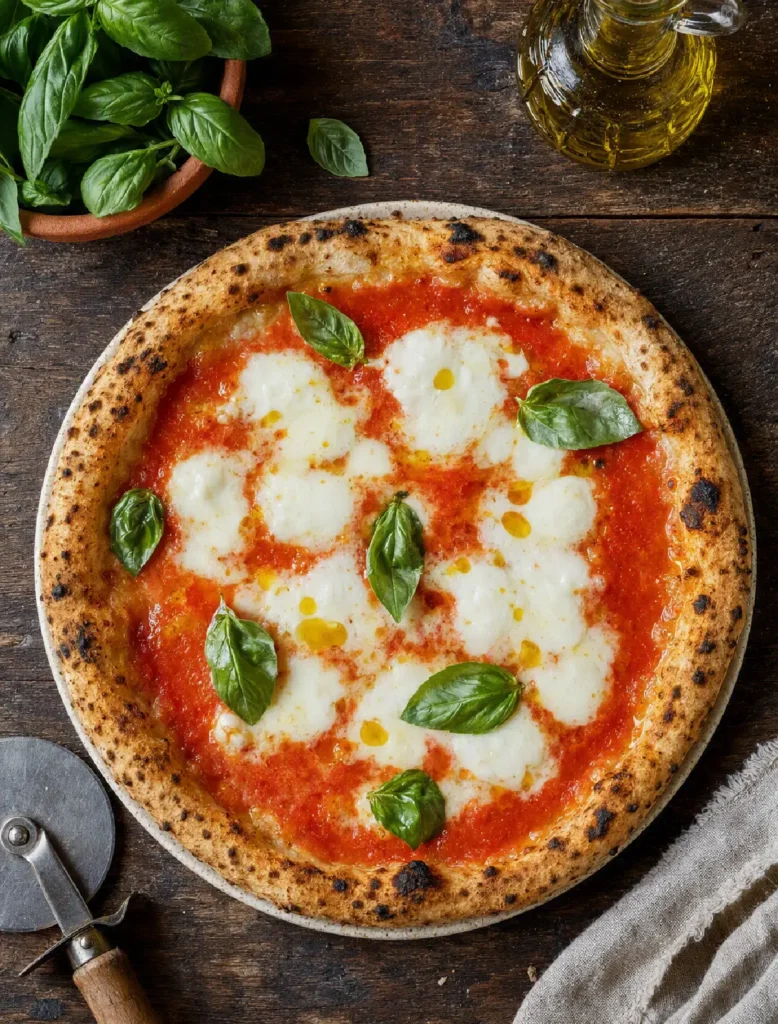
Spread about 70 g tomatoes over the dough, starting in the center and working outwards with the back of a spoon, leaving the rim uncovered.
Add about 90 g mozzarella, a few fresh basil leaves, and finish with 5 g extra virgin olive oil, drizzled over the surface.
Top one pizza at a time, just before baking, so the tomatoes do not remain in contact with the raw dough for too long.
9 Bake at the Highest Temperature 🔥
Slide the pizza onto the preheated pizza stone, baking steel, or upside-down baking tray and bake using the conventional/static setting at the oven's highest temperature for approximately 4–7 minutes. The exact time will depend on the actual temperature of your oven and the baking surface, so start checking the pizza after the first 3–4 minutes.
If the base is cooked but the crust is still pale, switch on the broiler/grill for the final part of the baking time and watch the pizza closely, as the intense heat from above can brown the crust very quickly.
Remove the pizza from the oven when the crust is puffed and well browned, the base is cooked, and the mozzarella has completely melted. Serve immediately, then stretch, top, and bake the remaining dough balls in the same way.
Servings 4
- Amount Per Serving
- % Daily Value *
- Total Fat 27g42%
- Saturated Fat 12g60%
- Sodium 2200mg92%
- Total Carbohydrate 120g40%
- Dietary Fiber 5g20%
- Sugars 6g
- Protein 37g74%
* Percent Daily Values are based on a 2,000 calorie diet. Your daily value may be higher or lower depending on your calorie needs.
Note
The small amount of yeast is intentional because the dough undergoes a long fermentation at room temperature. The exact timing will vary with the temperature of your kitchen: in a warmer room the dough will develop more quickly, while at lower temperatures it may need longer. The appearance and texture of the dough balls are therefore more important than following the clock exactly.
The mozzarella should be thoroughly drained before being added to the pizza. This is particularly important when using a home oven, where the longer baking time gives the mozzarella more opportunity to release moisture onto the center of the pizza.
This recipe keeps the ingredients and basic method rooted in Neapolitan tradition, but the baking method is adapted for a home oven. The Pizza Napoletana TSG specification calls for temperatures and baking times that a standard domestic oven cannot reproduce, so a pizza stone, baking steel, or preheated baking tray helps make the most of the heat available.
For a pizza closer in character to a Neapolitan one, avoid using a rolling pin. Always stretch the dough by hand, working from the center outwards without pressing down on the outer rim.
Pizza is best eaten straight from the oven. If you have leftovers, keep them covered in the refrigerator and reheat them in a hot oven. Avoid the microwave if you want the base and crust to retain a drier, firmer texture.
Keywords:
Pizza Margherita, Pizza Margherita Napoletana, Neapolitan Pizza, homemade pizza, traditional Italian pizza
The best-known story says that Pizza Margherita was created in Naples in 1889 to honor Queen Margherita of Savoy. It is a story that has become part of Italian popular culture, but the traces left by Neapolitan pizza during the nineteenth century take us further back in time.
Tomatoes and mozzarella were already being used on pizzas in Naples well before the meeting between Queen Margherita and Raffaele Esposito. So what actually happened in 1889, and where did the name Margherita come from?
👉 Read the history and origins of Pizza Margherita