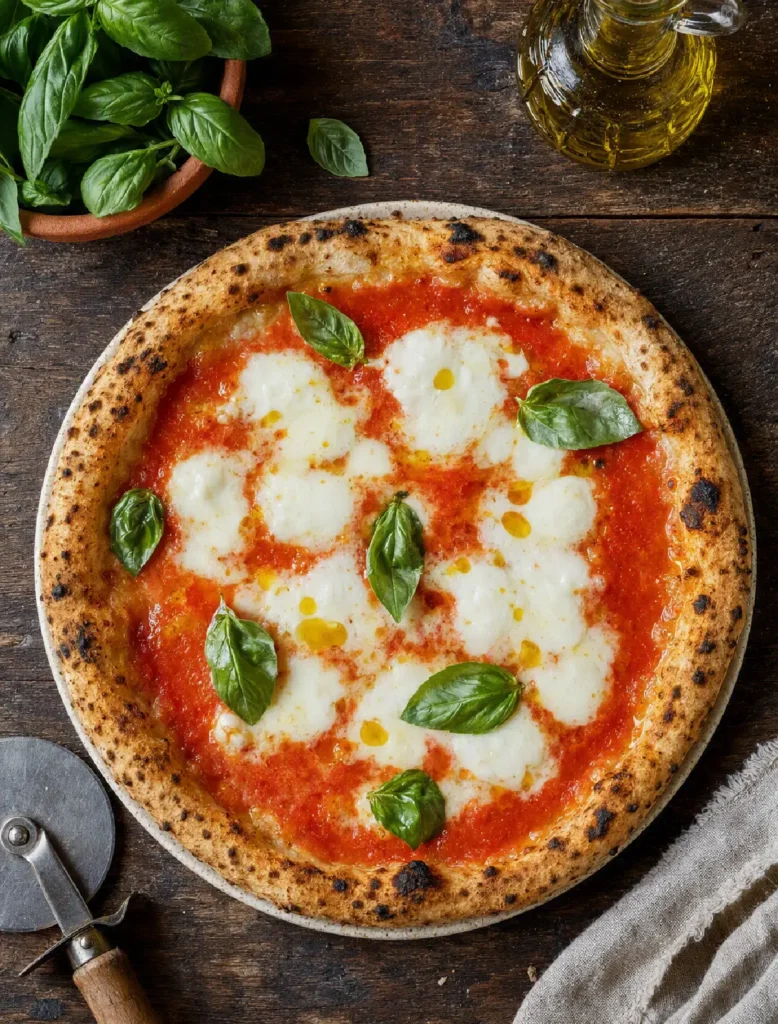
Pizza Margherita Napoletana is made with only a few ingredients, which makes every step important. The dough needs enough time to ferment and develop, the tomatoes should not overpower the other flavors, and the mozzarella needs to melt without releasing too much water.
The real challenge is the home oven, where lower temperatures require a few compromises compared with a pizzeria. The dough and toppings remain rooted in Neapolitan tradition, while the baking method makes the most of the heat available and keeps the cooking time as short as possible, so the dough does not dry out before the crust has time to brown.
Pizza Margherita Napoletana: Traditional Neapolitan Pizza Recipe
Description
A well-fermented dough topped with tomatoes, mozzarella, basil, and extra virgin olive oil for a homemade version of one of Italy's most iconic pizzas.
Ingredients
Per l'impasto
Per il condimento
Instructions
How to Make Pizza Margherita Napoletana
-
Start the Dough 💧
Pour 350 ml water into a large bowl and dissolve 18 g salt in it. Add about 60 g of the flour, taken from the total 630 g, and mix by hand until smooth and fluid. Add 1 g fresh yeast and dissolve it into the mixture.
-
Add the Flour and Knead ✋
Gradually add the remaining flour, continuing to work the dough in the bowl. Once it begins to come together, transfer it to a work surface and knead until smooth, soft, and elastic.
If the dough initially sticks to your hands, do not add extra flour. As you continue kneading, it will develop more structure and become easier to handle.
-
Let the Dough Rest ⏱️
Shape the dough into a ball, place it in the bowl, and cover it to prevent the surface from drying out. Leave it to rest at room temperature for about 2 hours.
The dough should begin to relax and develop, but there is no need to wait for it to double in volume before dividing it.
-
Shape the Dough Balls and Let Them Rise ⚪
Divide the dough into 4 portions of approximately 250 g each and shape them into smooth, well-sealed balls, handling them gently so you do not tear the surface.
Place them apart in a covered container and leave them to rise at room temperature for about 6–8 hours. The exact time will depend on the temperature of your kitchen. When ready, the dough balls should look relaxed and puffy and feel soft and extensible without collapsing or becoming sticky.
-
Prepare the Tomatoes and Mozzarella 🍅
Crush 280 g canned peeled tomatoes by hand, keeping a rustic consistency with some small pieces remaining. Do not cook or blend them. Season with salt to taste.
Cut 360 g mozzarella into strips or evenly sized pieces, place it in a colander, and allow it to drain thoroughly before using it. This removes some of the excess moisture and helps prevent water from being released onto the pizza during baking.
-
Preheat the Oven Thoroughly 🔥
Set the oven to its highest temperature using the conventional/static setting. Place a pizza stone or baking steel in the upper part of the oven and preheat it for 45–60 minutes, allowing the surface to store enough heat before baking.
If you have neither a stone nor a steel, you can use the standard metal baking tray that comes with a conventional oven. Place it upside down in the upper part of the oven and allow it to preheat with the oven for 45–60 minutes. Turning the tray upside down keeps the raised edges underneath, giving you a flat surface that makes it much easier to slide the pizza onto the hot metal without distorting its shape.
If your oven has a broiler/grill, you can use it during the final stage of baking if the crust needs more browning.
-
Stretch the First Dough Ball 🍕
Gently transfer one dough ball to a lightly floured work surface. Press it with your fingertips from the center outwards, pushing the air towards the edge while leaving a 1–2 cm rim untouched.
Continue gently stretching the dough by hand until you have a disc approximately 30 cm (12 in) in diameter. Do not use a rolling pin, as it would compress the dough and push out the gases developed during fermentation.
-
Top the Margherita 🌿
Spread about 70 g tomatoes over the dough, starting in the center and working outwards with the back of a spoon, leaving the rim uncovered.
Add about 90 g mozzarella, a few fresh basil leaves, and finish with 5 g extra virgin olive oil, drizzled over the surface.
Top one pizza at a time, just before baking, so the tomatoes do not remain in contact with the raw dough for too long.
-
Bake at the Highest Temperature 🔥
Slide the pizza onto the preheated pizza stone, baking steel, or upside-down baking tray and bake using the conventional/static setting at the oven's highest temperature for approximately 4–7 minutes. The exact time will depend on the actual temperature of your oven and the baking surface, so start checking the pizza after the first 3–4 minutes.
If the base is cooked but the crust is still pale, switch on the broiler/grill for the final part of the baking time and watch the pizza closely, as the intense heat from above can brown the crust very quickly.
Remove the pizza from the oven when the crust is puffed and well browned, the base is cooked, and the mozzarella has completely melted. Serve immediately, then stretch, top, and bake the remaining dough balls in the same way.
Nutrition Facts
Servings 4
- Amount Per Serving
- Calories 880kcal
- % Daily Value *
- Total Fat 27g42%
- Saturated Fat 12g60%
- Sodium 2200mg92%
- Total Carbohydrate 120g40%
- Dietary Fiber 5g20%
- Sugars 6g
- Protein 37g74%
* Percent Daily Values are based on a 2,000 calorie diet. Your daily value may be higher or lower depending on your calorie needs.
Note
The small amount of yeast is intentional because the dough undergoes a long fermentation at room temperature. The exact timing will vary with the temperature of your kitchen: in a warmer room the dough will develop more quickly, while at lower temperatures it may need longer. The appearance and texture of the dough balls are therefore more important than following the clock exactly.
The mozzarella should be thoroughly drained before being added to the pizza. This is particularly important when using a home oven, where the longer baking time gives the mozzarella more opportunity to release moisture onto the center of the pizza.
This recipe keeps the ingredients and basic method rooted in Neapolitan tradition, but the baking method is adapted for a home oven. The Pizza Napoletana TSG specification calls for temperatures and baking times that a standard domestic oven cannot reproduce, so a pizza stone, baking steel, or preheated baking tray helps make the most of the heat available.
For a pizza closer in character to a Neapolitan one, avoid using a rolling pin. Always stretch the dough by hand, working from the center outwards without pressing down on the outer rim.
Pizza is best eaten straight from the oven. If you have leftovers, keep them covered in the refrigerator and reheat them in a hot oven. Avoid the microwave if you want the base and crust to retain a drier, firmer texture.