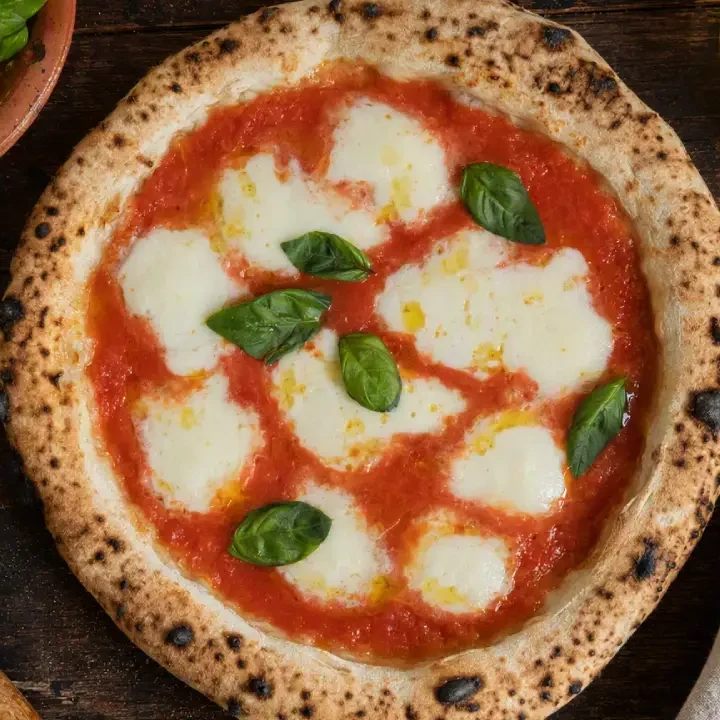
Tomato, mozzarella, and basil: Pizza Margherita is one of the most recognizable Italian dishes in the world. The story of its creation seems equally familiar. In 1889, pizzaiolo Raffaele Esposito is said to have prepared a pizza for Queen Margherita of Savoy using the three colors of the Italian flag, giving rise to the Margherita.
Contemporary documents, however, tell a different story: tomato and mozzarella were already being used on Neapolitan pizza decades before Queen Margherita visited Naples in 1889.
Pizza in 19th-Century Naples
Pizza was already part of everyday life in Naples in the early 19th century. It was prepared in shops, sold in the streets, and inexpensive enough to be accessible to the poorer sections of the population. A statistical record from 1807 lists dozens of pizzerias operating in the city.
In the 1830s, Alexandre Dumas wrote in Le Corricolo about pizzas topped with oil, lard, cheese, tomato, and small fish. He also noted that the ingredients varied according to market prices: what went on a pizza, and what it cost, depended on what was available and how much people could afford. Tomato and mozzarella appear together in a written source as early as 1848; in 1853, Francesco De Bourcard’s Usi e costumi di Napoli e contorni descritti e dipinti describes pizzas prepared with oil, lard, cheese, tomato, small fish, and thin slices of mozzarella.
Thirty years later, Matilde Serao portrayed pizza being sold through the alleys of Naples in Il ventre di Napoli. Shop assistants carried pizzas into the streets and sold portions costing as little as one soldo, cheap enough for children to buy. Among the toppings Serao mentions are tomato, garlic, mozzarella, and anchovies.
Raffaele Esposito and Queen Margherita
King Umberto I and Queen Margherita of Savoy stayed in Naples in 1889. According to the famous story, Raffaele Esposito, pizzaiolo at the historic Neapolitan pizzeria then known as “Pietro… e basta così”, prepared three pizzas for the Queen. One was topped with tomato, mozzarella, and basil, whose red, white, and green were associated with the colors of the Italian flag. According to the story, this was the Queen’s favorite, and Raffaele Esposito decided to name it Margherita in her honor.
The main documentary evidence supporting the story is a letter dated 11 June 1889, attributed to Camillo Galli, head of the Royal Household’s Table Services, stating that the three pizzas prepared by Esposito had been greatly appreciated by the Queen.
Historian Zachary Nowak has challenged the letter’s authenticity. Comparing it with Royal Household correspondence from the same period, he identified inconsistencies in its layout, handwriting, stamps, and official procedures, and concluded that the letter was a forgery. The year 1889 therefore remains associated primarily with the history of the Margherita name, rather than with the first appearance of tomato and mozzarella on pizza.
From the Streets of Naples to the Rest of the World
Pizza travelled with Italian emigrants and found one of its most important new homes in the United States. During the 20th century, increasingly distinctive styles developed far from the Neapolitan tradition: sizes, doughs, toppings, and cooking methods changed, while the word pizza entered the international culinary vocabulary without even needing to be translated.
From Tradition to Official Recognition
Official recognition came much later. Pizza Napoletana is now protected in the European Union as a Traditional Speciality Guaranteed (TSG), with a specification defining its ingredients, dough preparation, shaping, characteristics, and cooking method.
The recognition granted by UNESCO in 2017 is different. It does not cover Pizza Margherita, or even pizza simply as a food: what was inscribed on the Representative List of the Intangible Cultural Heritage of Humanity is the Art of Neapolitan ‘Pizzaiuolo’.
The protected heritage encompasses the craft behind Neapolitan pizza: preparing and working the dough, the pizzaiuolo’s techniques and gestures, managing the cooking process, and passing this knowledge from one generation to the next.
Want to make Pizza Margherita at home? The ingredients, dough, and method have been adapted for home preparation.