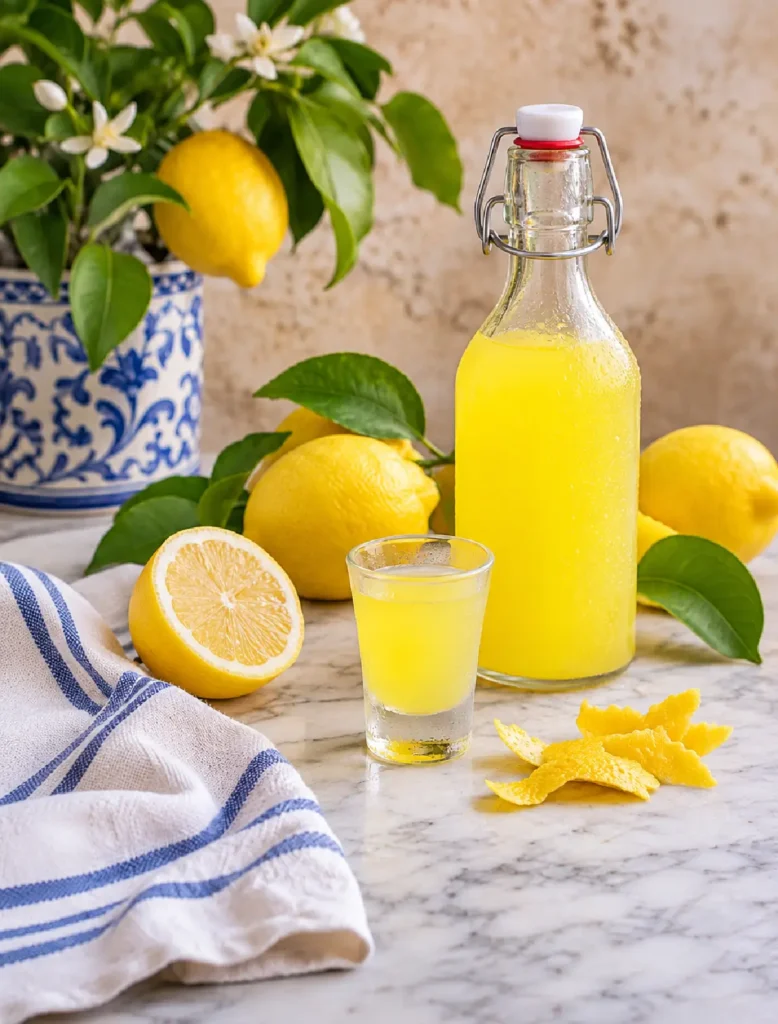
Limoncello often arrives at the table when the meal is over, sometimes in a bottle taken straight from the freezer. In a small glass, it has a rich texture and a shade of yellow that varies depending on the lemons used. The first sip is sweet, followed by the aroma of lemon zest and a slightly bitter edge that keeps the sugar from overwhelming the citrus flavour. This Italian liqueur is deeply connected to Campania, particularly Sorrento, Capri and the Amalfi Coast, where making it at home has long been part of local tradition.
To make homemade limoncello, we need just four ingredients: lemons, food-grade alcohol, water and sugar. Choosing the right fruit makes a real difference. We look for fragrant lemons with peel that has not been treated after harvesting, as this is where the essential oils responsible for the liqueur’s distinctive aroma are concentrated. When peeling them, we take care to remove only the yellow zest, leaving behind the white pith, which would make the liqueur bitter. We steep the zest in alcohol for 10 days, allowing it to gradually release its colour and fragrance.
Next, we prepare a simple syrup with water and sugar, let it cool and combine it with the strained alcohol. The liqueur may turn cloudy as the essential oils from the lemon zest disperse in the water. Rather than serving it immediately, we leave it to rest so that the sweetness of the syrup and the strength of the alcohol have time to come together. When it is finally ready, a small serving, well chilled, is all we need.
Homemade Limoncello
Description
Make traditional homemade limoncello with lemon zest, food-grade alcohol and simple syrup. After 10 days of infusion and 30 days of resting, this Italian lemon liqueur is ready to serve chilled.
Ingredients Approximate Yield: 1.2 litres (about 40.6 US fl oz)
Instructions
How to Make Homemade Limoncello
-
Wash and Peel the Lemons 🍋
Wash the lemons thoroughly under running water, gently rubbing the peel to remove any impurities, then dry them with a clean kitchen towel. Using a vegetable peeler, remove only the yellow zest, avoiding the white pith underneath, which would make the liqueur bitter. Weigh the zest until you have 150 g (5.3 oz).
-
Steep the Lemon Zest 🫙
Place the zest in a clean, dry glass jar with an airtight lid. Pour in 500 ml (16.9 US fl oz) of food-grade ethyl alcohol at 90% or 95% ABV (180 or 190 proof), making sure the zest is completely submerged. Seal the jar and leave it to steep for 10 days in a cool, dark place, away from heat sources. Gently shake the jar once a day.
-
Prepare the Sugar Syrup 🥄
After 10 days, pour 500 ml (16.9 US fl oz) of water into a saucepan and add 300 g (10.6 oz) of granulated sugar. Heat over medium heat, stirring until the sugar has completely dissolved. There is no need to boil the syrup for long. Remove from the heat and allow it to cool completely.
-
Strain and Combine 🍶
Strain the infused alcohol through a fine-mesh sieve, optionally lined with food-safe cheesecloth, to remove the lemon zest and any remaining particles. Slowly pour the cooled syrup into the infused alcohol, stirring well. The liqueur may become slightly cloudy as the lemon essential oils disperse when mixed with water.
-
Bottle and Leave to Rest 🍾
Using a funnel, transfer the limoncello into clean, completely dry glass bottles. Seal tightly and store in a cool, dark place for approximately 30 days, allowing the flavours to develop and blend.
-
Serve the Limoncello ❄️
Once the resting period is complete, place a bottle in the refrigerator to chill thoroughly. You can also chill the small serving glasses before pouring the liqueur.
Note
Choosing the lemons
Use organic lemons or lemons with peel specifically suitable for consumption and free from post-harvest chemical treatments. Sorrento IGP lemons and Amalfi Coast IGP lemons are excellent choices, but other fragrant varieties work well too. The number of lemons is approximate; the important quantity is 150 g (5.3 oz) of yellow zest.
Alcohol strength
Using food-grade alcohol at 90% or 95% ABV produces a relatively strong liqueur. The final alcohol content depends on the alcohol used and the actual volume after adding the syrup. In the United States, these strengths correspond to 180 and 190 proof. Never use denatured alcohol, rubbing alcohol or alcohol intended for cleaning.
Storage
Keep limoncello in tightly sealed glass bottles, protected from light and heat. Refrigerate before serving. Freezer storage is suitable only when the final alcohol concentration is high enough to prevent freezing.
Appearance
A slightly cloudy appearance is normal and results from the essential oils extracted from the lemon zest. Repeated filtration is not necessary to make the liqueur completely clear.
Using the leftover lemons
After removing the zest, squeeze the lemons and use the juice in other recipes, or freeze it in small portions.