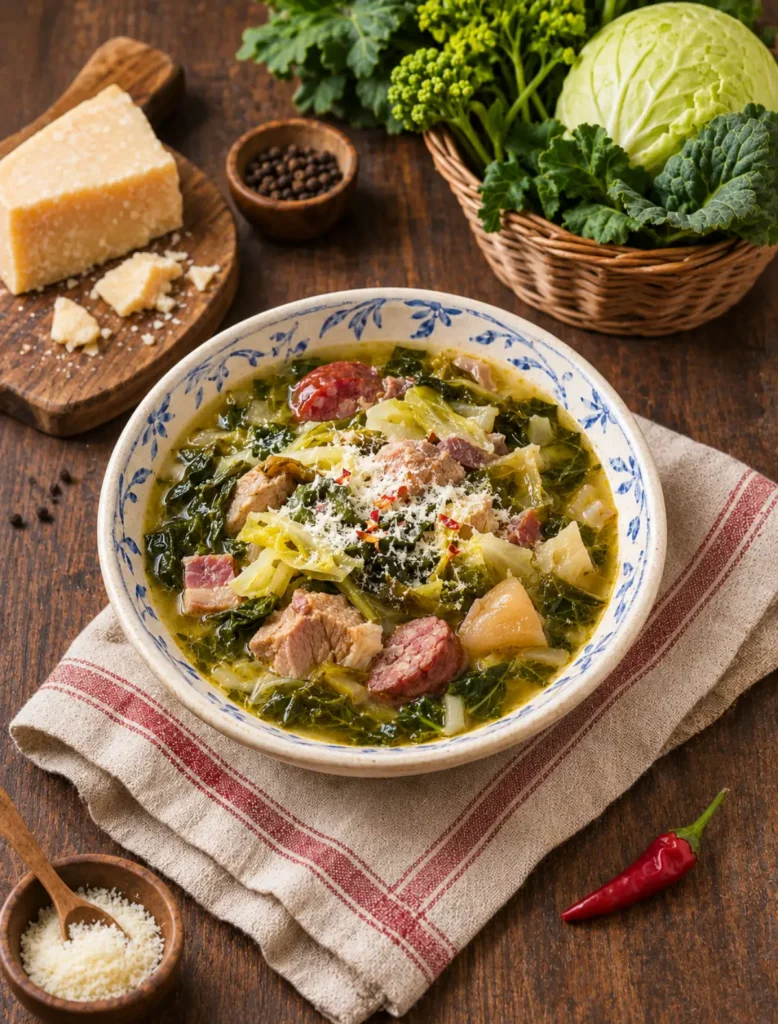
Leafy greens make up a generous part of Neapolitan minestra maritata. Escarole, chicory, green cabbage, leaf broccoli and broccoli rabe are cooked in a rich pork broth with pieces of sausage and guanciale. The slightly bitter flavour of the vegetables contrasts with the richness and savouriness of the meat. The Parmigiano Reggiano rinds also contribute their flavour as they soften during cooking.
The version we prepare belongs to the Neapolitan tradition of humble home cooking, in which even pork skin and ham bones were put to good use. Preparation takes several hours, although much of that time is spent waiting. We gently simmer the meat and allow the broth to cool so that we can remove the fat from the surface.
We blanch the vegetables separately without cooking them completely. Only during the final stage do we bring them together with the meat. This is the “marriage” from which the soup takes its name, as the vegetables finish cooking and absorb the flavours of the broth. We can also prepare it a day ahead, as it tastes even better the following day.
Minestra Maritata: Traditional Neapolitan Pork and Greens Soup
Description
Minestra maritata combines five varieties of vegetables with a rich broth made from pork skin, ham bone, Naples salami, sausages and guanciale. A traditional dish from Campania's humble home cooking, characterised by slow cooking and the combination of savoury meat and slightly bitter greens.
Ingredients
Instructions
How to Make Traditional Neapolitan Minestra Maritata
-
Prepare the Meat and Aromatics 🔪
Check the fresh pork skin and cured ham rind, removing any remaining bristles and scraping the surface if necessary. Cut them into large pieces.
Peel the carrot, wash the celery and peel the onion, then cut them into large chunks. Leave the Naples salami and sausages whole, while the guanciale can be cut into large pieces.
-
Prepare the Meat Broth 🍲
Place the ham bone, pork skin, ham rind, salami, sausages, guanciale, carrot, celery and onion in a large pot. Add a few black peppercorns and pour in the cold water, making sure all the meat is covered.
Slowly bring to a boil, then reduce the heat and simmer for approximately 3 hours, with the lid slightly ajar. During cooking, periodically remove any foam and impurities that rise to the surface using a skimmer.
The broth should simmer gently rather than boil vigorously. If the liquid reduces too much, add a little hot water.
Do not add salt at this stage, as the ham, salami and guanciale will naturally release their salt into the broth.
-
Remove and Cut the Meat 🥩
Once the pork skin and ham rind are tender and the meat is thoroughly cooked, remove them from the broth using a slotted spoon.
Remove any remaining pieces of meat attached to the ham bone and discard the bone and any inedible parts. Cut the pork skin, ham rind and guanciale into small pieces, then slice the salami and sausages into rounds or bite-sized pieces.
Transfer everything to a container, add a few tablespoons of broth to keep the meat moist, cool quickly and refrigerate promptly.
-
Strain and Degrease the Broth 🥄
Strain the broth through a fine-mesh sieve, removing the aromatics and any remaining pieces of meat.
Cool it quickly using an ice-water bath or by dividing it into smaller containers, then refrigerate.
Leave the broth in the refrigerator for approximately 4 hours, or until the fat has solidified on the surface, then remove it with a spoon. If we prepare the broth the day before, we can leave it in the refrigerator overnight.
-
Prepare the Vegetables 🥬
Trim the leaf broccoli, green cabbage, chicory greens, escarole and broccoli rabe, removing damaged leaves, tough cores and the harder parts of the stems.
Wash all the vegetables thoroughly, several times if necessary, to remove any traces of soil. Roughly chop the larger leaves and keep the different varieties separate.
-
Blanch the Vegetables 💧
Bring plenty of lightly salted water to a boil and blanch the vegetables separately, working in small batches.
Cook them for approximately 2-5 minutes, depending on the texture of the leaves and stems. They should soften without becoming fully cooked.
Drain the vegetables, allow them to cool slightly and gently squeeze out any excess water.
-
Finish Cooking the Vegetables 🍲
Scrape the outer surface of the Parmigiano Reggiano rinds with a knife to remove any impurities, then cut them into small pieces.
Bring the degreased broth back to a boil and add all the blanched vegetables, the Parmigiano Reggiano rinds and a small piece of hot chilli pepper.
Reduce the heat and simmer gently for approximately 30 minutes, allowing the vegetables to absorb the flavours of the broth and the cheese rinds to soften.
-
Add the Meat and Finish the Soup 🥘
Add the previously prepared meat and simmer for another 5-10 minutes, making sure all the pieces are thoroughly heated.
Taste the broth and adjust the seasoning with salt and pepper only if necessary. Turn off the heat, cover the pot and allow the soup to rest for approximately 30 minutes so that the flavours can come together.
-
Serve the Minestra Maritata 🍽️
Serve the soup hot, gently reheating it if necessary. Divide the broth, vegetables, pieces of meat and softened Parmigiano Reggiano rinds evenly among the serving bowls.
Finish with a sprinkling of grated Parmigiano Reggiano.
Nutrition Facts
Servings 6
- Amount Per Serving
- Calories 550kcal
- % Daily Value *
- Total Fat 32g50%
- Saturated Fat 11g56%
- Sodium 1400mg59%
- Total Carbohydrate 16g6%
- Dietary Fiber 8g32%
- Sugars 5g
- Protein 45g90%
* Percent Daily Values are based on a 2,000 calorie diet. Your daily value may be higher or lower depending on your calorie needs.
Note
Storage
Minestra maritata can be stored in the refrigerator for 2-3 days in an airtight container. After cooking, cool it quickly and refrigerate it within 2 hours.
It can also be frozen in individual portions for approximately 2 months. The vegetables may become slightly softer after thawing. Allow the soup to thaw in the refrigerator and reheat thoroughly before serving.
Make-Ahead Preparation
Minestra maritata is particularly well suited to being prepared in advance. We can cook the meat and prepare the broth the day before, leaving it in the refrigerator overnight. The following day, it will be easier to remove the solidified fat and finish the preparation with the vegetables.
The fully prepared soup also develops a richer flavour after resting overnight in the refrigerator.
Choosing the Vegetables
The vegetables used in minestra maritata can vary according to the season, availability and family traditions. Different versions of the recipe may also include Savoy cabbage, borage, Swiss chard and other wild greens.
The important thing is to maintain a balance between mild-flavoured vegetables and those with slightly bitter notes, such as chicory and broccoli rabe.
Vegetable Substitutions Outside Italy
If traditional Neapolitan Christmas broccoli is unavailable, we can use other varieties of leaf broccoli, such as spigariello, or alternatively kale.
Chicory greens can be replaced with edible dandelion greens, while curly endive, also known as frisée, can be used instead of escarole. If broccoli rabe is unavailable, turnip greens are another option.
These substitutions will not reproduce the exact flavour of the traditional Neapolitan recipe, but they help preserve its characteristic balance between mild and slightly bitter vegetables.
Choosing the Meat
Our version uses only pork, following the tradition of Neapolitan humble home cooking. Other interpretations of minestra maritata include hen, beef or different cuts of pork, such as ribs, trotters and ears.
To preserve the character of our preparation, we prefer cured meats that are not excessively spiced and cuts of pork suitable for slow cooking.
How to Degrease the Broth
Refrigerating the broth makes it easier to remove the fat released by the meat during cooking. Once chilled, the broth may develop a jelly-like consistency. This is perfectly natural and results from the collagen found mainly in the pork skin and ham rind.
The broth will become liquid again when reheated.
Blanching the Vegetables
Blanching the vegetables separately allows us to account for their different cooking times and soften the bitter notes of certain varieties.
Avoid cooking them completely at this stage, as they will continue cooking in the meat broth for approximately another 30 minutes.
Adjusting the Seasoning
The ham bone, Naples salami, guanciale and Parmigiano Reggiano rinds naturally contribute salt to the soup. For this reason, it is best not to salt the broth at the beginning of the preparation.
Taste it towards the end of cooking and add salt only as needed.
What to Serve with Minestra Maritata
We can serve minestra maritata with slices of rustic country bread, lightly toasted if desired, for dipping into the broth.