The first thing you notice when tasting casoncelli alla bergamasca is the flavour of the meat, followed by a subtle sweetness from the pear, sultanas and amaretti biscuits. Only a small amount of amaretti is used, along with cinnamon, nutmeg and lemon zest. None of these ingredients should overpower the others or mask the flavour of the roast beef and fresh pork sausage meat.
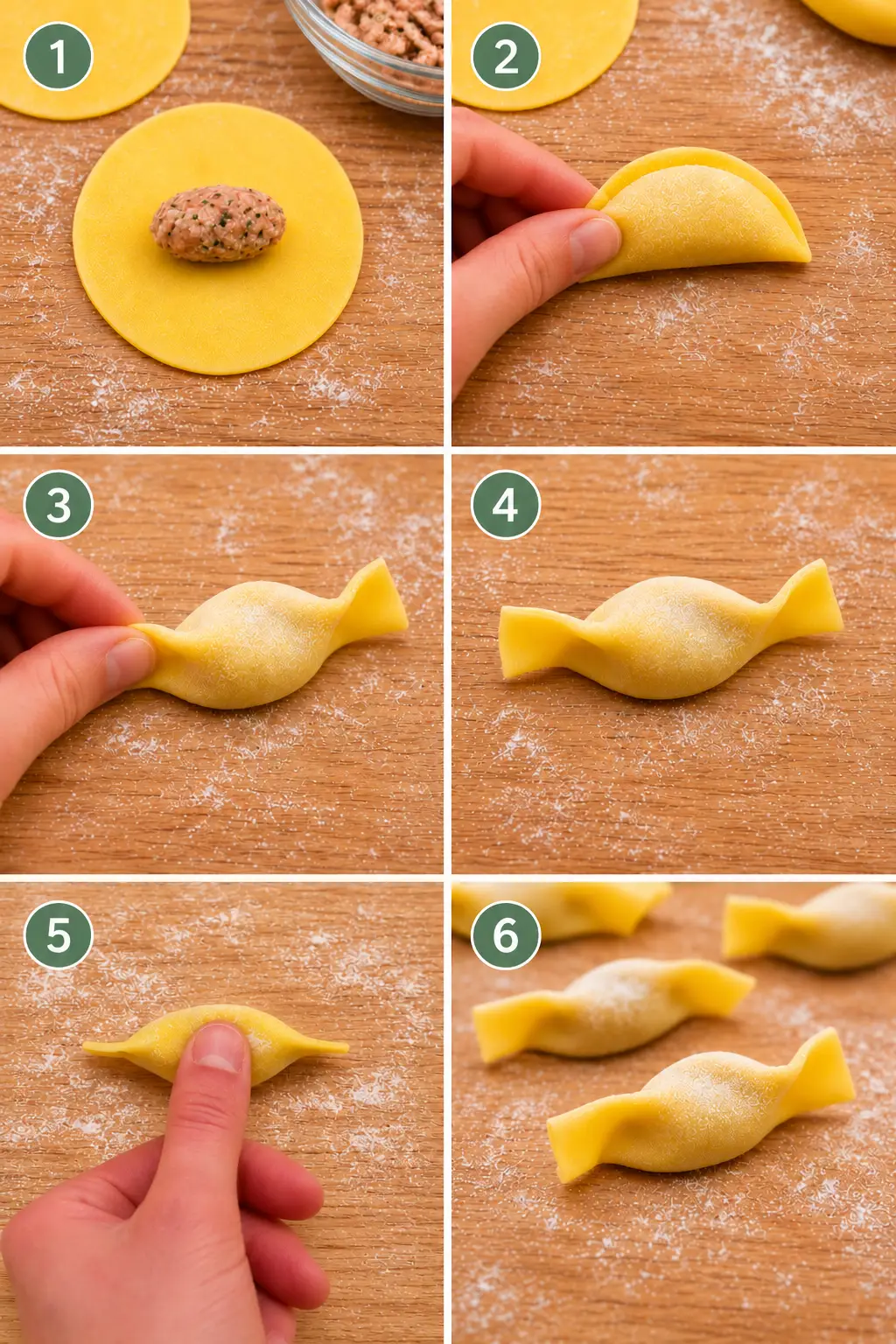
One of the distinctive features of casoncelli is the way they are shaped. After folding each pasta disc into a half-moon, gentle pressure is applied to the centre, creating a small indentation that catches the butter and grated cheese. The pasta sheet must be thin yet strong enough to hold the filling during cooking.
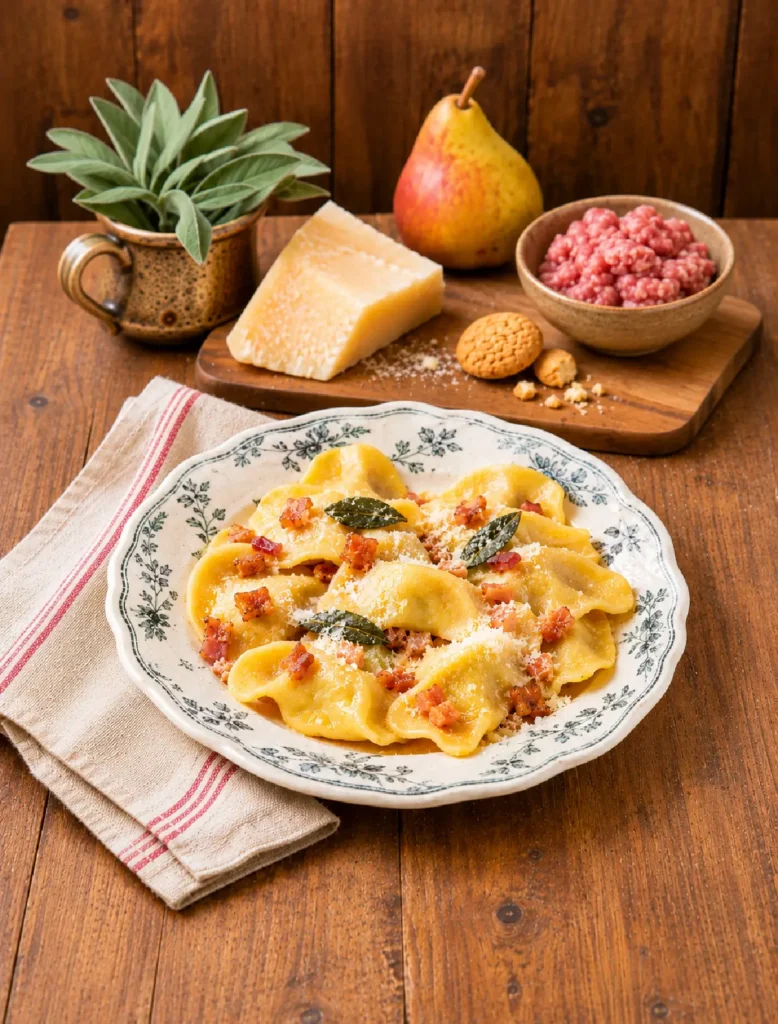
For the traditional dressing, pancetta is browned in butter with sage leaves. Once drained, the casoncelli are sprinkled with grated Grana Padano PDO before the hot butter is poured over them, together with the golden pancetta and sage leaves.
Casoncelli alla Bergamasca: Traditional Italian Meat-Filled Pasta
Description
We prepare traditional casoncelli from Bergamo using homemade pasta and a filling of roast beef, fresh pork sausage meat, pear, amaretti and spices. Once shaped into their distinctive half-moons with a central indentation, the casoncelli are boiled and served with grated Grana Padano PDO, melted butter, golden pancetta and sage.
Ingredients
For the pasta dough
For the filling
For cooking and dressing
Instructions
How to Make Casoncelli alla Bergamasca
-
Prepare the pasta dough 🥚
Place the Italian 00 flour and durum wheat semolina in a bowl, mix them together and add the eggs. Begin combining the ingredients with a fork, gradually adding as much water as needed.
Once the dough starts to come together, transfer it to a work surface and knead vigorously by hand for approximately 8-10 minutes, until smooth, firm and elastic.
Wrap the dough in plastic wrap and leave it to rest in the refrigerator for 30 minutes.
-
Prepare the beef for the filling 🥩
If we have leftover roast beef, we can use it directly. Otherwise, we need approximately 150 g (5.3 oz) of raw beef, preferably rump or a lean cut from the round, such as knuckle.
Heat a little extra virgin olive oil in a small pan and brown the meat on all sides. Season lightly with salt, reduce the heat and continue cooking with the lid on, adding a little water if necessary.
Once cooked, allow the meat to cool completely and weigh out 100 g (3.5 oz), removing any tough pieces or connective tissue.
-
Prepare the filling ingredients 🔪
Soak the sultanas in lukewarm water for approximately 10 minutes, then drain, squeeze out the excess water and chop them finely.
Peel and core the pear, then cut the flesh into cubes just a few millimetres across. Avoid leaving large pieces, as these could make the casoncelli more difficult to seal.
Finely crush the amaretti biscuits and chop the garlic and parsley leaves. Grate the lemon zest, taking care not to include the bitter white pith.
Pass the roast beef and fresh pork sausage meat through a meat grinder. Alternatively, use a food processor, pulsing briefly to achieve a fine texture without turning the meat into a paste.
-
Combine the filling 🥣
Place the minced roast beef, fresh pork sausage meat, breadcrumbs, pear, crushed amaretti and sultanas in a bowl.
Add the grated Grana Padano PDO, egg, garlic, parsley and lemon zest. Season with a little nutmeg, a pinch of cinnamon, pepper and salt, bearing in mind that the sausage meat and cheese are already quite salty.
Mix thoroughly by hand until the filling is evenly combined and compact. The ingredients must be combined while cold, without cooking the filling beforehand.
When a small amount of filling is pressed between our hands, it should form a ball that holds its shape without releasing any liquid.
If the mixture is too dry, add a very small amount of water. If it is too moist, incorporate a little more breadcrumbs.
Cover the bowl and refrigerate the filling while preparing the pasta sheets.
-
Roll out the pasta dough 🥢
Take the rested dough and divide it into smaller portions. Work with one portion at a time, keeping the remaining dough wrapped to prevent it from drying out.
Flatten the first portion slightly and pass it through a pasta machine, starting with the widest setting. Fold the pasta sheet over itself and pass it through the rollers again.
Gradually reduce the distance between the rollers until the pasta sheet is smooth, even and approximately 0.6 mm (0.024 inches) thick.
Alternatively, roll out the dough using a rolling pin on a lightly floured work surface.
-
Fill and seal the casoncelli 🥟
Using a round pastry cutter, cut the pasta sheet into discs measuring 6-8 cm (2.4-3.1 inches) in diameter.
Shape the filling into small balls weighing approximately 7-8 g (0.25-0.28 oz) each and place one in the centre of each disc. If using a larger cutter, adjust the amount of filling accordingly, leaving enough space around the edges for sealing.
If the pasta has started to dry out slightly, moisten the edges with a little water using a pastry brush or your fingertips.
Fold each disc into a half-moon, gently pressing the pasta around the filling to release any trapped air. Press firmly along the entire edge to ensure it is completely sealed.
-
Give the casoncelli their traditional shape 🤲
Position each half-moon with the folded side facing upwards. Bend the sealed edge slightly and gently press the centre of the fold with your thumb to create the characteristic indentation.
The casoncello should take on a slightly curved, boat-like shape.
Arrange the casoncelli on a tray lightly dusted with semolina, without overlapping them.
Gather the pasta trimmings, knead them together and leave them covered for approximately 15 minutes before rolling them out again.
Continue until all the pasta dough and filling have been used.
-
Prepare the butter, pancetta and sage dressing 🥓
Cut the pancetta into strips or small cubes. Wash and thoroughly dry the sage leaves.
Melt the butter in a large pan over medium-low heat, add the pancetta and cook until golden.
Add the sage leaves and continue cooking briefly until they have infused the butter with their aroma.
The butter may develop a light golden-brown colour, but it must not burn or become excessively dark.
-
Cook the casoncelli 🍲
Bring a large pot of water to the boil, season with salt and gently add the casoncelli.
Cook for approximately 7-8 minutes, maintaining a steady but gentle boil to prevent the pasta from opening during cooking.
If necessary, cook the casoncelli in batches to avoid overcrowding the pot.
Before draining, check that the pasta is cooked through, including the edges where the dough is folded, and that the filling is fully cooked. As it contains raw minced pork, the internal temperature must reach at least 71°C (160°F). Extend the cooking time if necessary.
Remove the casoncelli with a slotted spoon and allow the excess water to drain away.
-
Dress and serve 🍽️
Divide the casoncelli among serving plates, preferably warmed, and sprinkle with grated Grana Padano PDO.
Pour the hot butter directly over the cheese, distributing the golden pancetta and sage leaves evenly.
The heat of the butter will slightly melt the grated cheese.
Serve immediately.
Nutrition Facts
Servings 6
- Amount Per Serving
- Calories 780kcal
- % Daily Value *
- Total Fat 35g54%
- Saturated Fat 19g95%
- Sodium 900mg38%
- Total Carbohydrate 87g29%
- Dietary Fiber 4g16%
- Sugars 6g
- Protein 29g58%
* Percent Daily Values are based on a 2,000 calorie diet. Your daily value may be higher or lower depending on your calorie needs.
Note
How to substitute Italian pasta di salame
Pasta di salame is a fresh mixture of minced pork and fat traditionally used to make Italian salami before it is stuffed into casings and cured.
If it is unavailable, use an equal amount of fresh pork sausage meat or fresh pork sausages with the casings removed. Choose a variety without fennel, chilli or other particularly strong seasonings.
In the United States, look for fresh pork sausage meat or bulk pork sausage. In the United Kingdom, it is commonly sold as pork sausage meat or pork sausagemeat.
Alternatively, use minced pork with a fat content of approximately 25-30%, lightly seasoned with salt and pepper. Avoid excessively lean minced pork, which could make the filling too dry.
Do not use cured salami, precooked sausages or smoked sausages.
Which cut of beef to use
If leftover roast beef is unavailable, choose a small piece of beef suitable for relatively short cooking.
In the United States, top sirloin or top round are suitable options. In the United Kingdom, rump or topside can be used.
The beef must be completely cool before being incorporated into the filling.
The preparation and cooking times indicated in this recipe assume that the roast beef is already available. If preparing it from scratch, allow additional time for cooking and cooling.
Which pear variety to choose
Abate Fetel and Spadona pears are particularly suitable for this filling. If they are unavailable, Conference or Bosc pears are good alternatives.
Choose a ripe but firm pear. Avoid overly ripe or particularly juicy varieties, as they could make the filling too moist.
Which amaretti biscuits to use
Use dry, crisp Italian amaretti rather than the soft variety known as amaretti morbidi.
Only a small amount is needed to give the filling its characteristic sweet and slightly bitter almond flavour.
Outside Italy, they can usually be found in Italian food shops under the names amaretti biscuits or amaretti cookies.
How to substitute Grana Padano PDO
If Grana Padano PDO is unavailable, use Parmigiano Reggiano PDO or another mature hard cheese suitable for grating.
The flavour will be slightly different from that of the traditional recipe.
How to prevent casoncelli from opening during cooking
The pasta sheet should be thin but intact, without tears or excessive flour along the edges.
Avoid overfilling the pasta and release any trapped air before sealing. If necessary, lightly moisten the edges to help them stick together.
Maintain a gentle boil during cooking and use a slotted spoon to remove the casoncelli carefully from the water.
Refrigerating casoncelli
Uncooked casoncelli can be refrigerated at a temperature of no more than 4°C (40°F) for up to 24 hours.
Arrange them on a lightly floured tray without overlapping and cover them to prevent them from drying out.
Once cooked and dressed, casoncelli can be refrigerated in an airtight container for up to 2 days. Reheat gently in a pan with a little butter.
How to freeze casoncelli
Casoncelli can be frozen before cooking. Arrange them on a lightly floured tray, leaving enough space between each piece, and place them in the freezer.
Once completely frozen, transfer them to freezer bags or suitable airtight containers. For the best quality, use them within 2 months.
Cook the casoncelli directly from frozen without thawing them first, extending the cooking time as necessary to ensure the filling is fully cooked.