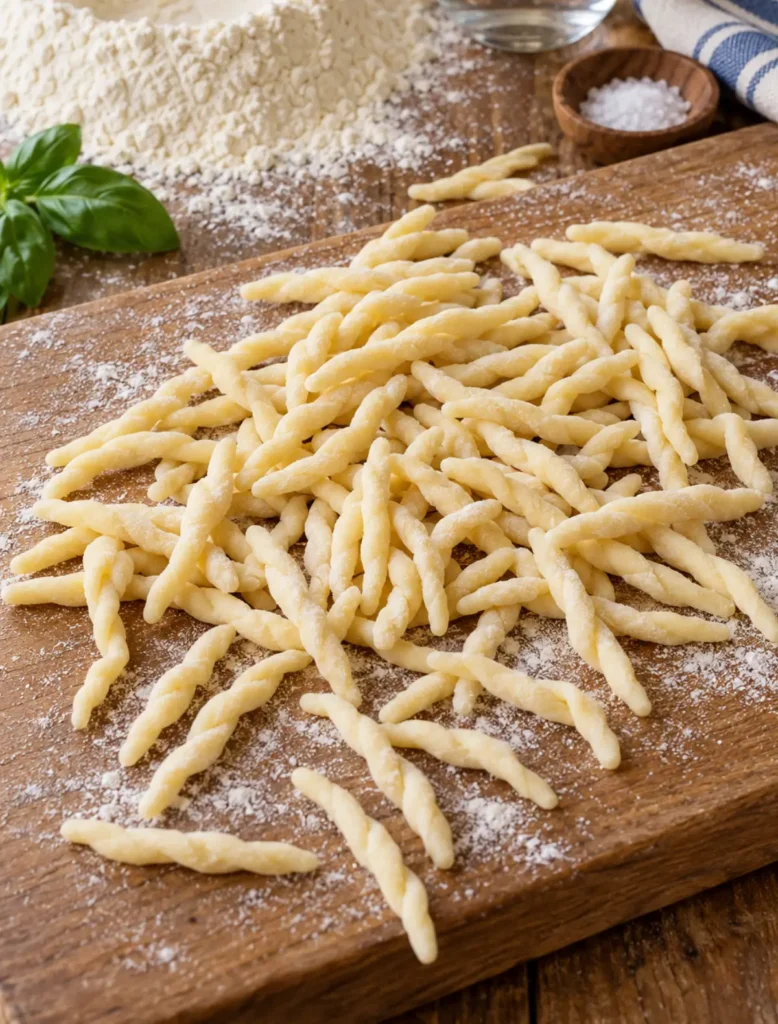
Trofie originated on the Riviera di Levante, particularly around the Golfo Paradiso, where they were shaped by hand long before this pasta became familiar on tables throughout Italy. Short, twisted and never perfectly identical, they are one of Liguria’s most characteristic pasta shapes. They are also officially recognized among the region’s PAT (Traditional Agri-Food Products).
Today, it is almost impossible to think of trofie without pesto Genovese. In Liguria, potatoes and green beans often join them in the version traditionally known as pesto accomodato. Trofie, pesto and vegetables have become one of the best-known combinations in Ligurian cooking.
Homemade Trofie: Traditional Ligurian Pasta Recipe
Description
Homemade trofie are a traditional Ligurian fresh pasta made with flour, water and a pinch of salt. Their characteristic short, twisted shape is formed by working small pieces of dough by hand on a wooden board.
Ingredients
Instructions
How to Make Homemade Trofie
-
Make the dough 🥣
Place the flour on a work surface and make a well in the centre. Add the salt and begin pouring in the lukewarm water a little at a time, gradually incorporating the flour. Continue until you have a firm dough that is soft but not sticky. The 200 g of water is approximate, and you may not need to use it all.
-
Knead and rest the dough ⏱️
Knead vigorously for about 10 minutes, until the dough is smooth and elastic. Cover it with a clean kitchen towel or an upturned bowl and leave it to rest at room temperature for 30 minutes.
-
Divide the dough into small pieces ✋
Pinch off one small piece of dough at a time, roughly the size of a chickpea. Keep the remaining dough covered while you work so that it does not dry out.
-
Roll and twist the trofie 🤌
Place one piece of dough on the work surface and roll it under the edge of your hand to form a small strand about 3-4 cm long. Without completely lifting your hand, drag your palm sideways across the work surface with a firm movement. The dough should twist around itself and take on the characteristic shape of trofie.
-
Arrange the trofie on the work surface 🌾
As you shape them, arrange the trofie on a lightly floured work surface or tray, keeping them separated. Continue in the same way until you have used all the dough.
Note
The amount of water can vary slightly depending on the flour. Add it gradually and stop when the dough is firm, elastic and no longer sticky. You do not necessarily need to use all 200 g.
To cook fresh trofie, bring a large pot of water to the boil, then add the salt. Add the trofie and drain them when cooked but still pleasantly firm. Cooking time can vary depending on their thickness and how long they have been left to dry, so tasting one is the best way to check.
If you are not cooking them immediately, leave the trofie on a lightly floured board or tray with some space between them to prevent them from sticking together.
Our recipe uses wheat flour, following the traditional version we have chosen as our reference. In Liguria, however, trofie made with durum wheat semolina are also found.