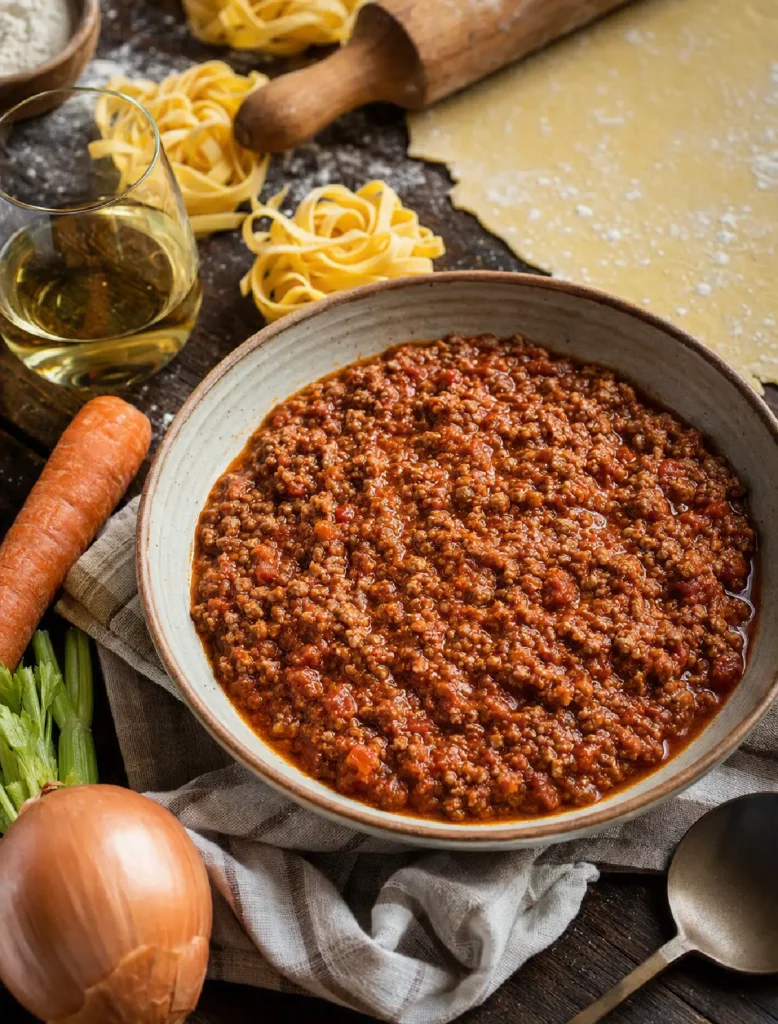
Ragù alla Bolognese is a rich, concentrated meat sauce built primarily around the flavour of the meat. It begins with pancetta, onion, carrot, and celery, followed by coarsely minced beef, which is thoroughly browned before the wine is added.
The amount of tomato is deliberately restrained: tomato passata and double-concentrated tomato paste complement the meat without turning the ragù into a predominantly tomato-based sauce. During the long cooking time, stock is added as needed while the sauce gradually reduces to a thick, cohesive consistency.
That consistency makes it a classic partner for fresh egg tagliatelle and an essential component of Bolognese Lasagna.
Ragù alla Bolognese: Traditional Italian Recipe
Description
Ragù alla Bolognese made with coarsely minced beef, pancetta, vegetables, wine, and a light touch of tomato, slowly cooked until thick and well combined.
Ingredients
Instructions
How to Make Ragù alla Bolognese
-
Finely Chop the Vegetables and Pancetta 🔪
Finely chop the onion, carrot, and celery with a knife, keeping the pieces small and fairly even. Finely chop the fresh pancetta as well, so that its fat can gradually render during the first stage of cooking.
-
Render the Pancetta and Soften the Vegetables 🥓
Place the pancetta in a heavy-bottomed saucepan with the extra virgin olive oil and cook over low heat until the fat begins to render. Add the onion, carrot, and celery and cook gently, stirring regularly and taking care not to let the vegetables brown too much.
-
Brown the Beef Thoroughly 🥩
Increase the heat, add the coarsely minced beef, and break it up thoroughly with a wooden spoon. Cook for about 10 minutes, stirring regularly, until the meat is well browned and most of the liquid it releases has evaporated.
Do not rush this stage: before adding the wine, the beef should be properly browned rather than simply cooked in its own liquid.
-
Deglaze with the Wine 🍷
Pour in the red or white wine and let it reduce completely over medium heat, stirring as it cooks. Wait until the liquid has reduced and the base has concentrated again before adding the tomato.
-
Add the Passata, Tomato Paste, and Stock 🍅
Add the tomato passata and double-concentrated tomato paste, stirring thoroughly to distribute them throughout the meat. Pour in an initial amount of hot stock, enough to keep the ragù moist as the slow cooking begins.
-
Slowly Cook the Ragù 🥘
Reduce the heat, cover, and cook the ragù very gently for about 2 hours, stirring occasionally. Add a little more hot stock as needed to prevent the sauce from becoming too dry.
The cooking time can be extended to approximately 3 hours, depending on the meat used and the consistency reached.
-
Add the Milk Halfway Through Cooking 🥛
If using the whole milk, add it halfway through the cooking time and continue cooking gently, allowing it to be absorbed and incorporated into the ragù.
-
Season and Finish the Ragù 🥄
At the end of cooking, season with salt and freshly ground black pepper. Check the consistency before removing the pan from the heat: the Ragù alla Bolognese should be thick and cohesive, without excess liquid.
Note
For long, even cooking, use a heavy-bottomed saucepan; an earthenware pot also belongs to the traditional preparation. Keep the heat gentle and add hot stock little by little only when needed. If the ragù is still too liquid towards the end, continue cooking uncovered until it reaches a thick, cohesive consistency.
The recipe registered in 2023 also recognises several variations. Beef alone may be replaced with a mixture of approximately 60% beef and 40% pork; the meat may be chopped with a knife, while flat or rolled pancetta may replace fresh pancetta. A light touch of nutmeg is also permitted. The documentation also mentions traditional additions including chicken offal, pork sausage, blanched peas added towards the end of cooking, and dried porcini mushrooms. These ingredients are not part of the main formula used in this recipe.
Traditionally, cartella di manzo, a beef cut from the diaphragm area, was used for ragù, but it can be difficult to find today. The current reference recommends collagen-rich cuts from the forequarter, including shin, shoulder, chuck, belly, and brisket point.
Whole milk is optional. If you choose to use it, add it halfway through cooking and allow it to be absorbed as the ragù continues to cook.
Once cooled, the ragù can be stored in an airtight container in the refrigerator for 3–4 days. It can also be frozen, preferably in individual portions. Thaw it in the refrigerator before reheating thoroughly.