Pappa al Pomodoro also comes from a very practical need: making use of bread that has gone stale. In Tuscany, that bread goes back into the pot with the tomatoes and completely changes texture, soaking up the sauce until it almost falls apart. By the end, you should no longer be able to distinguish the slices: what remains is a thick, soft and still rustic pappa.
The right bread makes quite a difference. Tuscan bread is dense and traditionally made without salt, so it absorbs the tomatoes without bringing too much flavour of its own. Then there are garlic, basil and good extra virgin olive oil, which is not only used at the beginning of the recipe. A final drizzle added raw makes a noticeable difference.
For the tomatoes, we can follow the seasons. Fresh tomatoes are perfect when they are ripe and full of flavour; during the rest of the year, good preserved tomatoes work very well. The method also changes somewhat between Tuscan kitchens. The bread may be added after the tomatoes have cooked or earlier, and either water or vegetable broth can be used to soften it. We are keeping our version simple, with garlic and basil.
There is no need to rush it to the table either. Once the cooking is finished, the bread continues to absorb the tomato and the texture becomes more uniform. Resting is therefore just as much a part of the recipe as cooking. Pappa al Pomodoro can then be eaten hot, left to cool until warm, or served at room temperature with fresh basil and extra virgin olive oil.
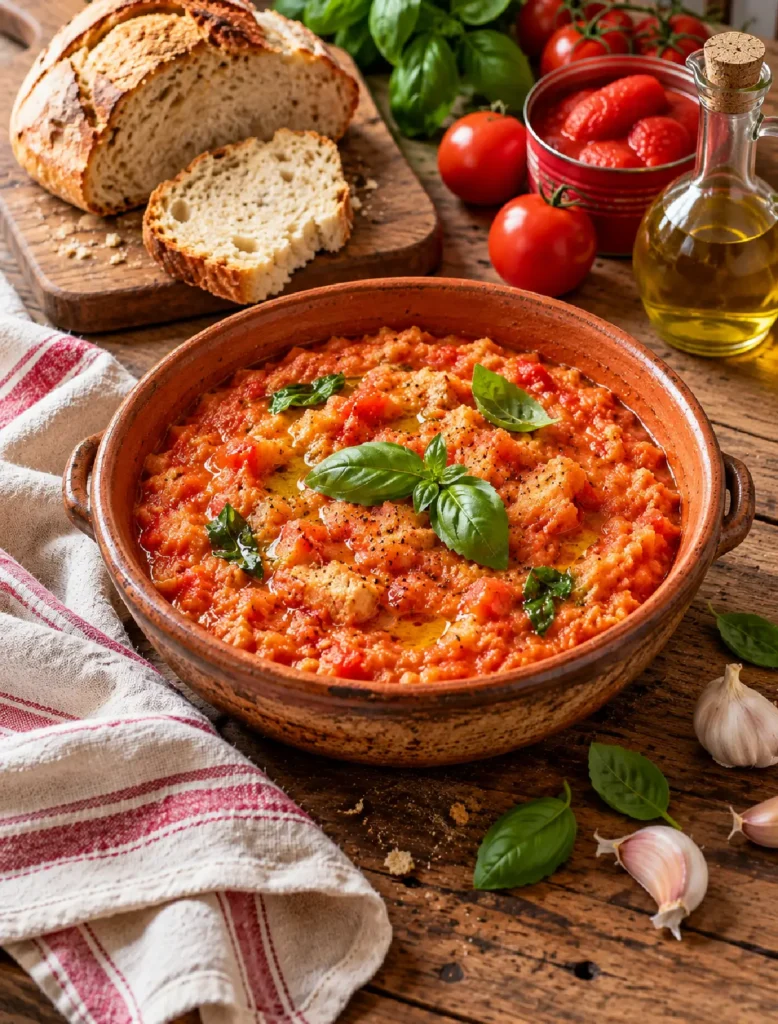
Pappa al Pomodoro: Tuscan Tomato Bread Soup
Description
Pappa al Pomodoro is a traditional Tuscan dish made with stale bread and tomatoes. The bread cooks directly in the tomato sauce until it breaks down, then the pappa is left to rest until soft and uniform. Fresh basil and extra virgin olive oil finish the dish.
Ingredients
Instructions
How to Make Pappa al Pomodoro
-
Infuse the oil with the garlic 🧄
Pour 30 g of extra virgin olive oil into a saucepan and add the 2 garlic cloves, cut in half. Let them gently infuse the oil for a few minutes over low heat, without allowing them to brown.
-
Cook the tomatoes 🍅
Add the 800 g of peeled tomatoes and crush them directly in the saucepan with a fork. Add a few basil leaves, a little salt and some freshly ground black pepper.
Cook over moderate heat for about 20 minutes, stirring occasionally. The tomatoes should lose some of their liquid and turn into a sauce, but should not become too dry.
-
Add the bread and water 🥖
Meanwhile, cut the 300 g of stale Tuscan bread into slices. Once the tomatoes are ready, add the bread directly to the saucepan and pour in the 300 g of hot water.
Cook over low heat for about 10-15 minutes, stirring frequently and working the bread with a spoon as it absorbs the liquid. The exact time will vary depending on how dry the bread is, so pay more attention to its texture than to the clock. The slices should become completely soft and begin to break down into the tomatoes.
If the pappa becomes too dry before the bread reaches this stage, add a little more hot water at a time.
-
Work the bread with a spoon 🥄
Stir vigorously and press down any remaining pieces of bread until the mixture becomes soft and uniform. There is no need to blend it: the bread should break down through cooking and stirring.
Turn off the heat while the mixture is still slightly softer than you want it to be when served, as the Pappa al Pomodoro will continue to thicken while it rests.
-
Leave it to rest for one hour ⏱️
Cover the saucepan and leave the Pappa al Pomodoro to rest for about 1 hour.
After resting, stir it again. If it has become too thick, add a little hot water and work it with the spoon until it returns to a soft consistency.
-
Finish with olive oil and basil 🌿
Taste and adjust the salt and pepper. Add the remaining 20 g of extra virgin olive oil and a few fresh basil leaves, then stir.
Serve the Pappa al Pomodoro hot, warm or at room temperature, finishing each portion with a drizzle of extra virgin olive oil and a few fresh basil leaves.
Nutrition Facts
Servings 4
- Amount Per Serving
- Calories 355kcal
- % Daily Value *
- Total Fat 14.4g23%
- Saturated Fat 2.1g11%
- Sodium 300mg13%
- Total Carbohydrate 49g17%
- Dietary Fiber 5.1g21%
- Sugars 8.3g
- Protein 8.9g18%
* Percent Daily Values are based on a 2,000 calorie diet. Your daily value may be higher or lower depending on your calorie needs.
Note
The amount of water can vary depending on the bread. Very dry bread will absorb more, so keep some additional hot water nearby and add it gradually without making the pappa watery.
If you want to use fresh tomatoes, choose ripe, flavourful ones. You can replace the 800 g of peeled tomatoes with about 1 kg of fresh tomatoes, peeled and roughly chopped before cooking.
Stale Tuscan bread is particularly suitable because it has a dense crumb and is traditionally made without salt. If you cannot find it, use a rustic white country loaf with a firm crumb, preferably one that is not heavily salted.
Pappa al Pomodoro can be served hot, warm or at room temperature. If you make it ahead, check the consistency before serving: the bread will continue to absorb liquid as it rests, so you may need to loosen it with a little hot water.