Sicilian Caponata brings together fried eggplant, celery, tomatoes, olives, and capers, but it is the sweet and sour combination of vinegar and sugar that gives the dish its distinctive flavor. Savory and slightly tangy with a touch of sweetness, it changes from one bite to the next without letting any single ingredient overpower the others.
For us, one step makes a real difference: do not cook everything together from the beginning. Fry the eggplant first and prepare the rest of the sauce separately, bringing them together only towards the end. This allows the eggplant to absorb the sweet and sour sauce and the other flavors without turning into one soft, indistinct mixture.
That contrast is what separates caponata from a simple eggplant and tomato dish. Sweetness, acidity, and savoriness all play a part, but the individual textures should still be recognizable in every bite.
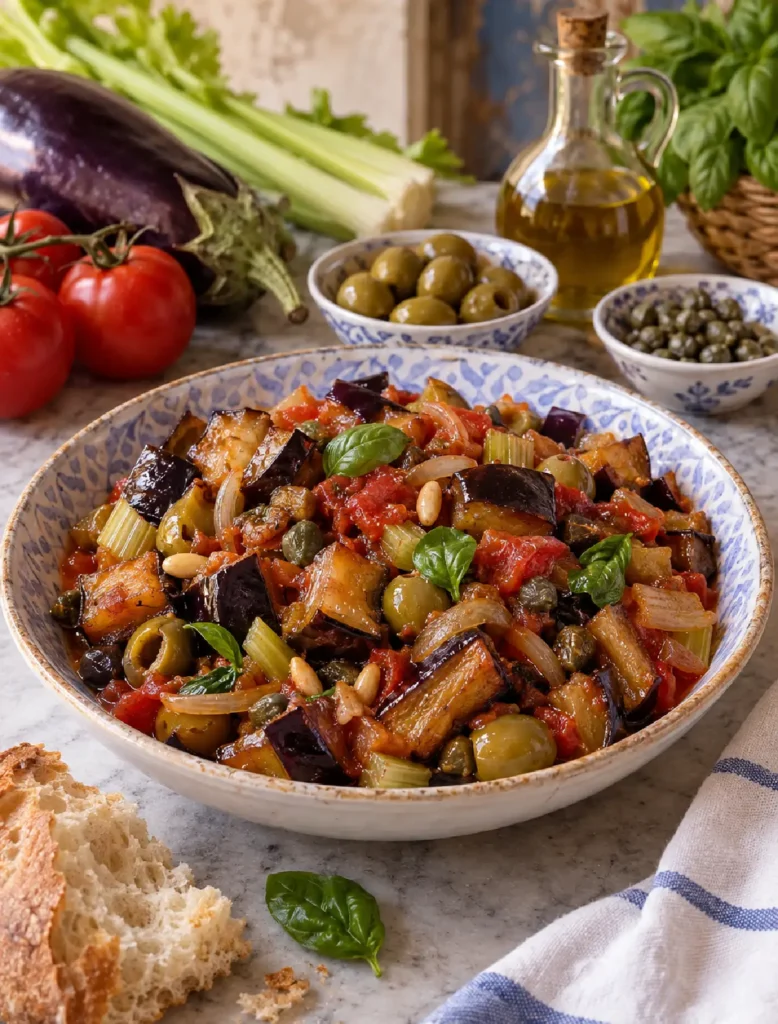
Sicilian Caponata: Traditional Sweet and Sour Eggplant Recipe
Description
Traditional Sicilian caponata with fried eggplant, celery, tomatoes, green olives, and capers, finished with vinegar and sugar.
Ingredients
For the Eggplant
For the Caponata
Instructions
How to Make Sicilian Caponata
-
Cut and Salt the Eggplant 🍆
Wash the eggplant, remove the stems, and cut into cubes about 2–2.5 cm (0.8–1 in) in size. Place in a colander, sprinkle with coarse salt, and leave to drain for about 1 hour. Rinse thoroughly under running water, then dry very well with kitchen paper.
-
Prepare the Celery and Other Ingredients 🔪
Trim the celery, remove any tough strings, and cut into small pieces. Blanch in boiling water for 2–3 minutes, then drain and set aside.
Meanwhile, rinse the capers thoroughly to remove the excess salt, halve the olives, finely slice the onion, and cut the tomatoes into small pieces. If using the pine nuts, toast them for a few minutes in a dry pan, taking care not to let them become too dark.
-
Fry the Eggplant 🔥
Heat plenty of peanut oil to approximately 175°C (350°F). If you do not have a thermometer, dip the tip of a wooden skewer or the handle of a wooden spoon into the oil. When small bubbles immediately form around the wood, the oil is ready for frying.
Fry the eggplant in small batches so the temperature of the oil does not drop too much. Once golden, remove with a slotted spoon and transfer to paper towels to drain the excess oil.
-
Prepare the Tomato Sauce 🍅
Heat 30 ml (2 tbsp) extra virgin olive oil in a large pan. Add the onion and cook gently until softened without letting it brown. Add the tomatoes and cook over medium-low heat until they soften and form a rustic sauce, stirring occasionally.
-
Add the Celery, Olives, and Capers 🫒
Add the blanched celery, green olives, and desalted capers to the tomatoes. Stir and cook gently for a few minutes. Do not add salt at this stage: the olives and capers may already provide enough saltiness.
-
Add the Sweet and Sour Mixture and Eggplant 🍶
Mix 50 ml (3.5 tbsp) white wine vinegar with 40 g (3 tbsp) granulated sugar in a small bowl until the sugar has dissolved. Pour the mixture into the pan, increase the heat slightly, and let the sharp vinegar aroma mellow for a few moments.
Add the fried eggplant and stir gently to coat it in the sauce without breaking up the pieces. Cook for another 2–3 minutes, then taste and add fine salt only if needed.
-
Add the Basil and Leave to Rest 🌿
Turn off the heat and add the fresh basil and, if using them, the toasted pine nuts. Stir gently, transfer the caponata to a serving dish or container, and leave it to cool and rest before serving.
Nutrition Facts
Servings 4
- Amount Per Serving
- Calories 530kcal
- % Daily Value *
- Total Fat 39g60%
- Saturated Fat 6g30%
- Sodium 1100mg46%
- Total Carbohydrate 44g15%
- Dietary Fiber 11g44%
- Sugars 25g
- Protein 7g15%
* Percent Daily Values are based on a 2,000 calorie diet. Your daily value may be higher or lower depending on your calorie needs.
Note
For caponata, choose fresh, firm eggplants with few seeds that will hold their shape during frying. Long purple eggplants are an excellent choice, but they are not essential. In this recipe, we salt the eggplant before frying, a step also found in the traditional PAT (Traditional Agri-Food Products) preparation. Modern eggplants do not always require salting to remove bitterness, but the process also helps draw out some of their moisture. After salting, rinse them and, most importantly, dry them very thoroughly before frying.
For good results, keep the frying oil at around 175°C (350°F) and fry the eggplant in small batches. If the temperature drops too much, the eggplant tends to absorb more oil. If you do not have a thermometer, dip the tip of a wooden skewer or the handle of a wooden spoon into the oil. When small bubbles immediately form around the wood, you can start frying.
Be careful with the salt. Green olives and capers are naturally salty, and their intensity varies from one product to another. Rinse the capers thoroughly to remove the excess salt and do not salt the sauce while it cooks. Taste the caponata at the end and add salt only if necessary. You can also adjust the sweet and sour balance slightly to taste, but the vinegar and sugar should remain balanced without overwhelming the vegetables.
Caponata is at its best after it has had some time to rest, allowing the tomatoes, sweet and sour sauce, olives, and capers to mingle with the eggplant. Let it cool completely and serve at room temperature. You can also prepare it in advance; the flavors will be even more integrated the following day.
Store the caponata in the refrigerator in a tightly sealed container for up to 3 days. Let it return to room temperature before serving. It can be frozen, but we do not recommend it: after thawing, the eggplant tends to become softer and lose some of its texture.