Eggplant Parmigiana is one of the great classics of Italian cooking. The eggplants are sliced and fried directly, without flour or batter, then layered with tomato sauce, fiordilatte, Parmigiano Reggiano, and basil.
In the oven, the layers come together, the fiordilatte melts, and a light golden crust forms on top. Inside, the eggplant remains soft, absorbing some of the tomato sauce and the flavor of the cheeses while retaining its own character.
The origins of Eggplant Parmigiana are still debated, particularly between Campania and Sicily, and the preparation changes from one area to another. Some versions coat the eggplant in flour, others dip it in egg before frying, while some include local cheeses or hard-boiled eggs. This version follows the most essential and recognizable combination: fried eggplant, tomato, fiordilatte, Parmigiano, and basil.
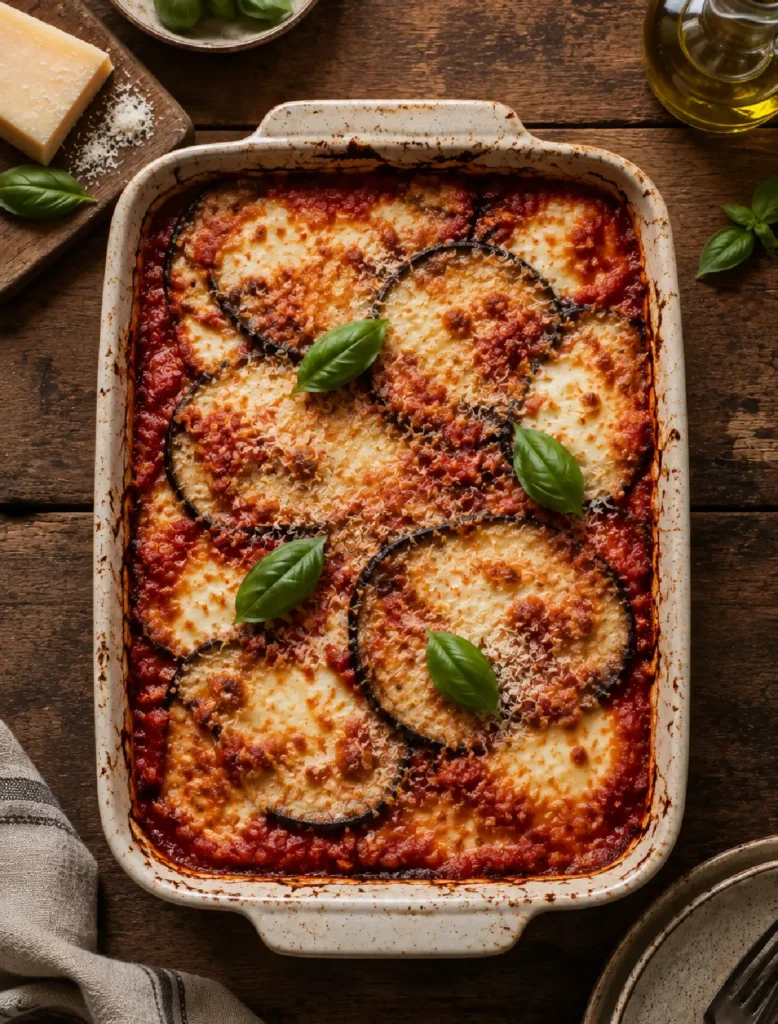
Eggplant Parmigiana: Traditional Italian Recipe
Description
Layers of fried eggplant, tomato sauce, fiordilatte, Parmigiano Reggiano, and basil, baked until the top is golden and lightly gratinated.
Ingredients Baking dish: approximately 20 × 30 cm (8 × 12 in)
Instructions
How to Make Eggplant Parmigiana
-
Slice and Drain the Eggplant 🍆
Wash 1 kg (2.2 lb) eggplants, trim off the ends, and slice them lengthwise into pieces about 4–5 mm (0.2 in) thick. Arrange the slices in layers in a colander, sprinkling a little salt between each layer. Place a plate with a light weight on top and leave them to drain for about 1 hour.
Once drained, discard the liquid and pat the eggplant slices thoroughly dry with paper towels, without rinsing them. They should be well dried before frying.
-
Prepare the Tomato Sauce 🍅
Heat 2 tbsp extra virgin olive oil in a saucepan with 1 lightly crushed garlic clove. Let the garlic gently flavor the oil without browning, then remove it.
Add 700 g (3 cups) tomato passata, season with salt, and cook over low heat for about 20 minutes, stirring occasionally. The sauce should reduce slightly while remaining fluid enough to spread easily between the layers.
Add a few basil leaves at the end of cooking and set the sauce aside.
-
Fry the Eggplant 🔥
Heat a generous amount of olive oil in a deep pan to approximately 170–175°C (340–350°F). If you do not have a thermometer, drop a small piece of eggplant into the oil: it should immediately begin to sizzle with steady bubbles without browning too quickly. If there is very little bubbling, the oil is not hot enough; if the eggplant fries too vigorously and darkens immediately, reduce the heat slightly.
Fry a few eggplant slices at a time, without flour or egg, turning them during cooking. Once soft and lightly golden on both sides, remove them from the oil and transfer them to paper towels to drain.
Continue until all the eggplant has been fried, allowing the oil to return to the correct temperature between batches when necessary.
-
Prepare the Fiordilatte and First Layer 🧀
Cut 250 g (8.8 oz) well-drained fiordilatte into small cubes or thin slices.
Spread a thin layer of tomato sauce over the bottom of a 20 × 30 cm (8 × 12 in) baking dish. Arrange the first layer of fried eggplant on top, overlapping the slices slightly where necessary.
Cover with more tomato sauce, then add some fiordilatte, a sprinkling of Parmigiano Reggiano, and a few basil leaves.
-
Complete the Layers 🥘
Continue in the same order: eggplant, tomato sauce, fiordilatte, Parmigiano Reggiano, and basil, until all the ingredients have been used.
Finish with a layer of eggplant, a thin layer of tomato sauce, the remaining fiordilatte, and a more generous sprinkling of Parmigiano Reggiano, which will help create a golden crust on top.
-
Bake the Eggplant Parmigiana ♨️
Bake in a preheated conventional oven at 200°C (400°F) for about 30 minutes. The Parmigiana is ready when the sauce is gently bubbling around the edges and the top is golden and lightly gratinated.
Remove it from the oven, but do not cut into it immediately.
-
Let It Rest and Serve 🌿
Let the Eggplant Parmigiana rest at room temperature for at least 20–30 minutes. This allows the layers to settle and makes it easier to cut into neat portions without the eggplant and filling sliding apart.
Before serving, finish with a few fresh basil leaves.
Nutrition Facts
Servings 4
- Amount Per Serving
- Calories 620kcal
- % Daily Value *
- Total Fat 45g70%
- Saturated Fat 13g65%
- Sodium 900mg38%
- Total Carbohydrate 35g12%
- Dietary Fiber 10g40%
- Sugars 18g
- Protein 23g46%
* Percent Daily Values are based on a 2,000 calorie diet. Your daily value may be higher or lower depending on your calorie needs.
Note
For a well-structured Eggplant Parmigiana, the fiordilatte should be thoroughly drained before being added to the layers. If it contains a lot of whey, cut it in advance and leave it to drain in the refrigerator for a few hours. This will reduce the amount of liquid released during baking.
This recipe uses eggplant fried directly in olive oil, without flour or egg. There are, however, several traditional variations. In some versions, the eggplant is coated in flour, while in others it is also dipped in egg before frying. There is therefore no single technique shared by every regional tradition.
Salting and draining the eggplant helps remove some of its moisture and prepares it for frying. With some modern varieties, which are generally less bitter, this step may not always be essential, but it remains useful when the eggplants contain a lot of moisture.
After baking, let the Parmigiana rest for at least 20–30 minutes before serving. It is also excellent when prepared ahead: after a few hours, the layers become even more compact and the flavors blend together. It can be served warm or at room temperature, rather than straight from the oven.
Store leftover Eggplant Parmigiana, well covered, in the refrigerator for 2–3 days. To serve it hot again, reheat it in the oven until the center is thoroughly heated. A microwave is convenient for a single portion, although the top will lose some of its gratinated texture.
Eggplant Parmigiana can also be frozen after baking and cooling completely, either whole or divided into portions. Thaw it in the refrigerator before reheating it in the oven. Freezing it before baking is less advisable, particularly because the fiordilatte and eggplant can release additional moisture.