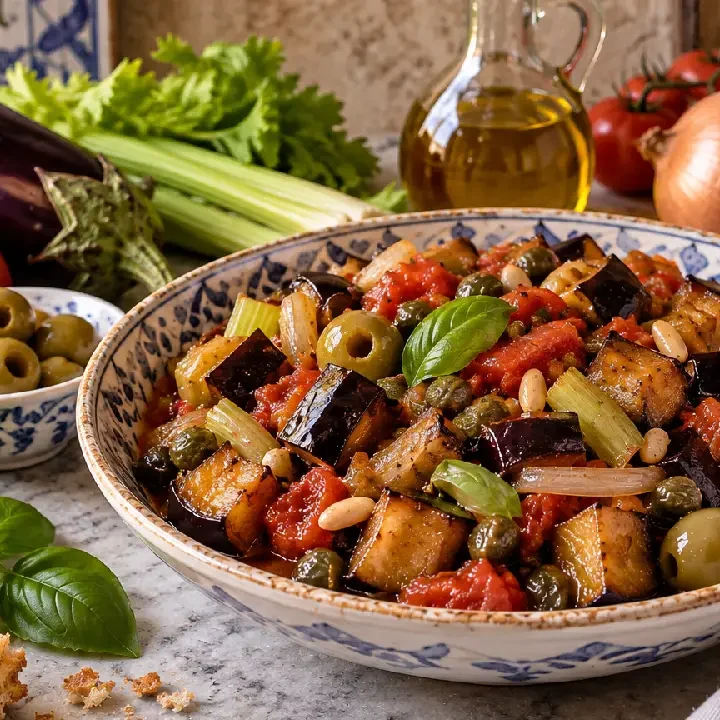
Today, say caponata and eggplant immediately comes to mind. Fried, of course, followed by celery, tomatoes, olives, capers, and that sweet and sour combination of vinegar and sugar that completely transforms the dish.
It all seems fairly straightforward.
Then we started looking into where the name came from, and the story became more complicated. Go back far enough and you find caponatas without eggplant, dishes eaten by sailors, Neapolitan recipes, and several different explanations for the origin of the word itself.
And, of course, there is the capone, the fish that appears in almost every account of caponata’s history.
That seems like a good place to start, but there is a surprise: to find the earliest traces of caponata, we may have to forget about eggplant for a moment.
When Caponata Had No Eggplant
Look up caponata in the Treccani Dictionary and you find something we did not expect.
The first definition has nothing to do with Sicily or eggplant. It describes an old sailors’ dish made with hardtack soaked in salt water and dressed with oil, vinegar, garlic, and onion.
Then comes a second meaning, from Naples: a kind of maritime panzanella made with softened hardtack, anchovies, onions, tomatoes, basil, green peppers, and olives.
Only with the third definition do we finally reach Sicily and fried eggplant with celery, onion, capers, olives, and tomatoes, dressed with a sweet and sour sauce.
And this is where the story gets interesting.
The word caponata was therefore also used for dishes very different from the one that carries the name in Sicily today. We cannot simply take one of these preparations and declare it the direct ancestor of another, but we do know one thing: the name has a longer history than the eggplant caponata we know today.
So What Does Capone Have to Do with It?
This is where the best-known story enters the picture.
In Sicily, capone is a name used for mahi-mahi. According to the familiar account, the fish was served on wealthier tables with a sweet and sour sauce, while people who could not afford it replaced the capone with cheaper eggplant.
Fish out, eggplant in: it would be a perfect explanation.
Perhaps a little too perfect.
When we tried to follow the trail, we could not find enough documentary evidence to turn this story into caponata’s birth certificate. The connection between the name of the fish and the name of the dish does appear in Sicilian food writing, but it remains one of several explanations proposed over time.
And there is another clue.
When discussing the etymology of caponata, Treccani does not point to mahi-mahi but to cappone di galera, the sailors’ preparation we encountered earlier.
At this point, instead of becoming clearer, the name becomes even more intriguing.
What If the Clue Is in the Cutting?
Following the sources led us to a completely different explanation.
In his study of caponata, Francesco Mangiapane discusses a proposal by linguist Max Pfister that shifts the focus away from the ingredients and towards the way they are prepared.
The trail leads to the idea of chopping or cutting food into small pieces.
Look at a caponata from this perspective and the connection starts to make sense: eggplant, celery, tomatoes, and the other ingredients all reach the plate after being cut into pieces and brought together.
Mangiapane observes that this action may be one of the elements connecting preparations that otherwise seem very distant when judged only by their ingredients.
So we did not find one definitive answer to the question, “Where does the word caponata come from?” We found something more interesting instead: several paths crossing around the same name.
When Did Eggplant Enter the Story?
Here, we would have liked to find a date. It would make things easy: year, recipe, author, mystery solved.
It does not work that way.
Mangiapane’s study follows the word caponata through historical cookbooks as well. During the nineteenth century, he finds it mainly associated with preparations resembling panzanella. In the body of works he examines, a Caponatina made with eggplant appears in Clementina Vertua’s Mangiare e bere in Sicilia, published in 1958.
But that date needs some context.
It does not mean somebody invented eggplant caponata in 1958. A recipe can live in home kitchens for decades before appearing in a cookbook that happens to survive or come to our attention.
So 1958 tells us that eggplant appears in that particular source. It does not give us the dish’s birth certificate.
And perhaps that is the most fascinating part of the search: between the older use of the name and modern Sicilian caponata, we do not find one recipe standing still. We find a dish changing over time.
When We Finally Reach the Caponata We Know
Eventually, the ground becomes much more familiar.
The Sicilian Region recognizes Caponata di melanzane among its PAT (Traditional Agri-Food Products) of western Sicily.
And here they finally are together: fried eggplant pieces, celery, green olives, tomatoes, onion, capers, sugar, and vinegar.
Now this looks like the caponata we recognize today.
But there is something worth keeping in mind: the official recognition refers to western Sicily, not to one fixed formula representing every caponata prepared across the island.
Because as soon as we move from one part of Sicily to another, the dish starts changing again.
Travel Across Sicily and Caponata Changes
In Palermo, we find what Visit Sicily describes as the simplest and most classic version. Move elsewhere and the variations begin.
In the Agrigento area, ingredients can include peppers, honey, garlic, chilli, pine nuts or almonds, and raisins. Around Catania, peppers also appear and some versions include garlic and potatoes. In Messina, even the way tomatoes are used changes, while in the Trapani area peppers and toasted almonds can join the dish.
There is no need to turn these differences into five recipes enclosed within rigid borders. They tell us something much simpler: caponata has adapted to the places and kitchens that have made it.
That is also why searching for “the real Sicilian caponata” as though only one version had ever existed on the island risks missing the most interesting part of its history.
So Which Caponata Did We Choose?
After following sailors, hardtack, capone, eggplant, and old cookbooks, we eventually had to return to the kitchen.
For our recipe, we chose the western Sicilian Caponata di melanzane recognized among the PAT as our reference: fried eggplant, celery, tomatoes, green olives, capers, and the sweet and sour balance of vinegar and sugar.
Not because the other caponatas are any less authentic. Quite the opposite: those variations are part of the dish’s history.
This version gives us a recognized traditional preparation to start from while allowing caponata to keep doing what it has done for a very long time: change without losing its identity.