Tortellini alla Bolognese are small parcels of fresh egg pasta filled with pork loin, prosciutto, Mortadella Bologna, Parmigiano Reggiano, egg and nutmeg. In Bologna, they are particularly associated with festive meals, and the most traditional way to serve them is in meat broth.
For this recipe, we use as our reference the recipe deposited with the Bologna Chamber of Commerce in 1974 by the Dotta Confraternita del Tortellino and the Accademia Italiana della Cucina. The original filling quantities were intended for a much larger batch than we would normally make at home, so we have reduced them while maintaining the proportions between the ingredients.
The pasta is just as important as the filling. Flour and eggs produce a dough that needs to be thin enough not to overwhelm the filling, but still strong enough to be filled and shaped without tearing. Their small size is one of the characteristics that distinguishes Bolognese tortellini from many other types of filled pasta from Emilia-Romagna.
Making them at home mainly requires time and a little practice. The filling needs to be thoroughly combined, the pasta must not dry out while you work, and each tortellino is shaped individually. This is the part that requires the most attention, particularly the first few times you make them.
Once shaped, you can cook the tortellini immediately or store them for later. In this recipe, we concentrate on making Tortellini alla Bolognese, from the egg pasta to the filling; when it is time to serve them, Bolognese tradition calls for them to be cooked and served in meat broth.
Tortellini alla Bolognese: Traditional Homemade Recipe
Description
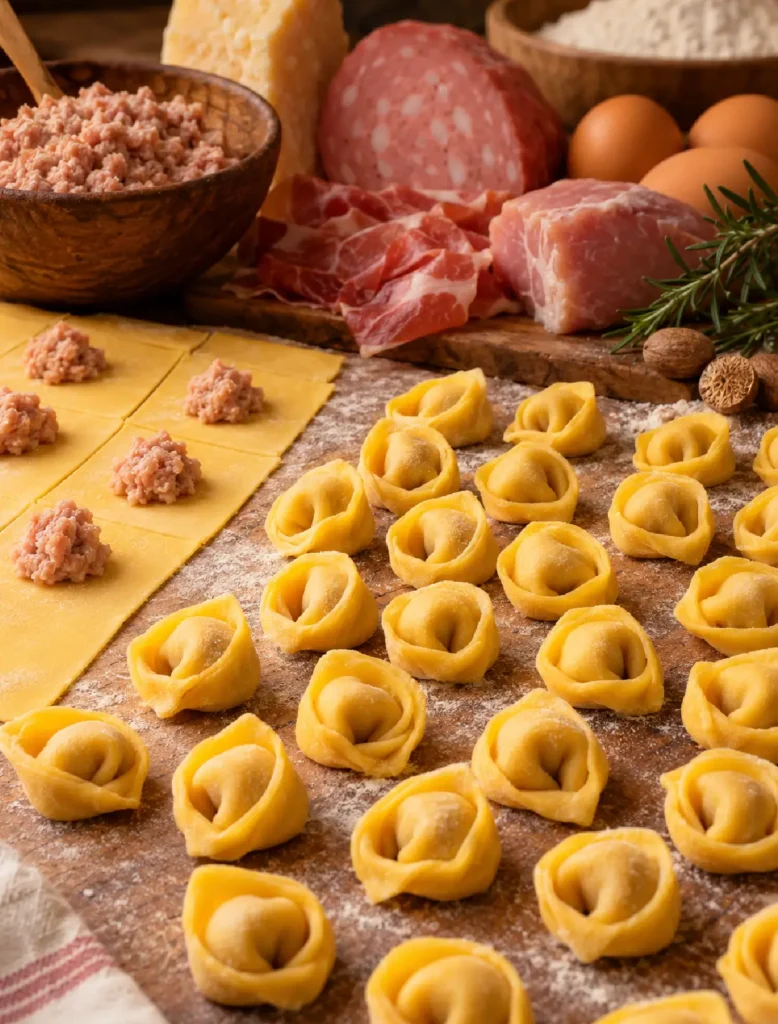
Tortellini alla Bolognese are made with thin fresh egg pasta and a filling of pork loin, prosciutto, Mortadella Bologna, Parmigiano Reggiano, egg and nutmeg. They take time and some practice to prepare, with each small piece shaped individually into the characteristic tortellino form.
Ingredients
For flavouring and cooking the pork loin
For the filling
For the egg pasta
Instructions
How to Make Tortellini alla Bolognese
-
Flavour the pork loin 🌿
Remove the leaves from the rosemary sprig and finely chop them with the garlic. Add the salt and some freshly ground black pepper, then spread the mixture over the pork loin, rubbing it over the entire surface. Place the meat in a container, cover and refrigerate for 2 days.
-
Cook the pork loin 🥩
Melt the butter in a pan and add the pork loin together with its seasoning. Cook over medium-low heat for about 10-15 minutes, turning it several times so that it colours lightly on all sides and cooks through to the centre. The exact time will depend on the shape and thickness of the meat: before removing it from the heat, check that there are no raw or pink areas inside. Remove it from the pan, allow it to cool slightly and clean away the remaining seasoning from its surface.
-
Prepare the filling 🥣
Cut the cooked pork loin, prosciutto and Mortadella Bologna IGP into pieces, then mince them very finely. Transfer everything to a bowl and add the grated Parmigiano Reggiano, egg and some freshly grated nutmeg. Mix until the filling is uniform and thoroughly combined. Cover and refrigerate for 24 hours.
-
Make the egg pasta 🥚
Place the flour on your work surface and make a well in the centre. Crack the eggs into the well, add a pinch of salt and gradually incorporate the flour with a fork. Once the dough begins to come together, knead it by hand until smooth and elastic. Shape it into a ball, cover and leave it to rest for 30 minutes.
-
Roll the pasta thinly 🟡
Divide the dough into several pieces and work with one portion at a time, keeping the rest well covered so that it does not dry out. Roll the pasta into a very thin sheet. Avoid using more flour than necessary at this stage: the pasta needs to remain soft enough for the edges to seal easily.
-
Cut and fill the squares 🔪
Cut the pasta into squares measuring about 3 cm (1.2 inches) on each side. Place a small amount of filling in the centre of each square, leaving enough room around the edges to seal the pasta properly. Work with only a few squares at a time, as thin fresh pasta dries quickly.
-
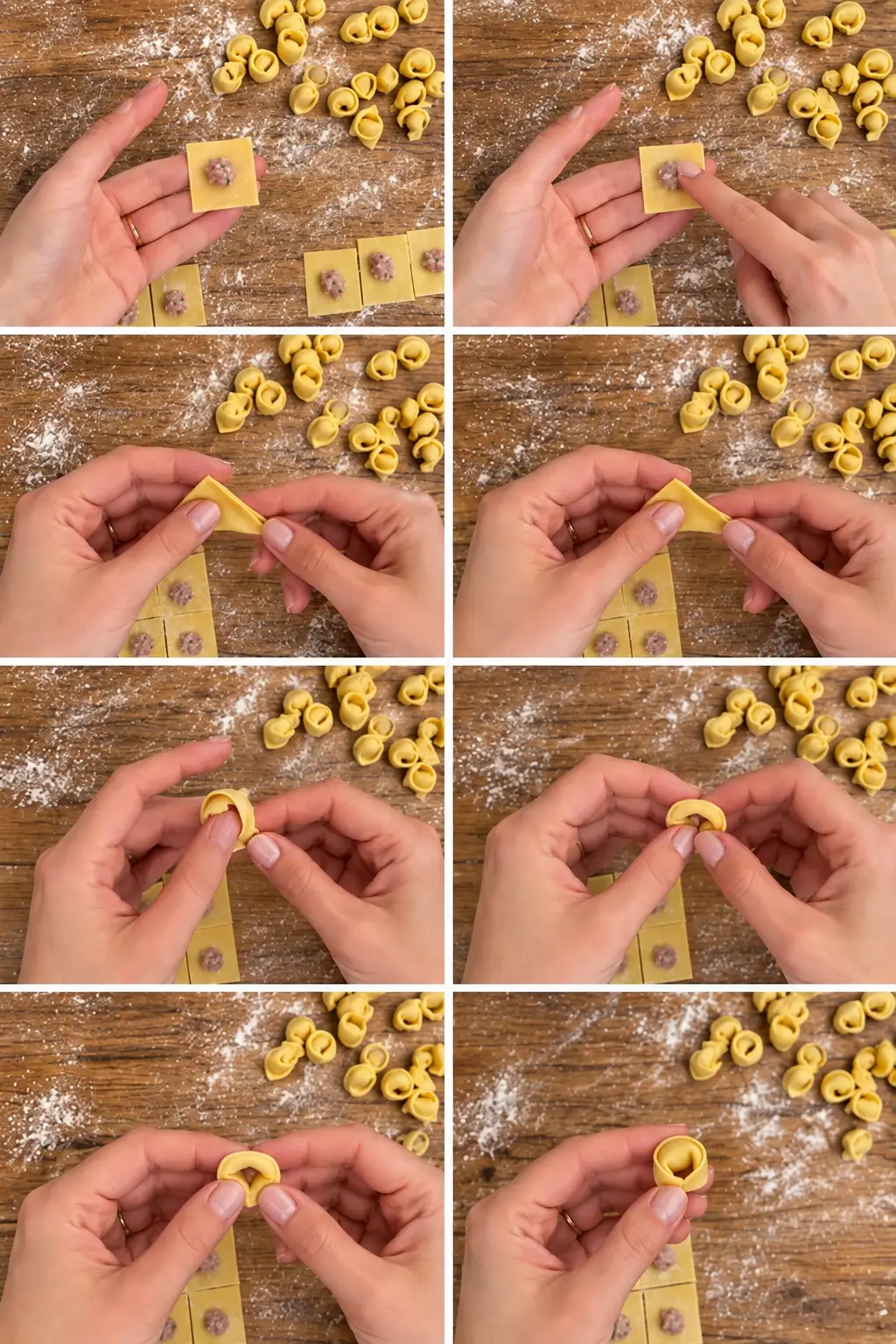
Shape the tortellini 🤌
Fold each square diagonally to form a triangle and press the edges firmly together to seal. Fold the long edge of the triangle slightly upwards, then wrap the two ends around the tip of your index finger and overlap them, pressing them together firmly. Gently slide the tortellino off your finger and place it on the work surface.
-
Finish shaping the tortellini 🟨
Continue with the remaining pasta and filling, always working with small portions of dough at a time. Arrange the freshly shaped Tortellini alla Bolognese on a lightly floured work surface, keeping them separated until you are ready to cook or store them.
Note
One of the most important things during shaping is to prevent the pasta from drying out. Divide the dough and roll out only a small amount at a time, keeping the rest covered. If the squares are exposed to the air for too long, their edges become more difficult to seal.
The Emilia-Romagna PAT (Traditional Agri-food Products) specification for Tortellini di Bologna indicates pasta squares measuring between 2.7 and 3.8 cm (approximately 1.1-1.5 inches). For this recipe, we use about 3 cm (1.2 inches), a practical size for making small tortellini without making them unnecessarily difficult to shape.
If you are not cooking them immediately, arrange the tortellini in a single layer on a lightly floured tray. For longer storage, freeze them on the tray first and transfer them to a freezer-safe container or bag once firm. This prevents them from sticking together.
The traditional way to serve Tortellini alla Bolognese is in meat broth. This recipe, however, is dedicated to making the tortellini themselves as fresh filled pasta, so the broth and final cooking are not included in the ingredients.