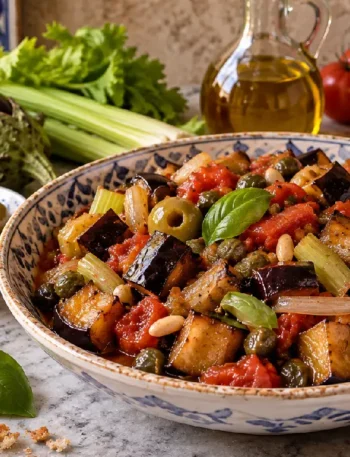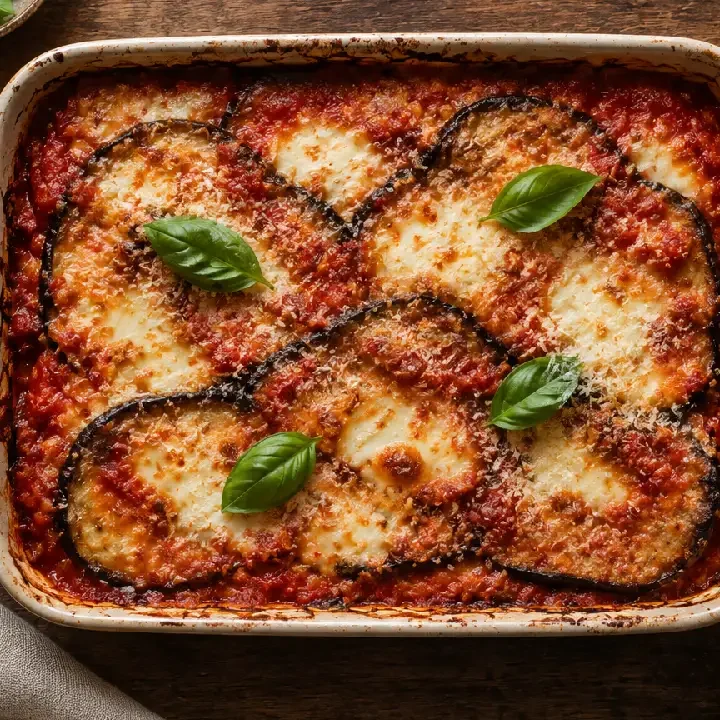
Fried eggplant, tomato sauce, cheese, and basil, layered together and baked. Today, that description is enough to recognize Eggplant Parmigiana, but the dish we know took shape through a much less straightforward process.
Its origins are disputed mainly between Campania and Sicily, although other parts of Southern Italy have important traditions of their own. Trying to assign the dish a precise birthplace and date, however, can easily turn theories into certainties.
Historical sources tell a more interesting story: a preparation that gradually evolved from vegetables cooked “alla parmigiana” to layers of eggplant with tomato, cheese, and basil.
Eggplant Had Been in Italy for Centuries
Eggplant is not native to the Mediterranean. It came from Asia, and its spread into Europe passed through the Arab world, eventually finding particularly favorable conditions in Southern Italy.
It was known in Italy centuries before Eggplant Parmigiana appeared. Neapolitan culinary sources from the 15th century refer to marignani, one of the old Italian names used for eggplants.
At first, eggplants did not have a particularly reassuring reputation. For a long time, they were considered difficult to digest and were surrounded by unfavorable beliefs. Salting and cooking techniques gradually helped establish them as part of Italian cooking.
By the 18th century, eggplants were firmly established in the cuisine of Southern Italy. This is also when the first preparations described as “alla parmigiana” begin to appear in written sources.
1773: Vincenzo Corrado’s “Zucche alla Parmegiana”
Vincenzo Corrado provides a particularly interesting example in Il Cuoco Galante, published in Naples in 1773.
Corrado was born in Puglia but spent much of his career cooking for the Neapolitan aristocracy. His book contains a preparation called “Zucche lunghe. Alla Parmegiana”, or long squash prepared alla parmegiana.
The squash is sliced, salted, floured, and fried in lard, then arranged with Parmigiano and butter before being finished in the oven.
This is not yet the Eggplant Parmigiana we know: most notably, there is no tomato, and the main vegetable is different. A few pages later, however, Corrado discusses “Petronciani”, an old term for eggplants, and states that they can be prepared in the same ways described for squash.
That detail matters: cooking vegetables “alla parmegiana” was already an established idea, and Corrado considered the same preparations suitable for eggplants.
Then Tomato and Basil Join the Layers
The next development also takes us to Naples.
In 1839, in the second edition of Cucina teorico-pratica, Ippolito Cavalcanti describes something much more familiar: fried eggplants arranged in layers with cheese, basil, and tomato sauce.
The connection with today’s Parmigiana is now easy to recognize.
Not every ingredient or proportion corresponds to the versions made today, and mozzarella does not yet have the role it would acquire in many later recipes. But the basic structure is there: fried eggplant, tomato, cheese, and basil.
Naples or Sicily? The Question Remains Open
It is probably the most famous question surrounding Eggplant Parmigiana, and one of the hardest to answer with certainty.
The 18th- and 19th-century written sources that lead most clearly towards the modern dish come from the Neapolitan culinary tradition. That is significant historical evidence, but it is not enough to prove that Parmigiana was invented in Naples.
Sicily also has a deeply rooted tradition built around eggplants and Parmigiana. Today, both the Sicilian and Campanian versions are officially recognized in their respective regional registers of traditional Italian food products.
Parmigiana belongs to a broader Southern Italian culinary context in which eggplants, tomatoes, cheese, and frying developed into different but closely related preparations.
The Name Is Not So Easy to Explain
The name itself has inspired more than one theory.
The most immediate explanation connects it to Parmigiano, which already appeared in preparations described as alla parmigiana in the 18th century. The term was also used for dishes in which eggplant was not necessarily the main ingredient.
There is also a well-known Sicilian theory. The Sicilian word parmiciana is said to refer to the overlapping wooden slats of a window shutter, whose arrangement would resemble the overlapping slices of eggplant in the dish.
It is an appealing explanation and one often repeated in accounts of Parmigiana’s history, but it is not a proven etymology.
Preparations described as “alla parmegiana” already existed before Eggplant Parmigiana took on its modern form. The origin of the name therefore remains unresolved, just like the birthplace of the dish itself. The differences become much easier to identify when we look at how Parmigiana is prepared across Southern Italy.
A Recipe That Changes Across Southern Italy
Travel from one region to another — and often from one family to another — and the recipe changes.
In the version most widely recognizable today, the eggplant slices are fried, then layered with tomato sauce, mozzarella or fior di latte, Parmigiano, and basil.
But that is far from the only version.
Some Campanian preparations dip the eggplant in egg before frying. In Sicily, versions can include caciocavallo, tuma, and hard-boiled eggs. The Puglian tradition may use eggplant slices coated in flour and egg, while richer interpretations can also include small meatballs, cured meats, and other cheeses.
Even the choice between mozzarella, fior di latte, provola, and caciocavallo can reveal something about where the Parmigiana is being made.
These are not simply arbitrary additions to an otherwise fixed recipe. They reflect the way the dish has adapted to local and home cooking traditions.
Traditionally, the Eggplant Is Fried
One element is shared by the main traditional versions: the eggplant is fried.
Grilled or oven-baked eggplant has become a common alternative, especially in versions intended to make Parmigiana lighter. They can produce excellent dishes, but they are more recent reinterpretations of the traditional preparation.
Frying changes both texture and flavor. The eggplant becomes soft and develops the texture that allows it to meld with the tomato and cheese during the final baking.
Flour, egg, or direct frying can vary according to the tradition being followed. Grilling takes the dish in a different direction.
A History Built in Layers
In the 18th century, we find vegetables prepared alla parmegiana and evidence that the same methods could be applied to eggplants. By the 19th century, Neapolitan sources describe layers of fried eggplant with tomato, cheese, and basil. Meanwhile, the dish became established in different parts of Southern Italy, developing distinct local characteristics.
The Eggplant Parmigiana we know today appears to be the result of this evolution rather than the sudden invention of a single cook.
Perhaps the many versions that have survived are the clearest sign of its success: the layered structure remains recognizable, while ingredients and details change with the regions and families that continue to make it.