With Sicilian Cannoli, the shell matters just as much as the filling. Thin and crisp, it holds a cream made with sheep’s milk ricotta and sugar, simple on its own but easy to customize with dark chocolate, pistachios, or candied orange peel.
The shells start with a dough made from flour, lard, and Marsala. After rolling it very thin, the dough is shaped around cannoli tubes and fried until golden and crisp. The ricotta, meanwhile, mainly requires patience: it needs to drain thoroughly before being mixed with the sugar.
There is one rule worth following: don’t rush to fill them. You can prepare both the shells and the ricotta cream in advance, but keep them separate until shortly before serving. This preserves the contrast between the crisp shell and the soft ricotta filling.
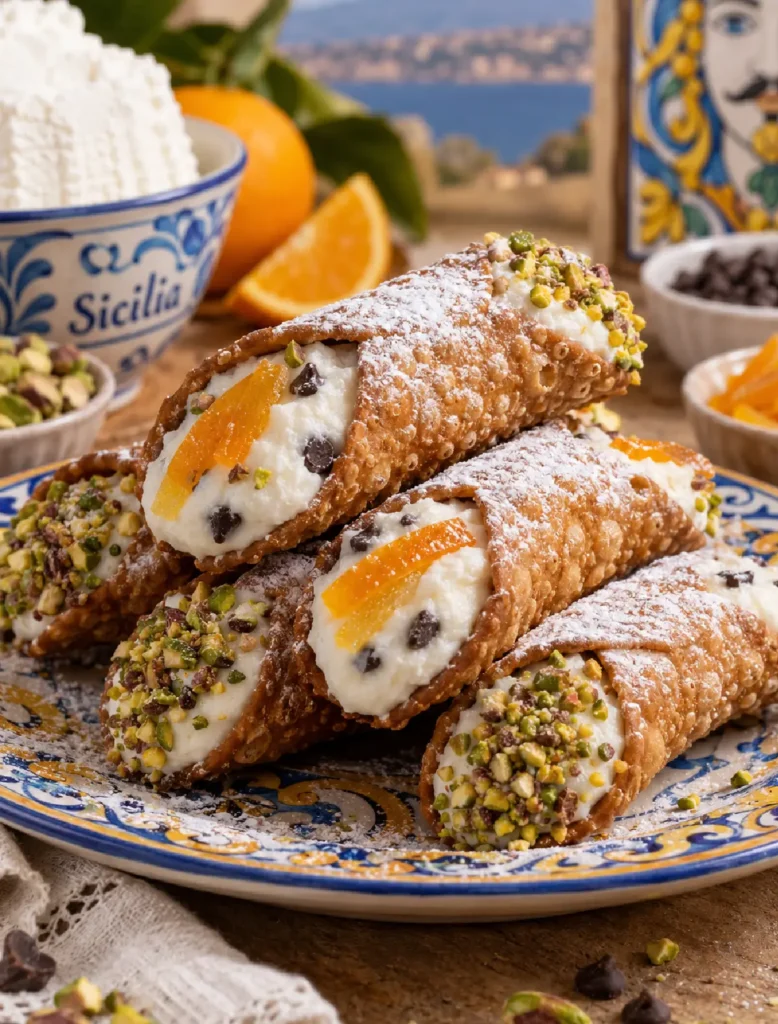
Sicilian Cannoli with Sheep’s Milk Ricotta and Fried Shells
Description
Thin, crisp fried shells filled just before serving with sheep’s milk ricotta, sugar, and vanilla.
Ingredients – Makes About 12 Sicilian Cannoli
For the Ricotta Filling
For the Cannoli Shells
For Decorating
Instructions
How to Make Sicilian Cannoli
-
Drain the Ricotta 🥛
The night before, place the sheep’s milk ricotta in a fine-mesh strainer set over a bowl. Cover and leave it to drain in the refrigerator overnight so that it can release the excess whey.
-
Prepare the Ricotta Filling 🍶
Push the well-drained ricotta through a fine-mesh sieve. Add the sugar and natural vanilla extract, then mix with a spatula until smooth and creamy.
At this point, you can add the dark chocolate chips or leave the ricotta filling plain. Cover and refrigerate until you are ready to fill the cannoli.
-
Prepare the Shell Dough 🥣
Place the flour, sugar, and salt in a bowl. Add the lard and work it into the flour with your fingertips until evenly distributed.
Beat the egg and reserve 5 g for sealing the shells. Add the remaining 45 g to the dough, followed by the Marsala and white wine vinegar. Knead until you have a smooth, compact, fairly firm dough.
Wrap the dough and leave it to rest in the refrigerator for 2 hours.
-
Roll and Shape the Shells 🟤
Divide the dough into portions and keep the dough you are not working with covered so that it does not dry out. Roll each portion with a pasta machine or rolling pin to a thickness of about 1.5 mm.
Cut out rounds about 10 cm / 4 in in diameter and stretch them slightly into an oval. Wrap each piece around a cannoli tube. Brush one edge with a very small amount of the reserved beaten egg, overlap the other edge, and press gently to seal.
-
Fry the Shells 🔥
Heat plenty of peanut oil to 175°C / 350°F. If you do not have a thermometer, dip the tip of a wooden skewer or the handle of a wooden spoon into the oil. When plenty of small bubbles immediately form around the wood, the oil is ready. Alternatively, drop in a small piece of dough: it should quickly rise to the surface and begin frying without browning immediately.
Fry a few cannoli at a time, still wrapped around their tubes. When the characteristic bubbles appear and the shells are golden, lift them out and drain on absorbent paper.
Let them cool slightly, then gently twist and remove the tubes. Leave the shells to cool completely before filling.
-
Fill the Cannoli 🍰
Transfer the ricotta filling to a piping bag fitted with a wide nozzle. Fill the cannoli shortly before serving, piping the filling first from one end and then from the other so that it reaches the centre.
-
Decorate and Serve ✨
Decorate the cannoli with chopped pistachios or candied orange peel, or simply leave them with the ricotta filling. Dust with icing sugar and serve immediately.
Nutrition Facts
Servings 12
- Amount Per Serving
- Calories 340kcal
- % Daily Value *
- Total Fat 15g24%
- Saturated Fat 7g35%
- Sodium 60mg3%
- Total Carbohydrate 40g14%
- Dietary Fiber 0.6g3%
- Sugars 23g
- Protein 10g20%
* Percent Daily Values are based on a 2,000 calorie diet. Your daily value may be higher or lower depending on your calorie needs.
Note
The sheep’s milk ricotta needs to be thoroughly drained before preparing the filling. If it contains too much whey, the filling will be softer and will quickly make the shells lose their crispness. Leave it to drain in the refrigerator overnight, then pass it through a sieve before adding the sugar.
For thin, crisp shells, roll the dough to about 1.5 mm / 0.06 in and keep any dough you are not working with covered. If the surface dries out before frying, it will be more difficult to obtain the characteristic bubbles.
Keep the oil at around 175°C / 350°F and fry only a few cannoli at a time so that the temperature does not drop too much. Once the shells have cooled slightly, carefully remove the tubes and leave the shells to cool completely.
You can prepare the shells and ricotta filling in advance, but store them separately. Keep the ricotta filling covered in the refrigerator and the completely cooled shells in an airtight container in a cool, dry place. Fill the cannoli only shortly before serving, as prolonged contact with the ricotta will soften the shells.
The dark chocolate chips, chopped pistachios, and candied orange peel are optional. Use them to finish the cannoli or leave the ricotta filling plain.