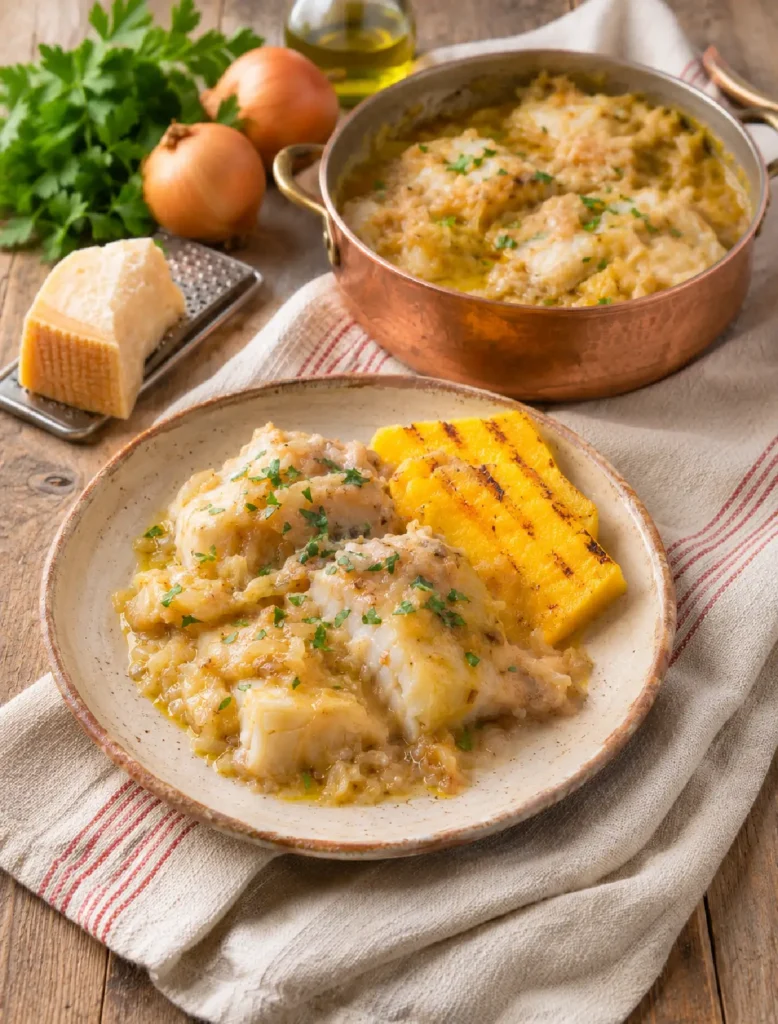
In Baccalà alla Vicentina, stockfish cooks slowly for hours until the flesh becomes tender enough to yield to a fork. The onions almost disappear into the cooking juices, while the milk and olive oil come together in a thick, pale sauce that coats the fish. It is traditionally served with yellow polenta, often sliced and lightly grilled until golden.
The secret lies in the cooking method, known locally as pipare. We keep the pan over the lowest possible heat, allowing only the gentlest movement in the liquid. Rather than stirring the fish with a spoon, we occasionally give the pan a careful circular shake to prevent anything from sticking. The process takes around four and a half hours, giving the stockfish time to absorb the flavours of the onions, salt-cured sardines and grated Grana cheese.
The name can be confusing outside Veneto. Despite being called baccalà, this dish is not made with salt cod. The traditional Vicenza recipe uses stockfish, cod preserved by air-drying rather than salting. Before cooking, we need to soak it in water for two to three days, changing the water regularly. It takes some planning, but we can also prepare the dish a day ahead. After resting overnight, the flavours often become even richer.
Baccalà alla Vicentina
Description
A traditional dish from Vicenza made with rehydrated stockfish, onions, salt-cured sardines, milk and Grana cheese. Slow cooking produces tender fish in a rich, creamy sauce. Traditionally served with yellow polenta.
Ingredients
Instructions
How to Make Baccalà alla Vicentina
-
Soak the stockfish 💧
Place the dried stockfish, already beaten, in a large container and cover it completely with plenty of cold water. Leave it to soak for 2–3 days, changing the water every 4 hours and keeping the container in the refrigerator.
Once the fish has softened sufficiently, drain it and pat it dry with kitchen paper.
-
Clean and cut the stockfish 🔪
Open the stockfish lengthwise and remove the central backbone and any remaining bones. Scrape away any scales, but leave the skin attached, as it helps the pieces hold together during the long cooking process.
Cut the fish into evenly sized pieces so they cook at a similar rate.
-
Lightly coat the fish with flour 🐟
Dust the stockfish pieces with all-purpose flour, making sure they are lightly coated on all sides. Gently shake off any excess flour and set the pieces aside while preparing the onion mixture.
-
Prepare the onions, sardines and parsley 🧅
Peel the onions and slice them very thinly. Clean the salt-cured sardines, removing the excess salt and bones, then cut them into small pieces.
Wash and dry the parsley before chopping it finely.
-
Cook the onion mixture 🥄
Pour a glassful of the measured extra virgin olive oil into a frying pan and add the sliced onions. Cook gently over low heat, stirring occasionally, until the onions are soft without becoming browned.
Add the sardines and continue cooking until they break down into the onions. Stir in the chopped parsley and mix everything together.
-
Arrange the stockfish in the pan 🍲
Choose a heavy-bottomed cooking pot, preferably earthenware. Spread some of the onion mixture across the bottom, then arrange the floured stockfish pieces close together in a single layer.
Spoon the remaining onion mixture over the fish, distributing the onions and sardines evenly across the surface.
-
Add the milk, cheese and olive oil 🥛
Pour the milk into the pot, allowing it to flow between the pieces of stockfish. Sprinkle the grated Grana Padano evenly over the fish, season with a little salt and freshly ground black pepper, then slowly pour in the remaining extra virgin olive oil.
The milk alone does not need to cover the fish. The combined cooking liquids should cover the pieces, so use a suitably sized pot rather than increasing the quantities in the recipe.
Do not stir with a spoon. Allow the ingredients to combine gradually during cooking.
-
Cook very slowly 🔥
Place the pot over the smallest burner and reduce the heat to its lowest setting. If cooking on a gas hob, use a heat diffuser if necessary to distribute the heat evenly.
Cook for approximately 4½ hours. The liquid should barely simmer, producing only tiny bubbles rather than a vigorous boil. This gentle cooking method is known in Vicenza as pipare.
Do not turn or stir the stockfish during cooking. Instead, occasionally hold the pot by its handles and give it a gentle circular shake to prevent the fish from sticking to the bottom.
-
Check the texture 🍴
Towards the end of cooking, check that the stockfish is tender and that the flesh separates easily with a fork. The onions should have almost completely broken down, forming a soft, creamy sauce with the milk and olive oil.
If the fish is not yet tender enough, continue cooking over very low heat. Taste the sauce and adjust the salt only if necessary.
-
Serve with polenta 🍽️
Turn off the heat and allow the Baccalà alla Vicentina to rest for a few minutes. Serve the fish with its creamy sauce and traditional yellow polenta, either soft or sliced and lightly grilled until golden.
Nutrition Facts
Servings 12
- Amount Per Serving
- Calories 510kcal
- % Daily Value *
- Total Fat 40g62%
- Saturated Fat 7g35%
- Sodium 320mg14%
- Total Carbohydrate 5g2%
- Dietary Fiber 0.5g2%
- Sugars 3g
- Protein 33g66%
* Percent Daily Values are based on a 2,000 calorie diet. Your daily value may be higher or lower depending on your calorie needs.
Note
Storage
Baccalà alla Vicentina can be kept in the refrigerator for 1–2 days in a tightly sealed container. After cooking, allow it to cool briefly before refrigerating, without leaving it at room temperature for too long.
To reheat, place it in a pan over low heat, adding a little water only if necessary to loosen the sauce.
Making It Ahead
We can prepare Baccalà alla Vicentina a day in advance. After resting for 12–24 hours, the flavours become more fully developed.
Keep it refrigerated during this time and reheat gently before serving.
Choosing the Right Stockfish
For this recipe, Ragno stockfish is particularly prized. It is a high-quality variety from Norway, traditionally associated with the Lofoten Islands.
Look for properly dried stockfish with pale flesh and its characteristic aroma, without any unpleasant smells.
We can also buy stockfish that has already been soaked, provided it is good quality. Bear in mind that its weight will be considerably higher than that of the dried product specified in the ingredients.
Choosing the Cooking Pot
Use a heavy-bottomed pot large enough to hold the stockfish pieces close together without stacking them.
If the pot is too wide, the milk and olive oil will spread too thinly across the bottom, making it difficult to keep the fish covered by the cooking liquids.
How to Tell When It Is Ready
Cooking time may vary slightly depending on the thickness and texture of the stockfish.
The fish is ready when the flesh separates easily with a fork and the sauce is creamy rather than watery.
If the sauce starts drying out too quickly, check that the heat is sufficiently low before adding any extra liquid.