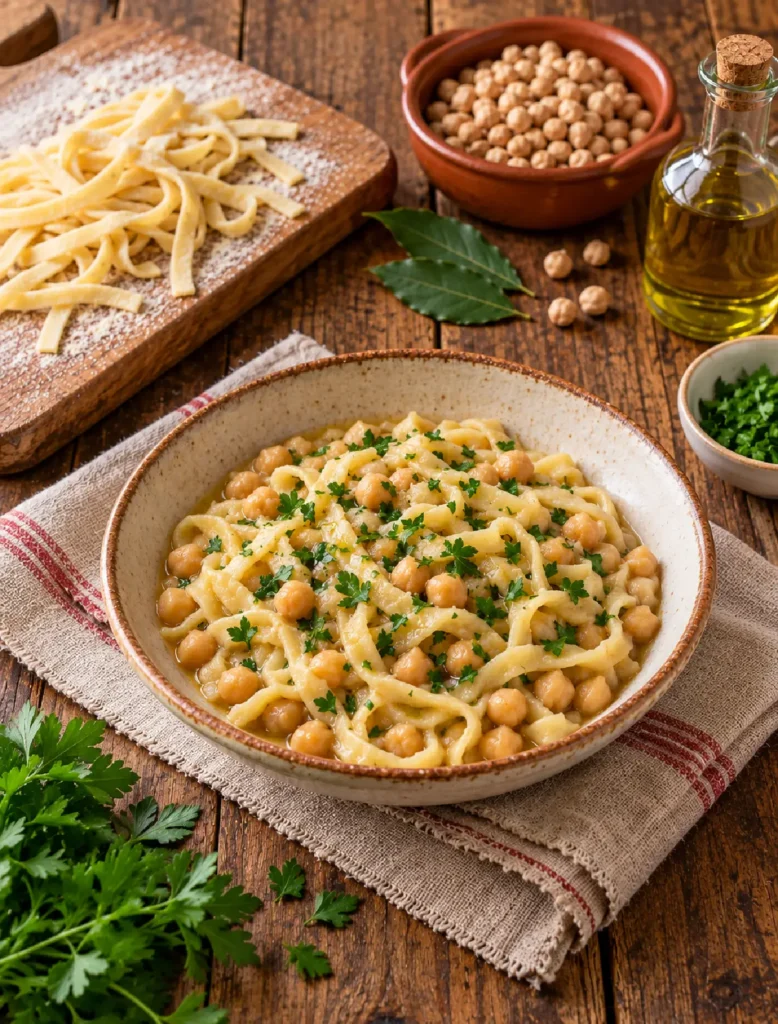
Lagane e Ceci is a traditional Calabrian first course made with handmade fresh pasta and chickpeas. The thin strips of pasta are boiled separately before being combined with the cooked chickpeas and some of their cooking liquid.
In the Grecanic area of Calabria, this dish is known as Taglierini e ciciri or Laganelle e ciciri and is recognised as a PAT (Traditional Agri-food Product). The version documented by the Calabria Region features an egg-free dough made with flour and water, chickpeas slowly cooked with bay leaves, and a finishing touch of extra virgin olive oil and fresh parsley.
The dish was traditionally prepared for 2 November, All Souls’ Day, as recorded in the Calabria Region’s official PAT documentation.
Lagane e Ceci, Calabrian Pasta with Chickpeas
Description
Lagane e Ceci is a traditional Calabrian dish featuring thin strips of homemade egg-free pasta and chickpeas slowly cooked with bay leaves. The pasta is boiled separately, combined with the chickpeas and finished with extra virgin olive oil and fresh parsley.
Ingredients
For the Chickpeas
For the Laganelle
To Finish
Instructions
How to Make Lagane e Ceci
-
Soak the chickpeas 🫘
The evening before, rinse the 350 g dried chickpeas and place them in a large bowl. Cover generously with cold water, using at least four times their volume, and leave to soak for 12 hours.
-
Cook the chickpeas with bay leaves 🍲
Drain and rinse the soaked chickpeas, then transfer them to a large saucepan or casserole, preferably made of terracotta. Cover generously with fresh water, add the 2 bay leaves and bring gently to the boil. Reduce the heat and simmer for approximately 1 hour 30 minutes to 2 hours, until tender. Add salt towards the end of cooking and leave the chickpeas in their cooking liquid.
-
Prepare the laganelle dough 🥣
Combine 200 g plain flour and 200 g finely milled durum wheat semolina on a clean work surface. Gradually add the 200 g water, incorporating it into the flour mixture. Knead for approximately 8–10 minutes, until the dough is smooth, uniform and fairly soft. Cover and leave to rest for 30 minutes.
-
Roll out and cut the laganelle 🔪
Lightly dust the work surface with semolina and roll out the dough using a rolling pin until approximately 1–2 mm thick. Leave the sheet to dry for a few minutes, just until it is no longer sticky. Dust lightly with semolina, then roll it up loosely. Using a sharp knife, cut it into strips approximately 5 mm wide. Carefully unroll the strips and arrange them on a semolina-dusted tray.
-
Boil the laganelle 💧
Bring a large pan of water to the boil, then add salt. Add the fresh laganelle and cook for approximately 3–5 minutes, depending on their thickness. Drain when cooked but still slightly firm, reserving a little of the pasta cooking water.
-
Combine the pasta and chickpeas 🥄
Remove the bay leaves and gently reheat the chickpeas with some of their cooking liquid. Add the previously boiled laganelle and stir carefully to combine. If necessary, add a little reserved pasta cooking water to keep the dish moist without making it excessively watery.
-
Finish with olive oil and parsley 🌿
Turn off the heat and add 60 g extra virgin olive oil and 15 g finely chopped fresh parsley. Stir gently and serve the Lagane e Ceci hot.
Nutrition Facts
Servings 6
- Amount Per Serving
- Calories 550kcal
- % Daily Value *
- Total Fat 15g24%
- Saturated Fat 2g10%
- Sodium 20mg1%
- Total Carbohydrate 85g29%
- Dietary Fiber 10g40%
- Sugars 7g
- Protein 19g38%
* Percent Daily Values are based on a 2,000 calorie diet. Your daily value may be higher or lower depending on your calorie needs.
Note
Choosing the flour. The official PAT documentation from the Calabria Region specifies flour and water without identifying a particular flour variety. This recipe uses a mixture of Italian type 0 wheat flour and finely milled durum wheat semolina, giving the laganelle a slightly more rustic texture. You can also prepare them using wheat flour alone.
Dough consistency. The 200 g water is an approximate quantity. Depending on the flour's absorption, you may need to add a very small amount more. The dough should be soft and easy to work with, without becoming sticky.
Cooking the chickpeas. Cooking times depend on the variety and age of the dried chickpeas. Make sure they are tender before adding the pasta and always reserve some of their cooking liquid. If too much water evaporates during cooking, add a little more hot water.
Final consistency. Lagane e Ceci should be moist and well combined rather than completely dry. Adjust the amount of liquid to your preference, remembering that the pasta will continue to absorb moisture after cooking.
Preparing ahead. You can cook the chickpeas the day before and refrigerate them in their cooking liquid. Prepare the fresh laganelle and combine them with the chickpeas shortly before serving.