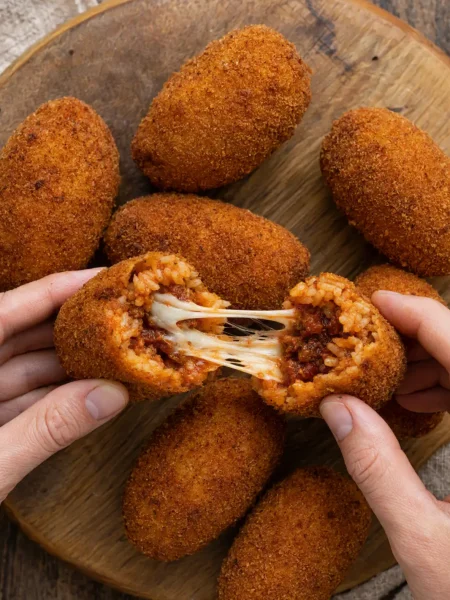
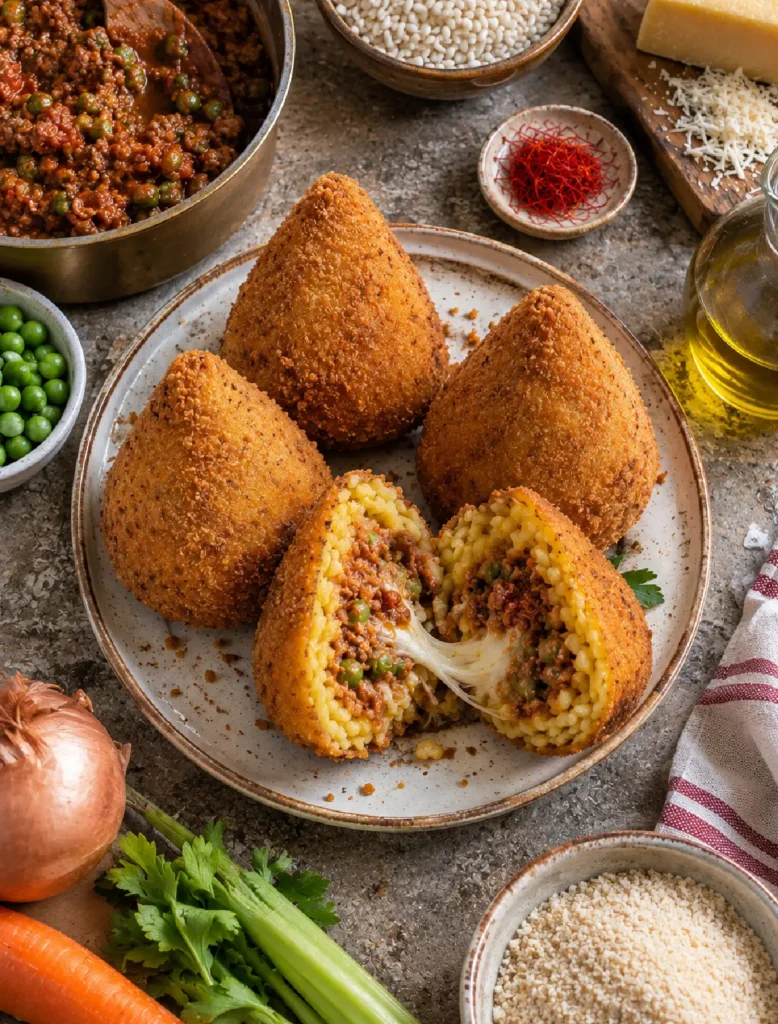
In Catania, arancini with ragù have an unmistakable shape. The rice is formed into a cone around a filling of ragù, peas, and cheese, then coated in batter and breadcrumbs before frying. Cut one open and the ragù stays nestled in the center while the hot cheese begins to melt and stretch.
Shaping them takes a little care. The rice needs to surround the filling evenly, particularly around the pointed top, while the ragù should be well reduced. If the filling contains too much liquid, closing and shaping the arancini becomes much more difficult.
In Palermo, the same Sicilian street-food classic changes both name and shape: arancina, generally round. In Catania, the masculine arancino and the conical shape prevail, two characteristics that have made Catania-style arancini immediately recognizable beyond Sicily.
Sicilian Arancini with Ragù: Traditional Catania-Style Recipe
Description
Rice, meat ragù with peas, and a melting cheese center: Catania-style arancini are recognizable by their conical shape and crisp breadcrumb coating, best enjoyed freshly fried.
Ingredients for 12 Arancini
For the Rice
For the Ragù
For the Filling
For the Batter and Coating
For Frying
Instructions
How to Make Sicilian Arancini with Ragù
-
Prepare the Ragù 🍅
Heat the extra virgin olive oil in a saucepan and add the finely chopped onion, carrot, and celery. Cook gently until softened, then add the ground beef and pork. Increase the heat slightly and cook, stirring, until the meat is no longer pink and begins to brown.
Pour in the red wine and let it evaporate. Add the double-concentrated tomato paste and stir well, then pour in the passata. Season with salt and black pepper and cook over low heat until the ragù is thick and well reduced. Add the peas towards the end of cooking and continue for a few minutes. Transfer the ragù to a container and let it cool completely.
-
Cook the Saffron Rice 🍚
Bring the vegetable stock to a boil in a fairly wide saucepan. Add the Carnaroli rice and saffron, and season with salt only if necessary. Stir and cook over medium-low heat, stirring occasionally, until the rice has absorbed the stock.
At the end of cooking, the rice should be cooked but dry, with no liquid remaining at the bottom of the saucepan.
-
Season and Cool the Rice 🧈
Remove the saucepan from the heat and immediately stir in the butter and grated aged caciocavallo until evenly distributed.
Spread the rice straight away over a large tray or baking sheet in a thin layer and let it cool completely before shaping the arancini.
-
Shape and Fill the Arancini 🤲
Lightly wet your hands with water and take a portion of rice. Spread it over your palm, making a hollow in the center. Add some ragù with peas and a few cubes of fresh caciocavallo, keeping the filling away from the edges.
Close the rice around the filling and compact it gently. Form a stable base, then gradually narrow the top to create the characteristic conical shape. Continue until you have made about 12 arancini.
-
Prepare the Batter and Coat the Arancini 🥣
Mix the 00 flour with the water and a pinch of salt until smooth and fluid enough to leave only a thin coating on the arancini.
Dip each arancino into the batter, let the excess drip off, then coat it thoroughly with the breadcrumbs. If necessary, gently reshape the cone with your hands after coating.
-
Fry the Arancini 🔥
Heat plenty of peanut oil in a deep pot to 170–175°C (340–350°F). There should be enough oil to completely submerge the arancini.
If you do not have a thermometer, dip the tip of a wooden skewer or the handle of a wooden spoon into the oil. When small bubbles immediately form around the wood, the oil is ready for frying.
Fry 2–3 arancini at a time so the temperature of the oil does not drop too much. Turn them gently if necessary and fry until evenly golden and crisp.
-
Drain and Serve 🧻
Lift the arancini from the oil with a slotted spoon and drain them on paper towels. Let them rest for a few minutes before serving: the filling will be very hot, and this brief rest also allows the arancini to settle.
Nutrition Facts
Servings 12
- Amount Per Serving
- Calories 520kcal
- % Daily Value *
- Total Fat 25g39%
- Saturated Fat 8.4g43%
- Sodium 650mg28%
- Total Carbohydrate 57g19%
- Dietary Fiber 2.4g10%
- Sugars 2.9g
- Protein 15g30%
* Percent Daily Values are based on a 2,000 calorie diet. Your daily value may be higher or lower depending on your calorie needs.
Note
For arancini that hold their shape well, let both the rice and the ragù cool completely before shaping. The ragù should be thick and well reduced: a filling with too much liquid makes the arancini harder to close and increases the risk of them breaking open during frying.
When shaping the cone, compact the rice without pressing it too firmly and make sure the filling is completely enclosed, especially around the pointed top. If the rice sticks to your hands, lightly wet them with water.
The batter should form only a thin coating. If it is too thick, add a little water at a time; if it is too thin and runs off completely, mix in a little more flour. After coating with breadcrumbs, check that there are no uncovered areas.
Keep the frying oil at around 170–175°C (340–350°F) and fry only a few arancini at a time. If the temperature is too low, they will absorb more oil; if it is too high, the coating will brown too quickly before the filling is thoroughly heated.
Arancini are best freshly fried after resting for a few minutes. Store any leftovers in a sealed container in the refrigerator and reheat them in the oven to restore more of the crispness of the coating than reheating them in the microwave.