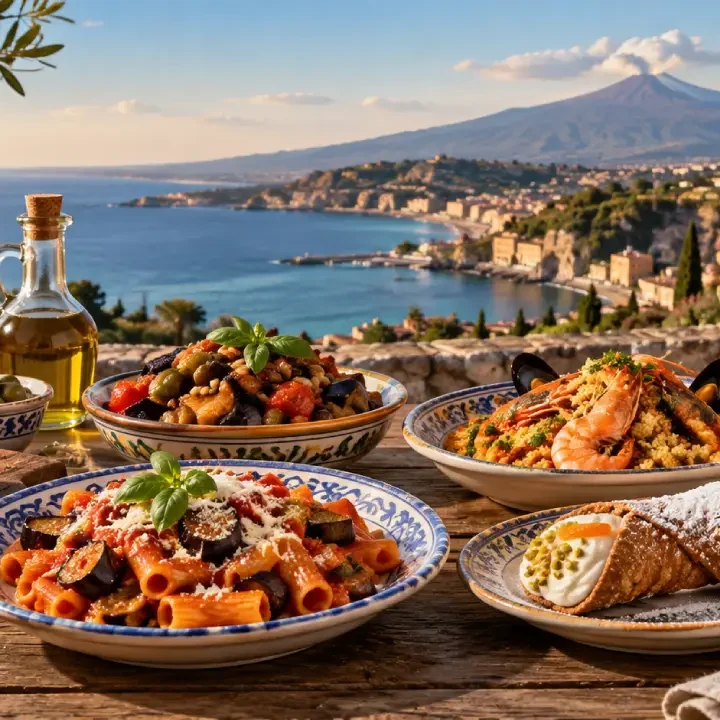
It takes only a few dishes to see how recognizable Sicilian cuisine has become: Pasta alla Norma, Caponata, Cannoli, arancine. These recipes have travelled far beyond the island and could already fill a table on their own.
But move from Palermo to Catania, head west towards Trapani or cross the island towards the southeast, and the ingredients and eating habits can change considerably.
In Palermo, food is also eaten in the street, from panelle and sfincione to pani câ meusa. In Catania, eggplant meets tomato and salted ricotta in Pasta alla Norma. Around Trapani, couscous reflects Sicily’s place in the Mediterranean, while in the Ragusa area a thin sheet of semolina dough is filled and folded to make a scaccia.
Talking about Sicilian cuisine, then, means bringing together different local traditions. The best way to see just how different they are is to travel across the island.
Palermo: where food lives on the street
The markets of Palermo are a good place to start. Ballarò, Vucciria and Capo have long been places where food is bought, cooked and eaten within the same bustling streets.
Panelle are perhaps the simplest example. Made from chickpea flour and water, they are fried and tucked into bread, often alongside potato croquettes. Few ingredients, and no need for a plate or cutlery.
Then there are arancine, sfincione, pani câ meusa, frittola, and a long list of vegetables, fish and offal prepared to be eaten straight from a stall.
Street food here is not a category invented for visitors. It has long been part of the way Palermo cooks and eats.
Eggplant, tomato and salted ricotta: Catania on a plate
Three ingredients are almost enough to give away the destination. Fried eggplant, tomato and salted ricotta form the basis of Pasta alla Norma, one of Sicily’s best-known pasta dishes.
The recipe originated in Catania. How it came to be called Norma is less certain.
One of the most repeated stories involves the playwright Nino Martoglio and an exclamation he supposedly made after tasting the dish. Other explanations connect the name with Vincenzo Bellini’s opera Norma. There is no shortage of stories, but finding a definitive explanation is another matter.
Its connection with Catania is much clearer. So is the combination that makes the dish instantly recognizable: tomato, fried eggplant, basil and a generous grating of salted ricotta.
Caponata is never just one thing
We stay with eggplant, but the flavor changes completely.
In Sicilian Caponata, the eggplant is fried before meeting celery, tomato, green olives, capers, vinegar and sugar. It is the sweet and sour element that changes everything and sets Caponata apart from a simple eggplant and tomato side dish.
The Sicilian regional authorities recognize Caponata di melanzane among the island’s PAT (Traditional Agri-Food Products) of western Sicily. Compare versions from different places, however, and it quickly becomes clear that Caponata is not prepared in exactly the same way throughout the island.
Ingredients, proportions and additions can vary. Even the name has a far from straightforward history: its earliest traces do not immediately lead to the eggplant dish we know today.
This western Sicilian tradition is the reference point we used for our Sicilian Caponata.
In Trapani, semolina meets the sea
Head towards the western tip of the island and something completely different appears on the table.
Couscous is particularly associated with Trapani and San Vito Lo Capo. Traditionally, the semolina is worked by hand using a process known as incocciatura, gradually forming the small grains before they are cooked and seasoned.
Fish often takes center stage here. Couscous is served with a rich fish broth, giving the local preparation its own character compared with versions found along the southern shores of the Mediterranean.
The sea shapes many other dishes in the area, but not everything revolves around fish. Busiate with pesto alla Trapanese, for example, bring together tomato, almonds, basil, garlic and cheese.
Couscous and busiate have little in common on the plate, yet both immediately point towards the same corner of Sicily.
Around Agrigento, fava beans return to the table
After markets, eggplant and fish, the inland landscape tells a different story.
Around Agrigento, fava beans and other pulses have long held an important place in everyday cooking. One traditional preparation is macco di fave, a thick purée made by slowly cooking dried fava beans.
This is a cuisine shaped partly by necessity. Pulses were inexpensive, kept well and could provide a substantial meal without relying on meat.
Fava beans also appear in dishes connected with religious celebrations, including Macco di San Giuseppe. There is no need to turn it into the single “symbolic dish” of Agrigento. What makes it interesting is what it tells us about inland Sicily, its crops and a style of cooking built around simple, readily available ingredients.
Around Ragusa, the dough is folded again and again
A thin sheet of semolina dough, a filling and a series of folds. That is where scacce ragusane begin.
The filling can vary considerably: tomato and caciocavallo, ricotta and onion, vegetables, sausage, and other combinations shaped by the season and family habits.
Around Ragusa, Modica and Scicli, in the area of the Hyblaean Mountains, scacce are closely associated with festive occasions and home cooking. Shapes, fillings and customs vary from town to town, and family recipes still play an important role.
Simply calling them “Sicilian pizza” does not say very much. Their thin dough, distinctive folds and layers of filling give scacce a structure of their own.
Then come the sweets
With Sicilian pastry, it becomes even harder to stay in one place on the map.
Sicilian Cannoli are probably among the first sweets that come to mind: a crisp fried shell filled with sweetened ricotta, with decorations that vary according to local and individual traditions.
Cassata Siciliana takes a completely different direction, combining ricotta, sponge cake, marzipan and candied fruit. Then there are almond pastries, frutta martorana, pistachio desserts and granita, particularly rooted in eastern Sicily, where it can easily become breakfast when served with a brioche.
Ricotta, almonds, citrus fruit and pistachios appear again and again. Yet they do not produce one uniform pastry tradition: techniques, shapes and customs change across the island.
With our Sicilian Cannoli, we focused above all on what defines them: a thin, crisp shell filled with creamy ricotta only just before serving.
One Sicily is not enough
Putting these dishes on a map changes the picture.
Panelle take us to Palermo’s markets. Pasta alla Norma leads to Catania. Couscous takes us towards Trapani and San Vito Lo Capo. Scacce belong to the Ragusa area. Macco leads inland around Agrigento. Sicilian Caponata, meanwhile, covers a broader territory and changes as it moves across it.
And we have barely touched the full repertoire. Pasta con le sarde, anelletti al forno, swordfish involtini, sarde a beccafico, sfincione, cassata and many other dishes are still waiting beyond this journey.
Perhaps that is the limitation of the most familiar image of Sicilian food: a handful of exceptionally famous dishes can easily hide everything around them.
Across the island, city cooking, coastal traditions and inland foodways exist alongside family recipes and specialties that have remained much more local. They are all Sicilian, but that does not make them all alike.
Want to bring a little Sicily into your kitchen? Explore all the Sicilian recipes on DishToHub.