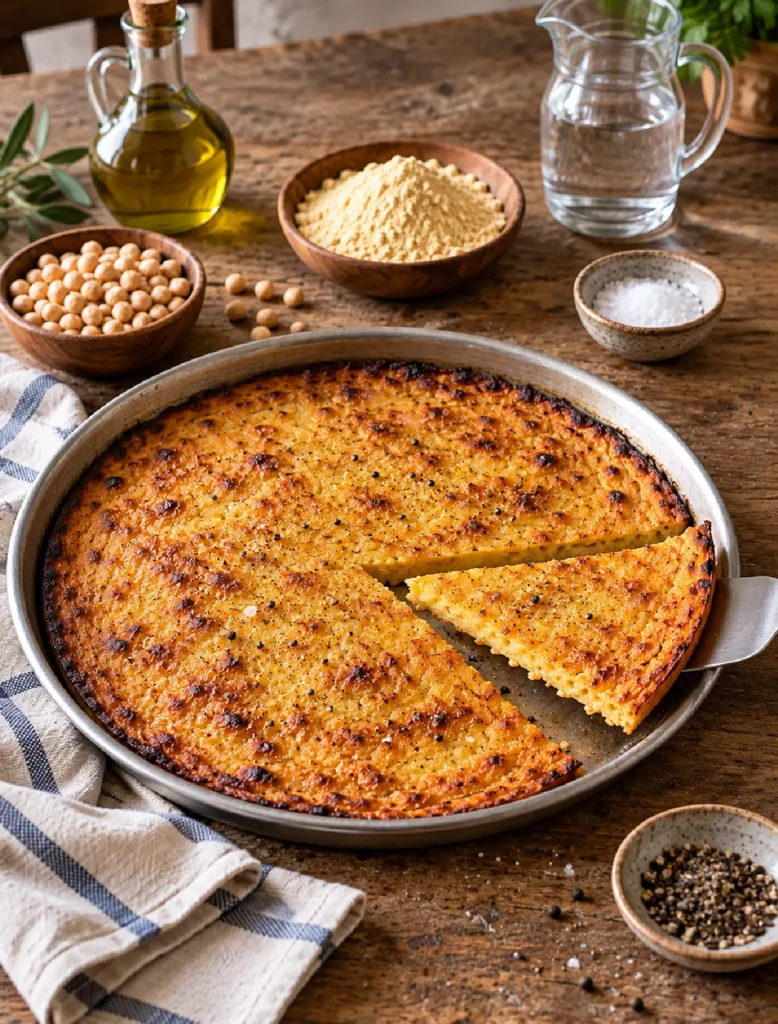
In Genoa, farinata is eaten straight from the oven, while it is still hot, golden on top and crisp around the edges. Here it is known as fainà, a familiar sight in the city’s sciamadde and bakeries, where it is traditionally baked in large, tinned-copper pans.
Chickpea flour, water, extra virgin olive oil and salt are all you need. Getting it right comes down to the proportions and the heat of the oven: farinata should be thin, well browned on top and soft in the centre. Before baking, the batter needs time to rest.
Chickpea farinata is made throughout Liguria and is recognised as a PAT (Prodotti Agroalimentari Tradizionali), one of Italy’s Traditional Agri-food Products. In Genoa, freshly ground black pepper over the hot farinata is all it needs.
Farinata Genovese: Traditional Genoese Chickpea Farinata
Description
Farinata Genovese, known in Genoa as fainà, is made with chickpea flour, water and extra virgin olive oil. After the batter has rested, it is baked at high heat until golden on top and soft in the centre.
Ingredients for one 32 cm / 12.5-inch round pan
Instructions
How to Make Genoese Farinata
-
Make the batter 🥣
Place the chickpea flour in a large bowl. Gradually add the water, whisking by hand to prevent lumps from forming. Continue whisking until the batter is smooth and very thin.
-
Let the batter rest ⏱️
Cover the bowl and leave the batter to rest at room temperature for at least 4 hours. Stir it a couple of times during the resting period. If any foam forms on the surface, skim it off with a slotted spoon or regular spoon.
-
Add the salt and prepare the pan 🫒
Preheat a conventional oven to its highest temperature, preferably 250°C / 480°F. Add the salt to the batter and mix well. Pour all 50 g of the extra virgin olive oil into a 32 cm / 12.5-inch round pan, spreading it across the entire bottom.
-
Pour the batter over the oil 🥄
Slowly pour the batter into the pan over the oil. Stir gently with a spoon, bringing some of the oil to the surface and distributing the batter into an even layer.
-
Bake the farinata 🔥
Place the pan in the lower part of the oven and bake at 250°C / 480°F for about 15–20 minutes, until the farinata has set and begun to turn golden. Move it to the upper part of the oven and continue baking for a few more minutes, using the grill/broiler if necessary, until the surface is deeply golden.
-
Slice and serve the farinata 🌶️
Remove the farinata from the oven and let it settle for a couple of minutes. Cut it into wedges and serve while still hot, with freshly ground black pepper if you like.
Nutrition Facts
Servings 6
- Amount Per Serving
- Calories 170kcal
- % Daily Value *
- Total Fat 10g16%
- Saturated Fat 1.3g7%
- Sodium 344mg15%
- Total Carbohydrate 14.5g5%
- Dietary Fiber 2.7g11%
- Sugars 2.7g
- Protein 5.6g12%
* Percent Daily Values are based on a 2,000 calorie diet. Your daily value may be higher or lower depending on your calorie needs.
Note
Traditional farinata is baked in a testo, a large round pan made from tinned copper, and benefits from the extremely high temperatures of a wood-fired oven. At home, you can still achieve a good result with a 32 cm / 12.5-inch round pan, preferably metal, by preheating the oven to its maximum temperature before baking.
The batter should form an even layer across the pan. After pouring it over the oil, stir gently so that there are no noticeably thicker areas, which would cook differently from the rest of the farinata.
Use the grill/broiler only if the surface is still too pale after the first stage of baking. Watch it closely, as it can brown very quickly at this temperature.
Rosemary is one of the additions found in some versions of farinata, but we have left it out of this basic recipe. Other ingredients are also traditionally added in different parts of Liguria.
Farinata is at its best freshly baked. Let it settle for only a few minutes after taking it out of the oven, then serve it hot or warm.